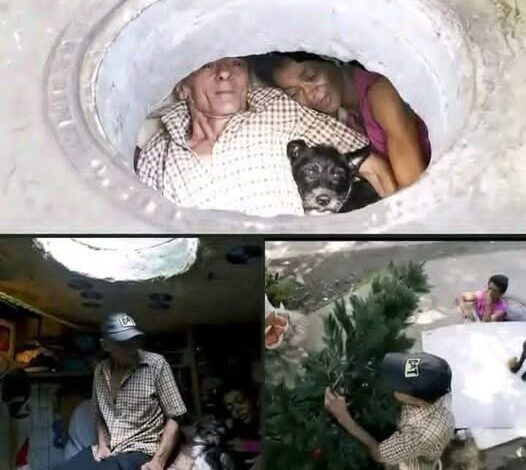
In today’s urban environment, the boundary between a secure home and total displacement is perilously thin, a reality that often remains hidden until it suddenly appears in the most jarring of forms. Across the nation, soaring rents, a shortage of affordable housing, and the fraying of traditional support networks are pushing people to the very edges of society. For one couple and their devoted dog, this pressure forced them into a space most would dismiss as refuse: the hollow interior of a massive concrete drainage pipe. This was not an experiment in minimalism or adventure—it was a calculated choice for survival in a world that offered no alternative.
From the perspective of a passerby or a driver speeding by, the large cylinders resting on a neglected lot look like abandoned infrastructure, forgotten relics awaiting a construction crew that may never come. They are the physical embodiment of stalled progress. But step closer, and one of these industrial shells reveals a story of careful ingenuity and quiet struggle. Inside the pipe, a home—or something approaching it—has been painstakingly arranged. A mattress is pressed against the curved walls, its edges molded to the cylindrical space. Belongings are not scattered at random; they are ordered, deliberate, a small assertion of control in an otherwise uncontrollable life. Folded clothes, personal trinkets, and essential items occupy their places with intention, demonstrating that even without conventional walls, one can assert a sense of home and dignity.
The pipe is hardly hospitable. It offers some protection from wind and rain, a thin barrier against the elements, yet it remains a space of extreme vulnerability. Nights bring penetrating cold, summers bake the concrete into a harsh oven, and a sudden storm could render the shelter uninhabitable in minutes. There are no locks, no guarantees of safety—security depends on vigilance and obscurity. Yet even within these limitations, the space becomes a fragile sanctuary, fiercely defended, offering the couple a sense of continuity in a world that constantly threatens upheaval.
Their dog adds an even deeper layer to this precarious life. In traditional housing settings, pets are often regarded as burdens; on the streets, they are anchors. For this couple, their dog is far more than a companion—it is a source of structure, responsibility, and emotional stability. Feeding, walking, and caring for the animal creates a rhythm to the day, a shield against despair. The presence of a living, loving creature reinforces purpose and provides comfort when the world outside is indifferent or judgmental. In these conditions, caring for a dog is an act of profound humanity and love.
Daily life in the pipe is a constant negotiation with scarcity and risk. Privacy is nonexistent; every movement can be observed, every conversation must be measured. Clean water for drinking, cooking, and hygiene requires planning and effort, often demanding long walks to distant public facilities. Sanitation is a daily challenge. What might appear to outsiders as a temporary hiding place is, in fact, a delicate balancing act in which a single illness, cold snap, or encounter with authorities could upend the entire arrangement.
This improvised dwelling is emblematic of a wider systemic issue: homelessness in the modern era is rarely the result of personal failings. It is usually shaped by economic pressures beyond an individual’s control—a medical crisis, a sudden job loss, family instability, or gaps in public support. The pipe is not a monument to the couple’s inadequacy but a testament to the failure of housing systems and social safety nets. It represents the ultimate limit of available options in a society that often prioritizes property over people.
Yet amidst this hardship, there is remarkable resilience. The act of keeping a small space organized, maintaining routines, and sustaining a partnership under constant stress is extraordinary. Remaining “neat” amidst dirt and instability, preserving a sense of self when society has effectively erased you from visibility—these are profound victories, quiet testimonies to human perseverance.
A home is not merely a physical structure; it is a foundation for safety, continuity, and the mental space to plan for the future. Without it, every choice becomes reactive, every day an exercise in survival. The drainage pipe may provide shelter, but it cannot deliver the peace required to truly live.
Scenes like this challenge the broader community to move beyond fleeting sympathy and toward collective action. Addressing homelessness demands more than sporadic donations or temporary shelter—it requires comprehensive affordable housing strategies, accessible mental health care, and pathways to stable employment. It asks us to see the pipe not as an eyesore, but as a dwelling for neighbors who have been failed.
Every improvised home—be it a tent in a park, a car in a lot, or a drainage pipe on a construction site—holds a human story. These stories are complex, personal, and deserving of respect. Behind each shelter is a life that predates displacement, filled with memories, passions, and dreams. Acknowledging this shared humanity is the first step toward a society where no one must seek dignity within the hollow of a pipe. Until systemic causes are addressed, these curved walls will continue to stand as silent, cold indictments of collective indifference.