A seemingly ordinary photograph is causing a stir across social media, leaving thousands of users blinking twice, squinting, and questioning what they’re really seeing.
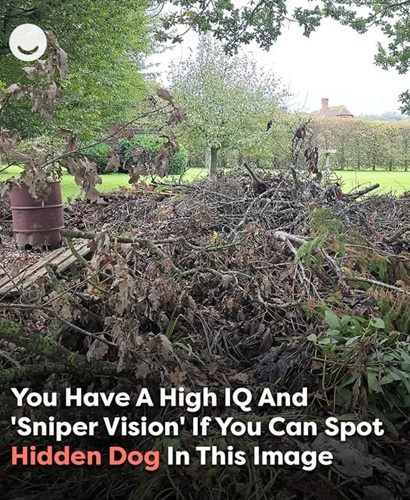
The image, now viral on the Reddit thread ‘FindTheSniper,’ challenges viewers to spot a cleverly hidden spaniel nestled among a dense network of tree branches.
At first glance, the photo looks like a chaotic jumble of wood and leaves. But hidden within this tangled natural maze is a brown spaniel, camouflaged so perfectly that it almost disappears into its surroundings.
The puzzle has quickly captured the attention of both casual scrollers and optical illusion enthusiasts, becoming one of the latest internet sensations.
First Impressions: Confusion Reigns
When users first see the image, it’s easy to dismiss it as just another nature shot. Twisting branches, scattered twigs, and overlapping leaves create an intricate, almost impenetrable pattern — a visual labyrinth that makes spotting the dog surprisingly challenging.

Some viewers reported feeling mild frustration at first, scrolling over the image again and again while questioning whether a dog was even there.
Reddit comments overflowed with disbelief. One user wrote, “I was convinced there was no dog in this picture. Had to double-check the original post to make sure I wasn’t being trolled.” Another admitted, “I needed help with this one—way harder than I expected!”
These reactions highlight the universal challenge of the illusion: even knowing a dog is hidden, the eye struggles to pick it out amid the chaotic tangle of branches.
The Science Behind Camouflage and Optical Illusions
The difficulty in spotting the spaniel comes down to how humans perceive patterns. Our brains are designed to detect familiar shapes — especially faces and animals — within visual noise.
When an object closely matches the colors, textures, and forms of its surroundings, however, it can slip past our attention entirely. This is the same principle that makes optical illusions so captivating.
Camouflage, in particular, is a survival strategy used throughout the animal kingdom. The spaniel in this image blends seamlessly into the environment, demonstrating tactics similar to those of snow leopards on rocky slopes or stick insects in dense foliage.

The dog’s brown fur closely mirrors the tones of tree bark and dead leaves, while the way its body is positioned among the twisting branches disrupts its outline, making it nearly invisible.
Even when viewers know a dog is present, their eyes can pass over it repeatedly without recognizing it.
How to Spot the Hidden Spaniel
Though the image seems nearly impossible at first glance, experts suggest several strategies for uncovering camouflaged objects. Start by focusing on the center of the photograph.
This helps minimize distraction from peripheral details. Slowly scan outward in all directions, looking for shapes that break the repetitive pattern of the branches.
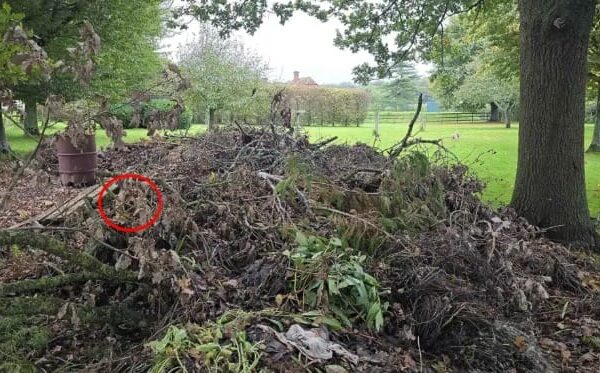
Shifting your gaze slightly to the left can also help. Reddit users who successfully found the spaniel report that this area reveals a subtle, brown form that stands out from the surrounding textures.
Pay attention to the outline of the ears and snout, as well as slight differences in color that indicate fur rather than bark. Once these visual cues are recognized, the dog suddenly “pops” into view — a classic demonstration of the Gestalt principle, where our minds complete familiar patterns from partial information.
The Rise of ‘Sniper Challenges’
This illusion is part of a larger trend called ‘sniper challenges’ on social media. These puzzles hide objects — often animals or small items — within intricate natural or manmade settings.
From tigers blending into jungle foliage to leopards tucked among rocky cliffs, these challenges test both patience and visual perception.
The appeal is twofold: they challenge the eye and brain while also providing a satisfying sense of accomplishment once the hidden object is spotted.

Many of these challenges go viral because they balance frustration with satisfaction, motivating users to share both their successes and amusing failures with friends and followers.
Community Reactions and Engagement
The Reddit thread featuring the hidden spaniel has sparked intense engagement. Users post screenshots highlighting the dog’s location, offer tips on spotting it, and compare their strategies.
For many, finding the dog becomes a “trial-and-error” exercise, illustrating how perception varies from person to person. Some spot it almost instantly, while others spend minutes — or even hours — scanning the image. This variation highlights how focus, attention, and cognitive style all influence what we see.
Creative methods for locating hidden animals have also emerged. Users report squinting, zooming in, or slightly blurring their vision to allow the brain to detect overall shapes and contrasts rather than fixating on fine details. These interactive strategies feed the viral appeal, encouraging people to test themselves and share results.
Beyond the Spaniel: Optical Illusions Across the Internet
The viral spaniel is far from an isolated phenomenon. Across platforms like Reddit, Instagram, and Twitter, optical illusions have become a popular genre, captivating audiences with their blend of art, psychology, and humor.
From ambiguous figures that shift depending on perspective to color-based illusions that trick the brain, these puzzles consistently reveal the quirks of human perception.
Wildlife camouflage is a particularly popular theme: owls hidden in tree hollows, foxes lying among autumn leaves, and birds blending into branches during nesting season all challenge viewers to discern hidden forms.
Each illusion demonstrates how easily our brains can be fooled when colors, textures, and patterns align perfectly, reminding us that seeing is not always believing.
Experts in visual cognition emphasize that engaging with optical illusions is more than mere entertainment — it actively stimulates cognitive skills such as pattern recognition, attention to detail, and visual memory.
In a world dominated by rapid scrolling and instant gratification, these puzzles provide a rare opportunity for focused, mindful observation.
The Psychology of Frustration and Reward
The allure of the ‘Find the Spaniel’ illusion lies in the emotional journey it creates. Initial failure often triggers mild frustration, prompting repeated attempts and heightened focus.
When the hidden spaniel is finally spotted, the brain rewards the effort with a surge of dopamine, the neurotransmitter associated with pleasure and satisfaction. This response reinforces the desire to tackle similar challenges, helping explain why viral optical illusions consistently capture attention across cultures and age groups.
Tips for Creating Your Own Optical Illusion Challenges
For those inspired by the spaniel image, crafting personal visual puzzles can be both fun and educational. Begin with a complex background — a dense forest, a pile of autumn leaves, or a cluttered room.
Place a small object, such as a toy animal or everyday item, ensuring it blends naturally with the surrounding colors and textures. Capture a high-resolution photo and challenge friends or social media followers to find the hidden item. The subtler the camouflage, the more satisfying the discovery.
Educators and parents have also used optical illusions as tools for cognitive development. By encouraging children to observe carefully and patiently, these puzzles improve visual reasoning, attention, and problem-solving skills while combining learning with playful engagement.
Why the Spaniel Resonates Globally
The widespread fascination with the ‘Find the Spaniel’ illusion goes beyond simple curiosity. It taps into a universal human desire to solve mysteries, detect hidden patterns, and experience the thrill of discovery.
The image’s viral success demonstrates how a single, well-crafted visual can unite thousands of people around a shared experience, fostering community through collective challenge and amusement.
Whether you are an optical illusion enthusiast or a casual viewer, the spaniel challenge invites everyone to slow down, look closely, and appreciate the joy of spotting something cleverly concealed in plain sight. It’s a reminder that sometimes the extraordinary is hiding just beyond the edge of perception, waiting for a patient eye to reveal it.
Conclusion: Patience, Perception, and Playfulness
The viral spaniel optical illusion is far more than a quirky internet trend — it is a testament to the intricacies of human perception and the enduring appeal of visual puzzles.
By combining natural camouflage, cognitive psychology, and interactive social engagement, the image captivates viewers, sparking laughter, debate, and awe.
Next time you encounter a tangle of branches or a busy scene, pause. Look carefully, scan deliberately, and consider that something unexpected might be hidden in plain sight.
For those with sharp eyes and patience, discovering the brown spaniel among the trees is an achievement both satisfying and mind-bending. Whether attempted solo or shared with friends, the challenge sharpens perception, rewards attention to detail, and offers a playful respite from the ordinary.
In a digital age where content is often fleeting, this optical illusion proves that some images can linger in the mind, spark curiosity, and create a viral wave of shared discovery across the internet.