Elon Musk’s unexpected remark about Jesus has ignited a firestorm online, with some now fearing it’s a chilling sign that something major — and potentially troubling — is about to unfold.

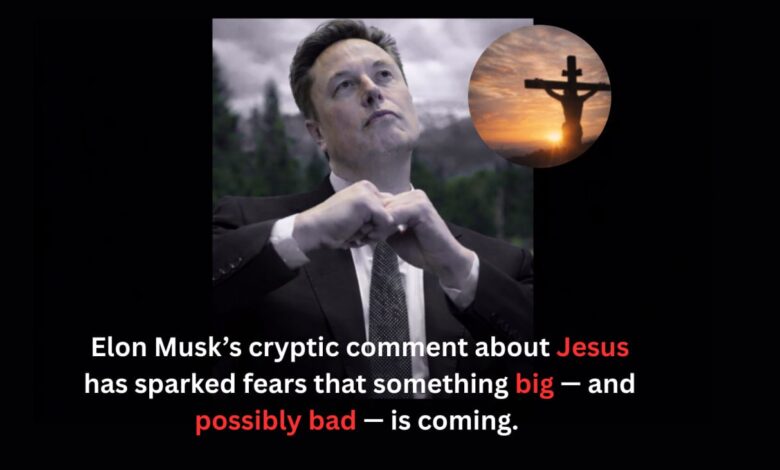
A brief reply from Elon Musk about Jesus Christ ignited a wave of online speculation, transforming a single sentence into a sprawling debate about faith, motive, and meaning.
The moment began when a user on X posed a pointed question about who might one day “evangelize Elon Musk.” Musk’s response was concise but powerful: “I agree with the teachings of Jesus.” That was it — no elaboration, no qualifiers.
Yet in today’s hyperconnected culture, even a short remark from one of the world’s most influential entrepreneurs can ripple outward at astonishing speed. Within hours, the post was circulating widely, dissected by supporters and critics alike. Some interpreted it as a natural continuation of Musk’s increasingly reflective tone on spiritual and philosophical questions. Others suspected there might be more beneath the surface.
For a few observers, the timing felt significant. They argued that public figures sometimes lean into faith language before major announcements, controversies, or personal revelations. One commenter bluntly predicted that “something really, really bad is about to come out about him,” suggesting the remark could be preemptive damage control.
Not everyone agreed. Many pushed back against the cynicism, pointing out that expressing admiration for ethical teachings does not automatically imply scandal. To them, Musk’s words read less like strategy and more like philosophy — an acknowledgment of moral principles centered on love, forgiveness, humility, and truth.
This tension reflects a broader cultural instinct to demand clarity. When a high-profile figure references religion, audiences often expect either a dramatic conversion narrative or a firm rejection of belief. Musk offered neither. Instead, he chose a narrow but meaningful distinction: agreement with teachings rather than declaration of faith.
His history with religion adds context to the reaction. Musk has spoken about spirituality several times over the years, and his position appears to have evolved rather than flipped abruptly. In 2022, he wrote that Jesus promoted love and forgiveness, admitting that he once viewed concepts like “turning the other cheek” as weakness before coming to see their deeper strength.
More recently, during a December 2025 podcast appearance, Musk reflected on the origins of the universe, suggesting that existence likely stems from something beyond current human comprehension. While he avoided traditional labels, he conceded that many would call such a source “God.” His comments hinted less at dogma and more at philosophical curiosity.
Family background also plays a role in shaping that journey. His mother, Maye Musk, has shared that her children were christened in the Methodist Church and attended Episcopalian Sunday school. She emphasized that the central lesson she sought to instill was simple: love everyone. Despite that upbringing, Musk distanced himself from organized religion as a teenager. Around 14, he began intensely questioning life’s meaning and the structure of the cosmos, describing himself at times as atheist or agnostic.
In a 2013 conversation with actor Rainn Wilson, Musk acknowledged humanity’s limited understanding of the universe while expressing skepticism about the idea of a constantly judging, conscious force. His approach has long blended scientific inquiry with existential wonder.
In more recent years, however, his language has softened. During a 2024 discussion with psychologist Jordan Peterson, Musk said he does not consider himself particularly religious but believes the teachings attributed to Jesus are wise and enduring. He highlighted principles such as loving one’s neighbor and exercising restraint instead of retaliation — values that resonate even outside a formal religious framework.
Musk frequently frames questions about God through a scientific lens. If the universe had a beginning, he has argued, it inevitably raises deeper questions about causation. For him, belief appears less about ritual and more about grappling with the unknown.
His latest comment has therefore revived an ongoing conversation about his worldview. Some see a gradual spiritual shift. Others interpret his words as the reflections of a technologist fascinated by ethics, metaphysics, and humanity’s future.
If Musk truly draws inspiration from the teachings of Jesus, the influence would likely manifest less in religious symbolism and more in ethical direction. Many of Jesus’ teachings emphasize the value of human life and the responsibility to care for others. In the automotive world, that philosophy could align with Tesla’s intense focus on safety — from crash engineering to driver-assist systems like Autopilot.
Compassion and service, central themes in Christian ethics, could also intersect with Tesla’s broader mission. The company’s pursuit of autonomous driving technology is often framed as a path toward reducing accidents and increasing mobility for the elderly and disabled. In that sense, technological advancement becomes not just innovation, but potential public good.
While environmental stewardship is not exclusively religious, the idea of caring for creation is deeply embedded in many Christian traditions. Musk’s push to accelerate the transition to sustainable energy through electric vehicles and solar technology reflects a belief that innovation should reduce harm and preserve resources for future generations.
As artificial intelligence becomes more embedded in transportation, ethical programming decisions carry increasing weight. A philosophy rooted in minimizing harm and prioritizing human life could influence how such systems are designed and deployed.
For now, Musk’s statement remains open-ended. A single line on social media has grown into a broader discussion about belief, morality, and the responsibilities of power. Whether it signals a personal transformation or simply a philosophical reflection, it underscores a deeper question — not just about Musk, but about anyone navigating faith in a skeptical age: is belief defined by public declarations, or by the values consistently lived out over time?