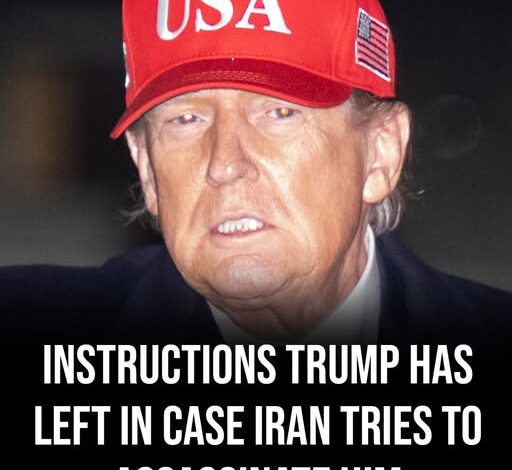
In his 2025 remarks, Donald Trump adopted a tone that seemed deliberately calibrated — part warning, part reassurance. He spoke of coexistence and stability, suggesting that nations should find ways to “live together” without constant escalation. Yet within the same address, he pivoted sharply, delivering a stark ultimatum: if Iran were ever to attempt an attack against him, the response would be overwhelming and absolute. He claimed he had already put directives in place — explicit instructions, he said — ensuring that any such action would be met with force so decisive it would leave no ambiguity.
It was language that blended deterrence with spectacle. On one level, it echoed long-standing doctrines of retaliation and strategic warning. On another, it felt intensely personal, framing geopolitical conflict around the threat to a single leader. The message was unmistakable: the cost of targeting him would extend far beyond a single act, reaching into the survival of the regime itself.
At the time, critics dismissed the remarks as characteristic hyperbole — an extension of Trump’s well-known rhetorical style. Supporters, meanwhile, framed it as strength: a clear line drawn in the sand meant to discourage aggression through the certainty of consequence. In either interpretation, the underlying strategy appeared rooted in deterrence theory — the idea that publicly declaring extreme consequences can prevent an adversary from ever testing those limits.
Now, as headlines fill with reports of escalating strikes, drone exchanges, and seismic shifts in regional leadership, those earlier words carry a different weight. What once sounded hypothetical now echoes against a backdrop of tangible instability. When airspace closes, embassies issue warnings, and military movements dominate global news cycles, rhetoric transforms. It stops being abstract and starts feeling immediate.
Trump’s framing was not solely about personal security; it was about projecting an image of total resolve. By claiming that standing orders existed — instructions ready to activate in the event of his assassination — he invoked a system designed to operate beyond emotion or hesitation. The implication was that retaliation would not depend on deliberation in the heat of the moment. It would be automatic, overwhelming, and preordained.
Such language raises complex strategic questions. Is it purely symbolic — a public reinforcement of strength intended to discourage hostile planning? Or does it signal a rigid posture that could limit diplomatic flexibility in a crisis? Deterrence often relies on credibility. The clearer and more uncompromising the threat, the more likely it is to prevent action. But the same clarity can heighten tensions if misinterpreted.
In the broader geopolitical arena, leaders’ words become part of the strategic environment. Statements are parsed by intelligence agencies, defense ministries, and foreign policy analysts. They are weighed not just for domestic political impact, but for international signaling. When rhetoric emphasizes obliteration and pre-set retaliation, it can amplify existing rivalries and shape how adversaries calculate risk.
The region now stands in a period of heightened volatility. Military responses and counter-responses create a feedback loop of pressure. In that environment, past declarations resurface with new intensity. The distinction between symbolic warning and actionable doctrine becomes less theoretical and more urgent.
Ultimately, Trump’s 2025 comments illustrate the power of language in matters of statecraft. Leaders often walk a narrow line between projecting strength and preserving room for de-escalation. The promise of peace can coexist with the threat of force — but that balance is delicate. When tensions rise, even old remarks can reverberate loudly, influencing perceptions, strategies, and expectations.
As events continue to unfold, the central question remains unresolved: were those directives a rhetorical device meant to reinforce deterrence, or a reflection of a strategic framework designed to activate under specific conditions? In times of uncertainty, that ambiguity itself beco