HOW A SINGLE OFF-HAND COMMENT FROM PRESIDENT DONALD TRUMP IGNITED A NATIONAL CONTROVERSY, LED TEAM USA’S WOMEN’S HOCKEY PLAYERS TO DECLINE A WHITE HOUSE INVITATION, SPARKED A FIERCE ONLINE DEBATE ABOUT RESPECT AND REPRESENTATION IN SPORTS, AND REVEALED THE COMPLEX RELATIONSHIP BETWEEN ATHLETES, POLITICS, AND PUBLIC EXPECTATION

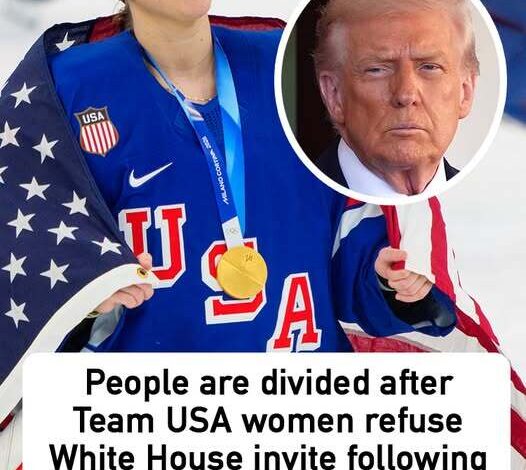
The boundary between athletics and politics has always been fragile, but at certain moments the two converge with unexpected intensity. Such a moment followed the United States’ remarkable performance at the 2026 Winter Olympics in Milan, where both the men’s and women’s ice hockey teams captured gold medals in dramatic overtime victories against Canada. What began as a wave of national celebration soon shifted into widespread debate after the women’s team declined an invitation to the White House, following a controversial remark by Donald Trump.
The chain of events started shortly after the men’s championship victory. President Trump placed a congratulatory phone call to the players, praising their achievement and acknowledging the intensity of the final. During the call, however, he referenced the women’s team — who had also just secured gold — remarking that he would “have to invite them too,” joking that he might otherwise face impeachment.
Though delivered as humor, the comment quickly took on a life of its own once it reached the public. Some listeners interpreted it as lighthearted banter. Others felt it subtly diminished the women’s success, framing their invitation as an obligation rather than recognition earned through victory on the ice.
In response, the Team USA women’s hockey handled the situation with restraint. In a carefully worded public statement, they expressed appreciation for the invitation while explaining that prior academic and professional commitments made attendance impossible. The message was respectful and neutral, avoiding any political language or criticism.
Despite the team’s measured tone, reaction across social media and public forums was swift and polarized.
Supporters praised the players for setting boundaries and prioritizing their responsibilities. Many argued that Olympic athletes — particularly women competing in sports without fully professional leagues — often balance training with school, work, and personal obligations. From this perspective, declining the invitation was neither political nor disrespectful, but practical and reasonable.
Others viewed the decision less favorably. Critics argued that a White House visit represents a longstanding national tradition that transcends personal scheduling conflicts. To them, declining an invitation from the president — regardless of administration — symbolized a break from unity and respect for the office itself.
The split in public reaction underscored a broader cultural shift. Once considered purely ceremonial, White House visits have increasingly become symbolic markers of political identity. Athletes today are no longer seen only as competitors; their choices, even when explicitly apolitical, are often interpreted as statements.
In this case, the women’s team made no political declaration. Their statement focused solely on gratitude and logistics. Yet in an era defined by rapid online discourse, intention often matters less than perception, and perception is shaped by existing divisions.
The original remark that sparked the debate further complicated matters. Trump’s reference to impeachment was received differently depending on audience and context. Some heard self-aware humor. Others perceived a suggestion that the women’s team required external pressure to be acknowledged — despite their equal accomplishment.
This illustrates the risk of humor in highly visible political roles. When spoken by a president, even a single offhand comment can be dissected, amplified, and reframed in countless ways.
Meanwhile, the players returned to their routines — managing training, careers, studies, and recovery after an exhausting Olympic cycle. Their response served as a reminder that Olympic success does not erase everyday responsibilities, especially for athletes who do not earn full-time incomes from their sport.
Still, the debate persisted. Some questioned the timing of the decision, while others defended the team’s explanation as entirely sufficient. The intensity of the discussion reflected not just differing views on sports etiquette, but the broader polarization shaping American public life.
At the heart of the story lies a larger question: what, if anything, do athletes owe political institutions — and where does personal autonomy begin?
Historically, White House ceremonies were meant to celebrate national achievement without partisan meaning. But in recent years, athletes across multiple administrations have declined invitations for a variety of reasons, signaling a shift away from the idea that participation is mandatory.
For the women’s hockey team, none of the surrounding controversy alters their accomplishment. Their gold medal represents years of discipline, sacrifice, and excellence. Their victory reinforced the United States’ dominance in women’s hockey and inspired countless fans.
Trump’s remark, meanwhile, highlights how quickly words can spark controversy in a digital era where context is compressed and reactions are immediate. For public officials, humor can easily blur into unintended consequence.
Ultimately, this episode is about more than a declined invitation. It reflects the evolving relationship between sports, politics, and public expectation — a space where even silence can be interpreted as speech.
The women’s team did not protest. They did not criticize. They simply said thank you and explained they could not attend.
Yet in 2026, even a polite refusal was enough to ignite a national conversation — one that says as much about the moment we live in as it does about the athletes who briefly stood at its center.