My romantic past had been defined by near-misses—connections that glowed briefly before fading into courteous endings. There were no dramatic implosions, just a recurring sense of incompletion that left me questioning whether I simply lacked the ability to build something lasting.
Then I met Elena.
From the start, our conversations felt natural. We didn’t volley rehearsed questions back and forth; we drifted through humor, ideas, and comfortable pauses. I wasn’t trying to impress her. I wasn’t strategizing my responses. For the first time in a long while, the chemistry didn’t feel constructed—it felt real.
After a month of consistently wonderful dates, I asked her to make it official. She said yes without hesitation, her smile warm and certain. Soon after, she suggested I meet her family. I took it as a meaningful step forward. When she casually mentioned that offering to cover dinner would leave a strong impression, I agreed without much thought. I imagined a small gathering—her parents, maybe a sibling or two. A generous gesture felt appropriate.
What awaited me at the restaurant was something else entirely.
Instead of an intimate dinner, I was led to a long table packed with unfamiliar faces—cousins, extended relatives, people whose connection to Elena I couldn’t even determine. Conversations paused as I approached. The collective gaze felt less welcoming and more evaluative. Introductions never came. I stood awkwardly beside Elena, waiting for someone to bridge the gap.
Then the menus opened.
Suddenly, the quiet dissolved into rapid-fire orders: premium steaks, elaborate seafood platters, multiple appetizers, expensive bottles of wine. The scale of it was dizzying. I barely registered my own order while mentally calculating what this would cost. I tried to catch Elena’s attention, subtly signaling my discomfort, but she acted as though everything was perfectly normal.
By the time dessert was discussed, a knot had formed in my stomach.
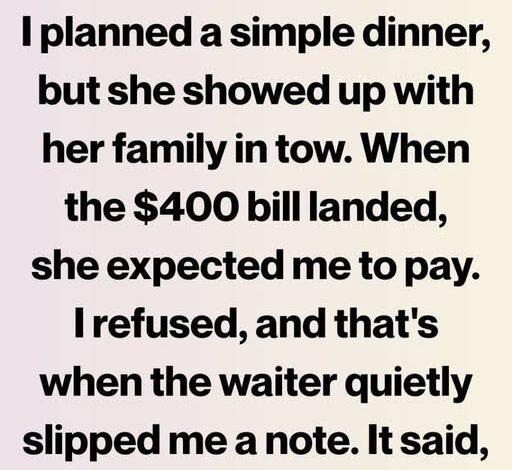
When the bill arrived, it confirmed my fear—four hundred dollars. Elena looked at me expectantly. I leaned closer and quietly expressed that I hadn’t anticipated covering a meal for so many people I hadn’t even met properly. Her expression hardened instantly. She accused me of embarrassing her and insisted this was simply “how family works.” Around us, the table fell silent again—this time with visible judgment.
That was when a waiter passed by and discreetly slipped a folded note into my hand.
“She’s not who she says she is.”
I excused myself and found him near the service station. In a low voice, he explained he’d seen this before—multiple times. Same woman. Same group. Different date each time. The pattern was always identical: large gathering, extravagant ordering, pressure to pay.
It wasn’t awkward hospitality. It was a rehearsed routine.
The realization was sobering but clarifying. I paid for my own meal and left a generous tip for the waiter’s honesty. With his help, I exited through a side door, avoiding the table entirely.
Walking to my car, I expected anger or embarrassment. Instead, I felt unexpectedly calm. The discomfort at dinner had been the price of clarity. I hadn’t just avoided a large bill—I had sidestepped a dynamic built on manipulation.
Later, curiosity led me to search online. Community forums and local discussion groups revealed similar accounts—same setup, same restaurant, same cast of characters. The pattern was unmistakable.
The experience reshaped something in me. I learned that not all warning signs are dramatic. Sometimes they arrive quietly, disguised as tradition or generosity. Sometimes intuition speaks in a subtle tightening of the chest or a question you can’t quite articulate.
That night, I left with more than my wallet intact. I left with a sharper trust in my instincts and the understanding that self-respect sometimes means standing up—even when everyone else at the table expects you to sit quietly and pay.