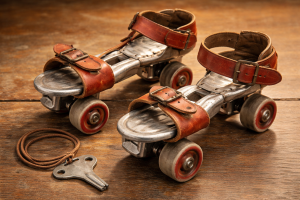
“If You Were a Child or Teenager Between the 1950s and 1970s, You May Remember This Strange Object That Captured Curiosity, Defined Generations, Sparked Endless Conversations, and Still Holds a Place in Nostalgia as a Symbol of Simpler Times and Forgotten Everyday Wonders From the Past”


An Object That Sparked Curiosity
For children growing up between the 1950s and the 1970s, it wasn’t unusual to stumble upon objects that seemed puzzling at first. Some toys resembled hardware-store equipment, some gadgets looked far more complicated than they needed to be, and many everyday items required a parent’s explanation before their purpose became clear. One particularly memorable example looked more suited to a toolbox than a toy chest—metal frames, leather straps, and a small detachable key.
For those who recognize it instantly, there’s no mistaking it: the classic strap-on roller skates of mid-century childhood.
Before Modern Skates Took Over
Long before padded boots and sleek sneaker-style skates became common, children relied on heavy, adjustable metal contraptions that fastened directly onto their regular shoes. These early skates were sturdy but far from graceful. Made almost entirely of steel, they were secured with narrow leather straps—sometimes canvas—that wrapped tightly around the shoe.
There was no dedicated skating footwear. The same shoes worn to school, church, or the corner store became, with a few quick adjustments, a pair of wheels ready for action. They rattled, they pinched, and they demanded balance. Yet despite their clunky design, they delivered something priceless: independence. For a child in the mid-20th century, strapping them on meant speed, exploration, and hours of outdoor play.
The Importance of the Little Key
Perhaps the most distinctive feature of these skates was the small metal key that came with them. Often worn on a string around the neck or tucked carefully into a pocket, the key allowed the skates to expand or contract to fit different shoe sizes. It tightened the frame securely, ensuring the wheels stayed in place.
Without that key, the skates were nearly impossible to use. Losing it could mean days—or weeks—without skating until a replacement was found. In many neighborhoods, kids shared spare keys, guarded them carefully, or improvised when one went missing. Owning the key felt almost like holding the power to unlock adventure itself.
Sidewalks as Racetracks
Once strapped in, sidewalks transformed into highways of imagination. Driveways became practice grounds. Quiet neighborhood streets turned into friendly competition zones where kids tested their balance and speed. The sound of metal wheels clattering over uneven pavement was unmistakable—a rhythmic clank that echoed through summer afternoons.
Falls were common. Knees were scraped. Palms stung after sudden tumbles. But these minor injuries were part of the ritual, proof of time spent outdoors. Every bruise carried a story, every wobble a lesson in coordination. There were no protective pads or helmets in most cases—just determination and laughter.
A Nostalgic Relic
Today, stumbling across a pair of these skates—at a flea market, estate sale, or in the back of a family closet—often sparks immediate recognition. Conversations begin with a simple question: “Remember these?” What follows are tales of block-long races, uneven sidewalks, and the thrill of mastering balance.
The metallic rattle of those wheels evokes memories as vivid as the scent of freshly cut grass or the distant melody of an ice cream truck. These skates symbolize an era when entertainment didn’t require batteries or screens—just open space and imagination.
More Than a Collectible
Vintage strap-on roller skates, especially those still paired with their original key, are now prized by collectors as pieces of American cultural history. Yet their true value lies not in rarity, but in the stories they carry.
They represent a childhood defined by movement and connection—neighbors gathering outside, friends challenging one another, and afternoons stretching endlessly beneath open skies. They remind us of a time when fun was hands-on and shared face-to-face.
If you happen to have a pair tucked away somewhere, consider keeping them. They’re more than old metal frames with wheels. They’re artifacts of freedom, resilience, and the simple joy of growing up in a different era.