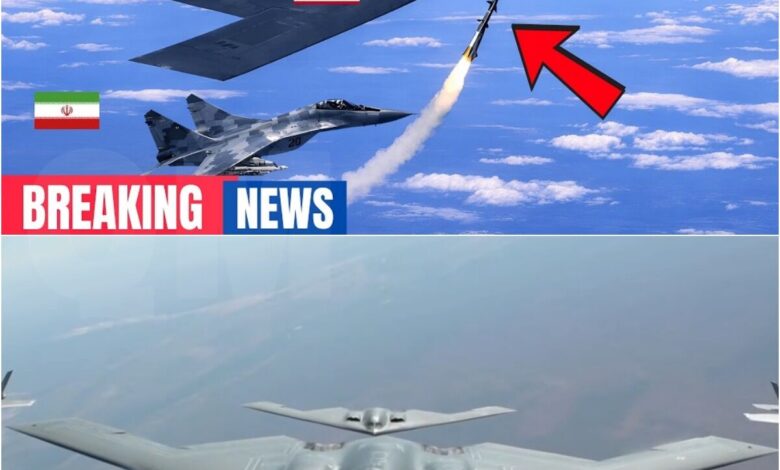
Iranian Jets Ambush a U.S. Stealth Bomber
Twelve Minutes That Redefined the Sky
In modern warfare, history is not always shaped by long campaigns or decisive battles. Sometimes, everything changes in minutes.
Picture the airspace above Iran at dusk—silent, vast, and deceptively calm. Far above the clouds, a U.S. stealth bomber slips across the horizon. Flying at extreme altitude, it moves without sound or signal, a machine designed not to be seen, not to be challenged.
To those watching from the ground, there is nothing. No radar return. No warning. Just empty sky.
But this flight is not about a strike. It is about positioning, intelligence, and pressure. A quiet test of defenses. A strategic probe in a game where perception matters as much as force.
A Web of Invisible Players
The bomber is not alone.
Beyond visual range, a fifth-generation fighter patrols silently, its sensors scanning the electromagnetic landscape. Every radar pulse, every communication signal is captured, categorized, and mapped in real time.
Elsewhere, an electronic warfare aircraft begins to manipulate the environment itself. Frequencies are distorted. Signals degrade. What once felt reliable becomes uncertain.
This is not a battlefield of explosions—it is a battlefield of information.
The Iranian Reaction
On the ground, Iranian air defense commanders detect anomalies. Something feels wrong. Procedures are triggered.
Fighter jets scramble, their engines cutting through the calm as they climb aggressively toward the suspected intrusion. The pilots believe they are responding to a routine violation—an intercept, a warning, a display of resolve.
They do not realize they are already being watched, tracked, and analyzed.
The sky has become a trap.
The Moment Everything Shifts
The stealth bomber has already completed its task. The real drama is only beginning.
As Iranian fighters search blindly, confusion spreads. Radar contacts flicker and disappear. Communications crackle with interference. Instructions arrive late—or not at all.
High above, unseen and untouched, the American fighter moves into position.
What follows unfolds with brutal efficiency.
Within minutes, the engagement is over—not through chaos, but through control. Maneuvers are executed with precision. Decisions are made faster than they can be countered. The imbalance is undeniable.
The pilots who expected a traditional encounter find themselves facing a form of warfare they were never meant to fight.
After the Silence
When the skies finally return to stillness, the consequences linger.
No cities burn. No official announcements are made. Yet the impact is profound. Capabilities have been exposed. Assumptions have been shattered. A message has been delivered without words.
This scenario, though fictional, highlights a deeper truth about modern conflict: superiority is no longer measured solely by numbers or firepower. It is defined by awareness, integration, and the ability to dominate unseen domains.
A New Kind of Warfare
Today’s battles are fought as much in data streams and signal space as they are in the air. Victory belongs to those who can see first, think faster, and disrupt the enemy before a single shot is fired.
In this imagined encounter, twelve minutes were enough to change the strategic equation.
And in the future, those minutes may matter more than ever.