Kicked Out at 17, I Bought a Quonset for $6 and Built a Bunker Beneath It, Thats When It All Began!

The transition from childhood to adulthood is often described as a gradual crossing of a threshold, but for Tyler, it was a sudden, cold eviction into the humid July air of rural Missouri. In the cultural memory of 2026—a year increasingly fascinated by self-reliance and the “forensic” reconstruction of personal histories—Tyler’s journey stands as a profound example of individuation. This Jungian concept describes the process of integrating past trauma to become a whole, self-contained individual. For Tyler, this transformation didn’t occur in a classroom or therapy office; it happened in the dirt, beneath a rusted metal arch purchased for the price of a sandwich.
The night he was expelled at seventeen was devoid of cinematic drama. No shattered plates, no screaming matches—just the tired, administrative voice of his mother from behind a bedroom door, informing him he was “no longer her responsibility.” With forty-three dollars and a duffel bag, Tyler was thrust into a world where he had no standing. This total lack of “above-ground” status drove him to seek security in the subterranean.
The $6 Architecture of Survival
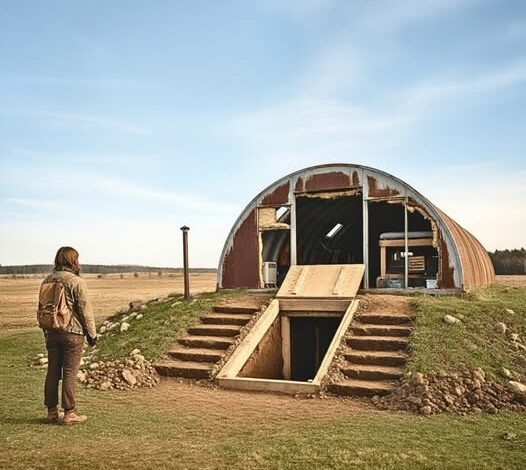
Three days into his homelessness, Tyler discovered a listing that would change his trajectory: an abandoned Quonset hut for six dollars. These half-moon steel structures, popularized after World War II for their durability and utility, sat neglected on a Missouri farm owned by Mr. Halvorsen.
To most, a Quonset hut is merely an architectural curiosity—its semi-circular design distributes weight and wind pressure efficiently—but to Tyler, it represented a six-dollar promise of survival. Halvorsen allowed him to stay on the condition that he remain invisible. It was this enforced invisibility, combined with the roar of summer storms against thin steel, that sparked Tyler’s idea of an underground bunker.
Subterranean Individuation: Digging for Control
Rejected by the world above, Tyler chose to create a world beneath it. Each shovelful of Missouri clay was an act of reclaiming agency. Working odd jobs hauling scrap and stacking lumber, he invested every cent in salvaged concrete blocks, rebar, and timber.
By winter, he had completed a 10×12-foot sanctuary beneath the Quonset. Candlelight illuminated his study of soil composition, structural loads, and library books on construction techniques—knowledge necessary to prevent collapse. He installed a hand-crank ventilation fan and a crude drainage system. When the hatch first sealed him in, the silence was not lonely—it was the first time he felt truly safe.
The Storm and the Pivot
Tyler’s engineering was tested in May, when a green-black sky and wailing sirens signaled a tornado system. In rural Missouri, storms expose human fragility. Tyler descended into his bunker. Above, the Quonset groaned under wind and debris, yet his underground shelter remained intact.
Word of the “kid in the metal hut” spread like a quiet beacon of hope. His first contract came from Clara Jensen, a widow seeking peace rather than miracles. Tyler realized he was not just selling structures—he was selling security he had once been denied.
Groundhold Structures: From Scars to Success
By twenty-four, Tyler had founded Groundhold Structures LLC. He built twelve bunkers across three counties, ranging from modest retreats for retirees to reinforced triple-door fortresses. Forgoing college, he gained an “education of the earth,” mastering local geography, water tables, bedrock placement, and ventilation.
The boy once told he was “not anyone’s responsibility” had become responsible for the safety of dozens. In the context of 2026, Tyler’s story reflects society’s turn toward self-sufficiency and the unraveling of traditional support systems. He didn’t wait for rescue—he dug his own salvation.
The Return: Closing the Hatch on the Past
Seven years later, Tyler returned to his hometown—not for reconciliation, but for a permit. Passing his mother’s house on Maple Ridge, he saw peeling paint and a porch light glowing out of habit. For a moment, he glimpsed his seventeen-year-old self with a duffel bag.
Yet Tyler’s individuation was complete. No dramatic confrontation was necessary. Some doors—like some hatches—are meant to remain closed. He had built an empire from the very stones thrown at him.
Tyler’s legacy reminds us that resilience is a silent but powerful declaration. In a world as volatile as a Missouri thunderstorm, he proved that foundations can be built even when there is no ground to stand on. From a $6 rusted arch to a successful engineering firm, Tyler’s story is a testament to transforming rejection into a fortress of one’s own design.