Most People Overlook the Small Hole on a Nail Clipper, Yet This Tiny Design Detail Reveals a Century of Thoughtful Engineering, Practical Innovation, Portability, Ergonomic Function, Manufacturing Precision, and Timeless Industrial Design That Quietly Shapes Daily Habits and Proves How Simple Objects Can Hold Remarkable Purpose

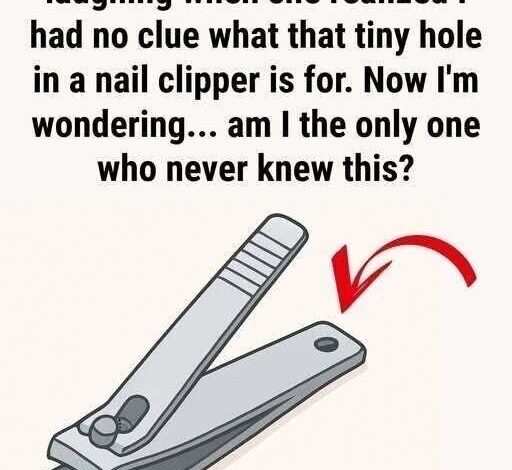
In everyday life, the most thoughtfully designed objects are often the ones we use without a second thought. They surround us quietly, performing their tasks without fanfare, yet every curve, groove, and notch has been honed over decades—or even centuries—of human experience. From the subtle ridges on a screwdriver handle to the gentle curve of a spoon, these features are rarely accidental; they are the culmination of trial, observation, and refinement. One of the most unassuming examples of this principle is the nail clipper. Small, compact, and universally familiar, it seems almost too ordinary to merit attention. Yet if you look closely, you’ll notice a tiny circular hole at the end of its lever—a feature so modest that most people never consciously register it. Despite its size and simplicity, this hole is a silent testament to practicality, history, and design philosophy, revealing the care with which even the smallest tools are conceived.
At first glance, the purpose of the hole seems obvious: organization and portability. Nail clippers are small, easily misplaced, and often the last thing anyone wants to hunt for in a drawer. By allowing a split ring, chain, or lanyard to pass through it, the clipper can be transformed from a simple grooming tool into a portable accessory. On a keychain, in a travel bag, or tucked into a grooming kit, it becomes accessible at precisely the moment it is needed. In modern life, where convenience and readiness have become almost as valuable as the objects themselves, this simple hole quietly resolves a very real problem: losing small personal items at the worst possible time. The hole allows the clipper to coexist with other essentials, always within reach, always practical.
But its function goes beyond portability. For users with limited hand strength or dexterity, the hole offers an additional point of control. A finger can be inserted to stabilize the clipper or to increase leverage, making it easier to trim thicker nails without slipping. In households where multiple clippers exist, the hole also allows them to be grouped or distinguished, reducing confusion. These subtle ergonomic advantages are invisible to the casual observer, yet they expand the clipper’s usability without complicating its form. The nail clipper remains elegantly simple, while quietly accommodating a range of human needs.
The hole is not a recent innovation. Its origins stretch back to a time when personal grooming tools were expected to be both compact and portable. In the late 19th and early 20th centuries, items like nail clippers, pocket watches, and small knives were frequently carried on chains or hooks, ensuring they were always within reach. The hole allowed these items to be secured to chatelaines, belts, or chains, transforming them into functional, mobile accessories. As homes became larger and more specialized storage became available, the hole endured—not as a relic, but as a feature that continued to meet practical needs. It demonstrates a principle of good design: a feature survives because it solves a problem that transcends generations.
With industrial manufacturing, nail clippers became cheaper, more widespread, and more standardized. Materials improved, additional features like fold-out files and small cleaning tools appeared, yet the hole persisted. From a production standpoint, it also serves practical purposes, aiding alignment, handling, and consistency during assembly. This dual function—useful both to the maker and the user—explains why it has survived through decades of design evolution. Unlike purely decorative elements that may go in and out of style, the nail clipper hole is valued for its tangible benefits at every stage of the product’s life. It is a perfect example of industrial design restraint, favoring subtle utility over unnecessary reinvention.
Ultimately, the small circular hole on a nail clipper is more than a minor detail. It is a quiet monument to thoughtful design, a reminder that even the most ordinary objects carry layers of intention, history, and human insight. By improving portability, usability, and production efficiency, it performs its function without calling attention to itself. In an age dominated by flashy technology and attention-grabbing gadgets, the nail clipper demonstrates a simple truth: effective design does not need to announce itself. The most successful innovations are often the ones we forget are designed at all, yet which shape our lives in small, meaningful ways every day.
The next time you pick up a nail clipper, pause for a moment. Look for that small, unassuming hole at the end of the lever. It is a tiny portal into centuries of human thought, adaptation, and care—a subtle reminder that even the simplest tools can carry profound lessons in design, utility, and the quiet ingenuity that surrounds us constantly.