Most couples celebrating a 40th wedding anniversary might choose a luxury cruise, a beach resort, or a quiet mountain retreat.
For South African couple Marius and Michelle Nortje, nothing compares to the thrill of encountering wildlife in its natural habitat. The wild has always been a place of adventure, discovery, and reflection—a world apart from the ordinary rhythm of everyday life. Their love story, spanning four decades, took an unforgettable turn during a visit to Kruger National Park, one of Africa’s largest and most renowned game reserves in northeastern South Africa.
Kruger spans nearly 19,500 square kilometers, sheltering iconic African species such as lions, elephants, rhinos, leopards, and giraffes.
A Routine Visit Turns Extraordinary
During their December 2025 anniversary trip, the couple—seasoned visitors to the park—set out on what they expected to be a standard safari drive.
“We go at least once a year, sometimes four times,” Marius explained.
While initially searching for lions along the tar roads, they veered onto a gravel path—a spontaneous decision that led to a remarkable encounter.
“We couldn’t find the lions on the tar road and turned off onto a gravel road,” Marius recalled. “Then we first saw one giraffe, then another, and finally a third. That’s when we noticed unusual growths all over her body.”
The female giraffe exhibited a series of lumps and protrusions across her skin. Marius, a professional wildlife photographer, quickly captured the moment. The images would later go viral.
“People wondered if she was in pain,” he said. “But she grazed peacefully. It didn’t seem to bother her, though it appeared uncomfortable.”
Marius shared the photos on Facebook, tagging South African National Parks (SANParks) to raise awareness. Though the organization had not responded by the time of the interview, the images quickly attracted broader attention.
Expert Insight
The giraffe’s condition drew the interest of WorldWide Vets, an international wildlife veterinary organization. Founder Dr. Gemma Campling explained that the giraffe was likely affected by Bovine Papillomavirus (BPV), a viral disease that causes skin growths or warts in various animal species.
“Many types of papillomavirus affect specific species,” Dr. Campling said. “In this case, the cow variant (BPV) likely impacted the giraffe.”
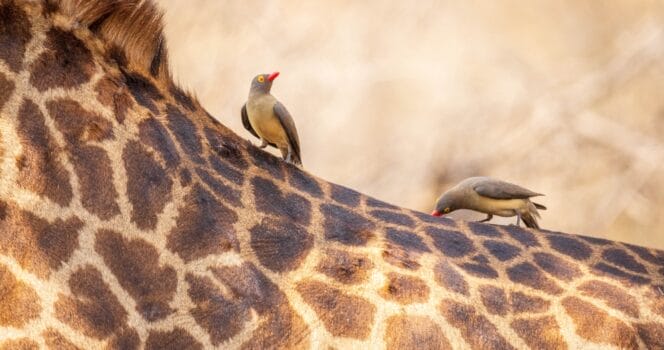
Transmission likely occurred via oxpecker birds, which feed on parasites such as ticks and lice, occasionally transferring the virus between animals. Fortunately, the rest of the herd appeared unaffected, underscoring the rarity of the case.
While the growths may look alarming, BPV is generally non-lethal, and most cases resolve naturally. Dr. Campling noted that while the lumps may cause discomfort as they grow, wildlife veterinarians primarily monitor affected animals rather than intervene unless mobility or health is compromised.
Public Reaction
The photographs quickly went viral, sparking fascination and concern worldwide. Observers praised the giraffe’s resilience.
“It’s amazing how she can continue grazing and behaving naturally despite her condition,” one viewer wrote. “Nature is truly resilient.”
The incident also highlighted the importance of wildlife monitoring and veterinary oversight in national parks. Regular observation allows experts to track unusual behaviors and anomalies, offering insights into species health and ecosystem dynamics.
The Nortjes’ Perspective
For Marius and Michelle, the encounter reaffirmed their love for Kruger National Park.
“Sometimes, the most unforgettable moments come when you’re not looking for them,” Marius reflected.
Michelle emphasized the significance of seeing animals in their natural environment. “It’s one thing to see wildlife on a routine safari,” she said. “It’s another to witness something rare, raw, and real. It makes you appreciate the work conservationists do to protect these animals.”
Their experience reinforced lessons about endurance, vulnerability, and the intricate connections between species within an ecosystem.
Conservation and Photography
The story underscores the critical role wildlife photographers play in documenting unusual phenomena. By capturing rare conditions, photographers like Marius contribute to both scientific knowledge and public awareness, helping experts monitor wildlife and inspiring global conversations about conservation.
“Photography allows us to document the extraordinary in the ordinary,” Marius explained. “Without these images, this giraffe’s condition might have gone unnoticed.”
Lessons from the Wild
The giraffe’s story is a testament to both fragility and resilience. Despite her condition, she grazed calmly—a reminder of nature’s adaptability and endurance. For the Nortjes, the encounter highlighted the value of patience, attentiveness, and mindful observation in the wild.
A 40-Year Love and a Rare Encounter
Celebrating 40 years together, Marius and Michelle experienced a moment that transcended their own love story. It was a lesson in resilience, empathy, and respect for nature. The images they captured offer a glimpse into African wildlife’s complexity, showcasing the strength and adaptability of creatures living in the wild.
Sometimes, the most profound memories are found not on luxury cruises or beach resorts, but in the untamed heart of the wild—through the lens of someone willing to truly see.
“It’s a privilege to witness such rare moments,” Marius said. “Wildlife, like life, is full of surprises, challenges, and beauty.”