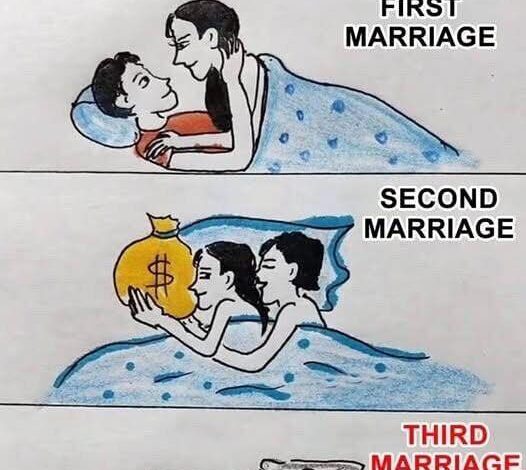
The path from first to third marriage is rarely a straight line. It is more accurately described as a series of awakenings, punctuated by loss, self-realization, and gradually deepening clarity about what love—and life—actually require. The first union is often built on projection: we fall in love not necessarily with who the other person is, but with who we hope they will become, and with the version of ourselves we imagine existing beside them. We conjure a shared story in our minds, one where desire, compatibility, and ideals align perfectly. When reality intrudes, the collapse can be shattering. The end of that first marriage doesn’t merely mark the failure of a relationship; it forces us to confront our own immaturity, avoidance, and deeply inherited assumptions about love, commitment, and happiness. Divorce in this context is an uninvited teacher, stern and uncompromising, illuminating patterns we might have otherwise ignored.
Subsequent marriages, if they occur, are rarely naïve. They arrive with the weight of experience, often after long periods of reflection and sometimes prolonged solitude. Custody schedules, divided holidays, financial scars, and the quiet memory of emotional missteps all shape the terrain on which the next relationship is built. In these unions, attraction remains important, but it no longer dominates. Trust, safety, and alignment of core values gain prominence. Partners pose harder questions, not only of each other but of themselves: What do I truly need? What can I realistically give? How do we navigate imperfection without erasing it?
There is a hidden cost to these more conscious beginnings. Every “new start” demands that we grieve the versions of ourselves and our previous lives that are now gone. The first love, with all its intensity, teaches lessons we cannot unlearn; the disappointments linger like faint scars, coloring our perceptions, shaping our choices. But this grief is not merely sorrow—it is the soil from which maturity and intentionality grow. Choosing love a second or third time is not about recovering what was lost; it is about approaching connection with eyes open, aware of fragility, and willing to accept the humanity of another as fully as we accept our own.
There is also a subtle courage in these later unions. They are formed not out of desperation or fantasy, but out of deliberate acknowledgment of need and capacity. Love is recognized as a practice rather than a declaration, an ongoing negotiation between desire and respect, between passion and patience. Where first marriages might have promised happiness as an automatic consequence of meeting the “right” person, later marriages understand that happiness is built, moment by moment, choice by choice, often in spite of uncertainty and past wounds.
In many ways, the journey from first to third marriage mirrors the broader human journey of self-discovery. Each union acts as both mirror and catalyst, reflecting truths we may have avoided and nudging us toward the growth we require. By the third marriage, if we are fortunate, we have learned the value of patience, the power of communication, and the importance of boundaries. We know that love is not a fix, nor a remedy for loneliness; it is a shared endeavor, an agreement to hold each other with intentional care, and to navigate imperfection together.
And so, the cost of learning—grief, regret, and memory—is balanced by a deeper capacity to choose wisely, to act with discernment, and to give fully without losing oneself. These marriages are quieter, perhaps less romanticized, but they carry a profound depth. They are the unions of adults who have learned the weight of promises, the responsibility of presence, and the grace required to love not just in hope, but in full awareness.
In this light, moving from the first to the third marriage is less about the number of vows taken and more about the evolution of the self. It is about learning to love not just the person beside us, but the version of ourselves that we bring into each relationship—the version that has been tempered by mistakes, reflection, and endurance. And in that, there is a remarkable beauty: the kind of love that survives past projection and enters fully into reality, aware of risk, scarred by history, and strengthened by the lessons it has endured.