Thirty bikers arrived to evict me, engines roaring and tension thick, but through conversation, shared humanity, unexpected kindness, and moments of courage, fear dissolved, walls fell, loyalties shifted, and what began as confrontation transformed into solidarity, protection, laughter, mutual respect, and a family forged on understanding rather than force alone.

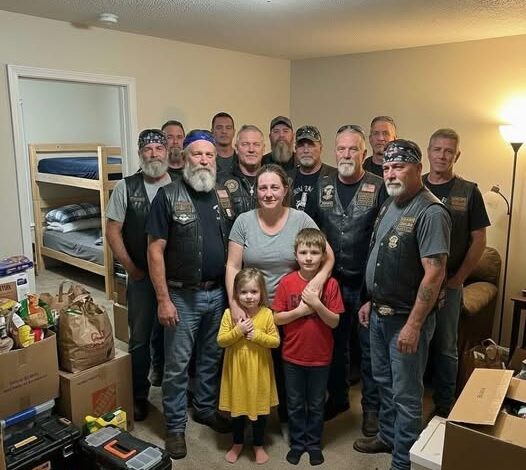
At seven on a bitterly cold Tuesday morning, I stood in the doorway of my small apartment, holding my four-year-old daughter tightly against my chest while my seven-year-old son clung to my legs, shaking so violently I could feel each tremor through my pajama pants. The hall light flickered overhead, casting long shadows that stretched across the cracked and worn stairwell. Every step that echoed from the stairs above was heavy, deliberate, and unnervingly loud, the sound of boots thudding against concrete reverberating through the narrow space. The building smelled of dust, old paint, and the faint tang of winter damp. The cold air crept in around the edges of the doorframe, biting my face and hands as I tried to steady my children, and myself.
Nearly thirty men in leather vests poured into the hallway, their presence immediate and overwhelming. They blocked the dim light and filled the narrow corridor with a sense of inevitability. At the front of the line stood Rick, my landlord, his jaw set and eyes cold and unreadable. There was no preamble, no attempt to soften the words. The rent was overdue, he said. Time was up. They were here to move us out, to place our lives’ possessions on the curb for anyone to see.
My chest tightened as if the air had been sucked from the room. I tried to speak, explaining that I had just started a new job, that my first paycheck was coming in a week, that I only needed a little more time. But Rick barely acknowledged me. My daughter began to whimper into my shoulder, her small hands clutching my sweater, and my son gripped my legs as though letting go would unravel the last stable thread in his world. Fear gripped me completely, an all-consuming weight pressing down on my shoulders. I could not imagine how we would survive the storm that had come for us that morning.
Then one of the bikers stepped forward. He was tall, broad-shouldered, with a gray beard framing a face marked not by malice, but by experience and years on the road. His vest read Marcus across the front. Unlike the others, there was a calm steadiness in his eyes that drew attention immediately. His voice was firm but not harsh as he asked me to step aside so they could begin their work.
Before I could respond, before I could even find the words to beg again, my son broke free from my legs and ran toward Marcus. He threw his arms around the man’s leather-clad thigh, burying his face into the worn material, tears streaming freely. “Please don’t take our home,” he cried.
The hallway went still. Marcus froze, unsure of how to proceed without causing harm, and for a moment the tension was absolute. Slowly, he looked past my son into the apartment behind me. His eyes fell on the wall opposite the doorway, and something in his expression changed. Without a word, he stepped inside, gently guiding my son away from his leg. One by one, the other bikers followed, filling the small apartment with their presence.
Rick shouted from the hallway, insisting they stay focused on the job, but none of the men paid attention. Their gazes were drawn to the photographs I had carefully arranged on the walls over the years: my husband in uniform, holding our children and smiling, standing shoulder-to-shoulder with his unit overseas, and the final image from his military funeral, flag folded and hands raised in solemn salute.
Marcus motioned for Rick to come inside, pointing steadily at the photographs. His voice was low, quiet, yet filled with weight. He asked the question Rick had never bothered to ask in all the months of late notices and warnings: who was this man? I told them I was a widow, raising our children alone after my husband had died in combat. One of the bikers squinted at the images, recognition dawning on his face. He spoke my husband’s name aloud, recounting his acts of bravery, explaining how he had served in overlapping units and saved lives during a dangerous mission. Silence filled the room as the gravity of those words settled over everyone.
Rick muttered something about business, but Marcus calmly asked how much rent was owed. Rick told him. Marcus nodded once, stepped back into the hallway, and spoke briefly with the others. Ten minutes later, he returned with a check covering the full amount. The eviction was canceled. Then Marcus turned to me and explained who they were: veterans who had lost brothers, sons, and comrades in combat, bound by a promise never to abandon the families left behind.
Even after the eviction threat had passed, the bikers stayed. They asked about my work experience and offered immediate employment with benefits, no waiting, no bureaucratic delay. They moved through the apartment, repairing things I hadn’t been able to fix—tightening a cabinet hinge, stopping a leak in the faucet, adjusting the heater so warm air finally filled the rooms. Boxes of groceries appeared, filling my empty pantry and refrigerator, and one man even checked my car, fixing a problem that had plagued me for months.
They inquired about my children’s schedules and helped arrange after-school care so I could work without fear. But most importantly, they listened. They listened as I spoke about my husband, about love lost, about plans interrupted, and grief that refused to leave. They listened without judgment, without rushing me, without pity. For the first time since my husband’s death, I felt truly seen.
My children gradually relaxed. My daughter fell asleep on the couch, soothed by the calm voices and the sense of security returning to her world. My son, once fearful, climbed onto Marcus’s lap and proudly declared that his father had been a hero. Marcus smiled, eyes glinting with unshed tears, and told him that courage runs in families, that his father’s bravery lived on through him. My son tried to hand Marcus his father’s dog tags, but Marcus gently refused, kneeling to pin a small club badge from his vest onto my son’s shirt, declaring him an honorary member. My son beamed, standing taller than I had seen him in months.
In the weeks that followed, the bikers kept their promises. They checked in regularly, sometimes with calls, sometimes with surprise visits carrying supplies or advice. My new job gave me stability; after-school care allowed me to work without constant fear. The apartment felt lighter, no longer defined by looming loss. My children laughed again, slept peacefully, and began to feel secure. Slowly, I learned to breathe again. Six months later, the bikers remain part of our lives, attending birthdays, school events, and milestones.
They didn’t just stop an eviction on a frigid morning—they reminded us that sacrifice is remembered, that legacy lives on, and that family can be chosen as well as born. In the darkest moments, true compassion can arrive in the most unexpected forms, teaching us that loyalty, kindness, and humanity can transform even the coldest hallway into a place of hope.