Trump Deploys U.S. Marines to , Taking a Major Military Action That Sparks Immediate Attention From Political Leaders, Military Analysts, and the Public, Raising Questions About Strategic Objectives, National Security Implications, and the Potential Impact on International Relations, While Citizens and Officials Monitor the Situation Closely for Developments and the Broader Consequences of This Deployment

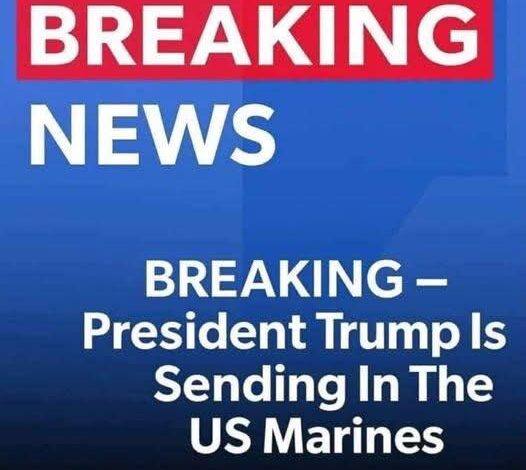
The Biden administration’s years saw heated debates over immigration, but former President Donald Trump has reignited the issue with a bold military maneuver. His administration announced the deployment of 200 U.S. Marines to Florida to support Immigration and Customs Enforcement (ICE), as part of a broader plan to bolster operations in states facing rising immigration pressures, including Louisiana and Texas. Although military officials stress that the Marines’ duties will be limited to administrative and logistical support, the announcement has sparked immediate controversy, raising questions about civil liberties, strategic intent, and the precedent it may set for future military involvement in domestic affairs.
According to Pentagon briefings, the Marines will not participate in law enforcement or combat operations. Their role will be strictly behind the scenes, assisting ICE with processing paperwork, managing supplies, and coordinating detainee transportation. Officials said the goal is to relieve administrative pressure on ICE staff, allowing trained agents to focus more directly on enforcement activities. While the mission is narrowly defined, the presence of uniformed Marines in immigration facilities has unsettled civil rights advocates, lawmakers, and some military analysts, who warn that the optics alone could undermine the traditional separation between military and civilian authority.
The response has been swift and divided. Immigration advocates warn that even non-combat roles for Marines could intimidate immigrant communities already fearful of detention or deportation. Families with uncertain legal status may perceive the deployment as a sign that immigration enforcement is becoming militarized, potentially deterring people from seeking asylum, reporting abuse, or accessing legal services. Critics also raise concerns about “mission creep,” cautioning that logistical support today could escalate into more direct involvement if pressures increase. Several lawmakers are demanding clarity regarding both the duration of the deployment and the limits of military authority in these facilities.
Supporters, however, view Trump’s decision as a practical solution to a long-standing staffing crisis within ICE. Overcrowded detention centers and insufficient administrative staff have hampered the agency’s efficiency. Assigning Marines to handle background tasks like records management and logistics allows ICE agents to return to frontline duties without being bogged down. Proponents stress that the mission is temporary and carefully defined, arguing it demonstrates Trump’s commitment to restoring order where Democrats, in their view, have fallen short. For many of Trump’s supporters, the move reinforces his image as a leader willing to deploy every available tool to enforce immigration law.
The situation also highlights broader debates over the military’s role in domestic operations. Historically, military involvement within U.S. borders is tightly controlled to prevent even the perception of authoritarian overreach. While troops are often deployed for disaster relief, pandemic response, or infrastructure projects, using them in immigration enforcement raises new concerns. Even if their tasks remain administrative, the sight of Marines in detention centers could normalize military involvement in politically sensitive civilian matters, challenging democratic norms and raising questions about the balance of power among federal agencies.
As the Marines take up their assignments in Florida, the deployment will remain closely scrutinized by lawmakers, advocacy groups, and the public. Immigration policy is one of the nation’s most contentious issues, and this decision has added a new flashpoint. For some, it represents pragmatic problem-solving; for others, it is a worrying step toward blurring boundaries that should remain clear. Whether the presence of Marines will effectively ease ICE’s workload or further inflame controversy remains uncertain—but it has already transformed what was intended as a logistical measure into a significant moment in the ongoing national debate over immigration, security, and the domestic role of the U.S. military.