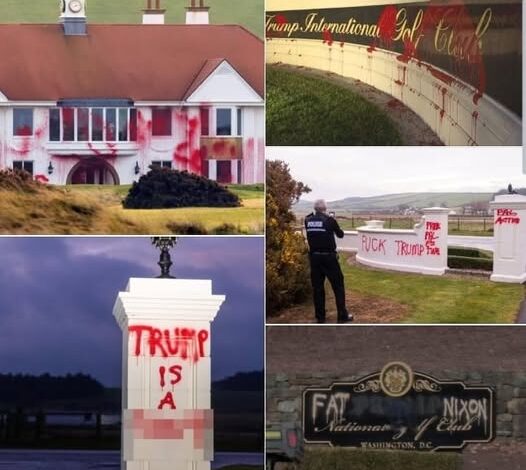
The rugged, wind-battered coastline of Ayrshire, Scotland, is home to the iconic Trump Turnberry resort, a symbol of luxury and a high-profile destination for golfers from around the globe. Yet this week, the serene landscape was shaken by an unsettling event: the resort became the target of a significant act of vandalism. Under the cover of darkness, unknown individuals left behind a trail of crimson paint and provocative graffiti, prompting an immediate investigation by Police Scotland and reigniting broader discussions about the intersection of private property and political expression.
The incident came to light early one damp February morning when staff arrived to find the historic hotel and several outbuildings defaced. The vandals’ reach extended beyond the buildings themselves—prominent signage and entrance features, which welcome international guests to the famed Ailsa course, were also targeted. The stark red paint stood in sharp contrast to the pristine white walls and manicured grounds, a visual clash that quickly captured the attention of both local residents and the online world. To supporters of former U.S. President Donald Trump, the act was a disrespectful attack on a local landmark and a significant employer. To critics, the vandalism appeared as a symbolic statement against the Trump brand, echoing tensions that have followed it across international borders.
Police Scotland responded swiftly, cordoning off the affected areas to allow forensic teams to carefully collect evidence. Officers combed the grounds for discarded paint canisters and other clues, while a dedicated digital unit began reviewing hours of CCTV footage. Though the resort is known for its extensive security network, the sprawling coastal grounds provide multiple potential points of entry. Authorities are treating the incident as serious criminal damage, though they have yet to categorize it as a political hate crime pending analysis of the graffiti and further investigation into the perpetrators’ motives.
Trump Turnberry occupies a unique position within Scotland’s cultural and economic landscape. The resort is a major employer in South Ayrshire, providing hundreds of jobs and drawing international tourism revenue. Yet since Donald Trump purchased the property in 2014, it has remained a lightning rod for controversy. From environmental disputes to protests during presidential visits, Turnberry has always been more than a hotel—it has been a tangible emblem of political and social debate. The recent vandalism, arguably the most audacious in recent memory, suggests that these tensions are intensifying.
The timing of the attack is notable. Occurring amid shifting geopolitical discussions and renewed domestic debates in both the United Kingdom and the United States, the act seems to intersect with broader political currents. While some of the slogans sprayed on the property have been partially concealed during initial cleanup, early reports suggest they reflect contemporary grievances, hinting at either coordinated activism or a lone-wolf statement. Investigators are scrutinizing the event for patterns, timing, and potential links to local or international groups.
In response, the resort moved quickly to mitigate damage. Restoration crews began work immediately, delicately removing paint from the century-old buildings without harming the historic masonry. The aim is to restore the resort to its five-star condition before the peak of the spring golf season. Yet while the physical traces of vandalism can be cleaned, the security implications are more lasting. Discussions are already underway to enhance perimeter surveillance, implement advanced motion-sensing technology, and increase nighttime patrols, ensuring the safety of both guests and staff moving forward.
Public reaction has been sharply divided. Locally, many residents expressed frustration, seeing the vandalism as an attack not just on the property but on a key employer in their community. Online, the debate was more polarized: some viewed the act as “guerrilla art” or symbolic protest, while others condemned it as criminal and counterproductive, undermining lawful avenues for expression.
The incident underscores the challenges faced by high-profile, politically-linked properties in today’s socially charged climate. From Mar-a-Lago in Florida to Trump Tower in New York, locations associated with political figures are increasingly treated as extensions of their personal and ideological identities, making them targets for both protest and attention. Scottish authorities recognize that the handling of this case will be watched closely worldwide, given its diplomatic and security implications.
As the sun sets over the Firth of Clyde, the red paint may fade under the efforts of cleanup crews, but the questions remain: Who carried out the attack? What message did they hope to send? Police Scotland continues to urge anyone who may have witnessed suspicious activity near the Turnberry grounds on the night in question to come forward. The investigation is not just about restoring property—it’s about understanding motivations behind an attack on one of the most visible symbols of American influence in the United Kingdom.
Ultimately, the vandalism at Turnberry serves as a stark reminder of how, in 2026, the lines between private enterprise and public politics have blurred. A luxury golf resort can become both a target and a symbol in a matter of hours, transforming a quiet Ayrshire night into a flashpoint of international discussion. While the physical damage may be temporary, the incident highlights the ongoing global tensions that accompany politically-linked properties and the complex intersection of security, protest, and public perception.