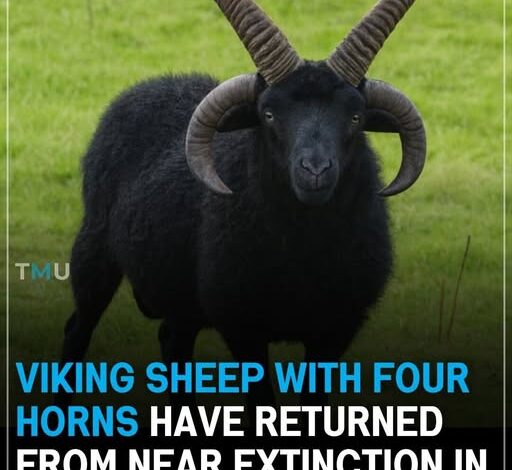
Four-horned “Viking” sheep are making a steady comeback in Britain, in what many conservationists describe as a quiet but meaningful success story. The rare breed, called the Manx Loaghtan, had once dwindled to dangerously low numbers but is now gradually rebuilding thanks to dedicated preservation efforts.
The Manx Loaghtan is best known for its striking appearance. Many individuals grow four sweeping, curved horns — and occasionally even six. Their dark brown wool and primitive features connect them to ancient Northern European livestock. Historians believe Norse settlers brought the breed to the Isle of Man and surrounding regions during the Viking era, giving the sheep both cultural and historical significance.
However, as modern agriculture shifted toward highly productive commercial breeds, traditional livestock like the Manx Loaghtan fell out of favor. By the 20th century, their population had declined dramatically, surviving mostly in small, scattered flocks. At one point, extinction was a real possibility.
Their survival is largely due to the work of conservation-minded farmers and rare-breed organizations. Carefully managed breeding programs focused on maintaining genetic diversity while slowly increasing flock numbers. Advocacy groups also worked to raise awareness of the breed’s heritage value and ecological benefits, encouraging farmers to reintroduce them into grazing systems.
Today, Manx Loaghtan sheep can once again be seen grazing in parts of Britain and the Isle of Man. While they are still classified as a rare breed, their numbers are improving steadily — a sign that long-term conservation efforts are paying off.
Experts note that preserving traditional breeds like the Manx Loaghtan is about more than nostalgia. These animals represent valuable genetic diversity, resilience traits, and centuries of agricultural history. Their recovery underscores the importance of safeguarding rare livestock in an era dominated by uniform commercial farming.
The return of Britain’s four-horned Viking sheep is more than a novelty. It is a testament to resilience, stewardship, and the power of sustained conservation — a living link between modern pastures and an ancient past.