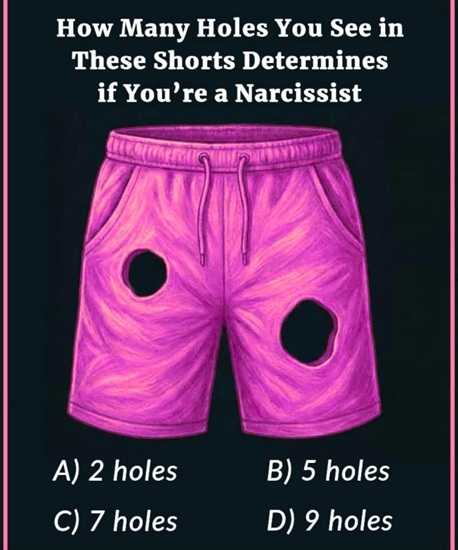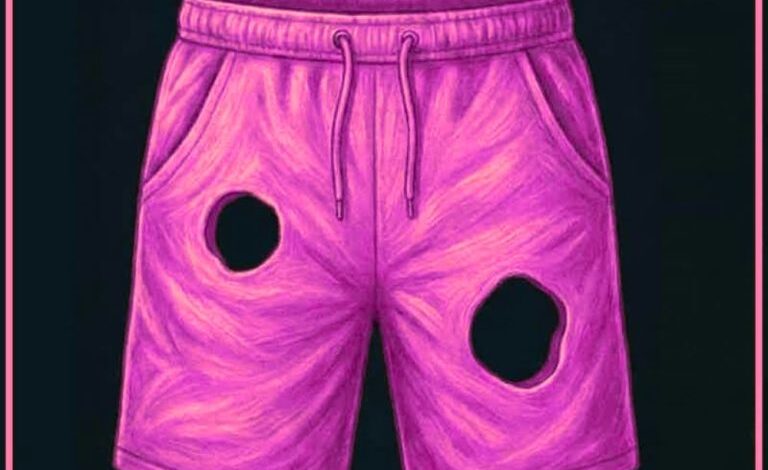
At first glance, the viral image seems completely ordinary: a worn, slightly tattered pair of shorts laid out flat. The fabric shows signs of aging, with noticeable tears near the legs.
Nothing about it immediately suggests anything unusual. But when paired with the provocative caption, “How many holes do you see determines if you’re a narcissist,” the mundane photo transforms into a psychological prompt that captures attention instantly.
This combination of visual simplicity and emotionally charged framing is exactly why the image spread so quickly on social media. It encourages viewers to make snap judgments, tests confidence in perception, and subtly pressures people to defend their answers. In the fast-scrolling digital environment, this kind of puzzle is perfectly engineered to stop thumbs mid-scroll and ignite discussion.
Why It Feels Like a Test
The caption plays a major role in shaping responses. By implying that the number of holes seen reflects narcissism—a term loaded with social and emotional significance—it turns a simple counting task into a judgment-laden exercise.
Viewers aren’t just counting holes; they are unconsciously evaluating what their answer might say about them. Psychologically, this taps into several cognitive tendencies:
- Ego involvement: People want to believe their answer reflects insight or intelligence.
- Social comparison: Viewers compare their response to others’ opinions.
- Fear of judgment: No one wants to be perceived as oblivious or self-centered.
- Confirmation bias: Once a choice is made, it’s defended vigorously.
This framing converts an innocuous visual into a mini social experiment—though it has no scientific or diagnostic validity.
The Immediate Response: Two Holes
Most viewers instantly answer “two,” focusing on the two obvious torn areas on the legs. This reaction isn’t careless—it reflects how the human brain prioritizes salient visual features. The tears are irregular, jagged, and visually prominent, naturally drawing attention.
From an evolutionary standpoint, humans are wired to detect anomalies quickly. This instinctive, fast-thinking response is efficient and usually effective in everyday life. Seeing two holes doesn’t indicate shallow thinking or limited intelligence; it simply reflects how perception works under rapid, instinct-driven processing.
A Broader View: Counting Five Holes
As conversation unfolds, others note that the shorts were originally designed with additional openings:
- One hole for the waist
- Two holes for the legs
- Two extra holes caused by the tears
This yields a total of five holes, which many consider a more complete answer.
Reaching this conclusion requires stepping back from instinct and considering structure and function. It reflects a more analytical mindset, redefining what qualifies as a “hole” rather than focusing solely on visible damage. Both perspectives are logically valid.
Going Further: Layered or Multi-Dimensional Counting
Some analyses go even deeper, factoring in fabric layers. Shorts have front and back panels, so certain holes may pass through multiple layers, creating counts of seven, eight, or even nine holes. Though less common, this approach illustrates the flexibility of human reasoning when definitions are expanded.
At this point, the puzzle becomes less about the shorts themselves and more about how people define terms, apply logic, and justify their answers. Without a strict definition of “hole,” no answer is universally correct.
Why the Narcissism Angle Misleads
The claim that hole-counting reveals narcissism is unsupported by psychology or neuroscience. Narcissistic Personality Disorder is complex and requires clinical assessment. Using this idea online is purely rhetorical—it’s meant to provoke reactions and encourage sharing.
In reality:
- Seeing two holes reflects instinctive perception.
- Seeing five holes reflects structural reasoning.
- Seeing seven or more reflects abstract, layered analysis.
None of these outcomes reveal personality traits, intelligence, or emotional makeup—they simply reflect different cognitive pathways triggered by the same image.
Why People Defend Their Answers
The viral appeal isn’t the shorts; it’s the discussion they provoke. Once someone picks an answer, commitment bias drives them to defend it. Social media amplifies this through public replies, likes, reactions, and visible disagreement, turning a simple image into heated debates over logic, perception, and reasoning—none of which are truly being measured.
The Core Takeaway
The viral shorts image succeeds because it highlights a fundamental truth about human cognition: perception is subjective. We don’t all see the same thing, even when observing identical stimuli.
How we perceive and interpret the world is influenced by:
- Attention
- Context
- Past experiences
- Assumptions
- Personal definitions
Rather than assessing narcissism, the image reveals how quickly we jump to conclusions, trust first impressions, attach meaning to arbitrary labels, and defend personal interpretations.
Why Content Like This Spreads
This image fits into a class of viral content that is:
- Immediately understandable
- Emotionally provocative
- Debatable
- Accessible to all
Its simplicity ensures anyone can engage, everyone can argue, and no definitive answer ends the conversation.
Final Thoughts
The viral “holes in the shorts” image is not a measure of personality, intelligence, or self-awareness. Its value lies in illustrating human thought processes: how we perceive, reason, and respond to social framing in the digital age.
The real fascination isn’t the shorts themselves—it’s the way people think about them, defend their reasoning, and interact with others. In this case, the discussion becomes the true source of engagement, showing that human cognition is as varied as it is compelling.