With heavy hearts, we announce the passing of a true legend! When you find out who she is, you will cry!

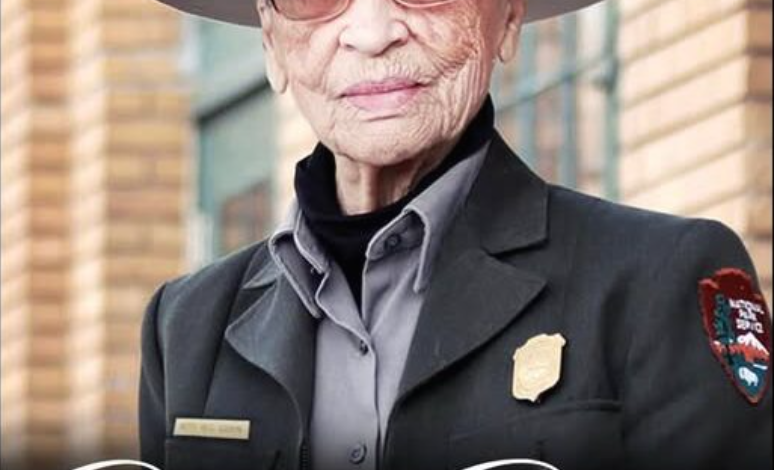
The story of the United States is often told through the sweeping deeds of presidents, the movements of armies, or the upheavals of social revolutions. Yet the deeper fabric of the American experience is stitched by those whose work unfolds quietly on the margins—lives often overlooked but whose impact resonates across generations. Betty Reid Soskin was one such figure. When she passed away on December 21, 2025, at the extraordinary age of 104, the nation lost not only its oldest National Park Service ranger but also a living link to a century of American history. Her life embodied resilience, courage, and an unyielding dedication to truth, illustrating that meaningful contributions can arrive late in life and that the work of remembrance and justice is never truly complete.
Soskin was born Betty Charbonnet in 1921 in Detroit, Michigan, into a family of Cajun-Creole and African American heritage. Her early years were shaped by displacement and adaptation, including the Great Flood of 1927, which forced her family to relocate first to New Orleans and later to Oakland, California. These formative experiences exposed her to the dual realities of survival and systemic inequality, instilling a lifelong awareness of social injustice. Oakland of her youth was a city of contrasts: low skylines, modest infrastructure, and yet vast possibilities. Soskin grew up amid cultural milestones and national tragedies—the disappearance of Amelia Earhart, the Port Chicago explosion, and rapid industrialization of the Bay Area—which made history tangible and immediate in her daily life.
During World War II, Soskin’s life intersected with the tensions of the American home front. She worked as a file clerk in a segregated union hall, witnessing the stark contradictions of the era: Black Americans defending democracy abroad while denied its full benefits at home. In 1945, she and her husband, Mel Reid, opened Reid’s Records in Berkeley, California. The store became more than a business; it was a cultural hub where Black musicians and audiences could connect, affirming community identity and creativity in a society rife with marginalization. Its seventy-year endurance reflected Soskin’s commitment to both cultural preservation and community engagement.
Her most public role, however, began in her eighties. At 84, she joined the Rosie the Riveter/World War II Home Front National Historical Park in Richmond, California. Initially a consultant, she quickly became the park’s moral and historical compass. She identified a glaring omission: the experiences of Black workers on the home front were largely invisible, overshadowed by the familiar “Rosie” imagery that predominantly represented white women. Soskin challenged this narrative, insisting that segregation, discrimination, and the untold struggles of African Americans be central to the park’s story. Through meticulous research supported by a PG&E grant, she transformed marginalized histories from footnotes into core elements of the national record, earning a permanent ranger position she held for sixteen years.
As a ranger, Soskin did more than convey facts; she embodied history. Visitors from across the globe came to hear her speak, connecting her lived experience to broader historical narratives. She illuminated the home-front contributions of Black Americans while drawing parallels to contemporary social issues, making her interpretive programs both educational and deeply personal. Even after retiring at 100 in 2022, her intellect and voice remained vibrant, carrying the authority of a century of lived experience. Recognition at the national level followed: in 2015, President Barack Obama invited her to help light the National Christmas Tree—a symbolic moment bridging her early life under segregation with a national stage of acknowledgment.
Soskin’s engagement extended beyond history. Even in her second century, she spoke on contemporary challenges: political polarization, the spread of disinformation, and the erosion of civil discourse. Having witnessed the victories of the Civil Rights Movement, she approached current struggles with clarity and pragmatism, emphasizing that the protection of truth and justice requires ongoing vigilance.
Family remained central to her life. Living in Richmond with her daughter, Di’ara, Soskin maintained an active presence in both home and community. Her passing was described as the peaceful conclusion of a “fully packed life,” one in which she had contributed fully to her family, her work, and her country. She corrected historical records, amplified marginalized voices, and ensured that future generations inherit a richer, more complete understanding of American history.
Her legacy continues through institutions and projects bearing her name, including a middle school and the documentary Sign My Name to Freedom, which chronicles her journey. Soskin demonstrated that age is no barrier to relevance and that speaking truth to power is a lifelong endeavor. She proved that one can begin their most impactful chapter at any stage in life and that silence in the face of injustice is never acceptable.
Ultimately, Betty Reid Soskin’s life was an act of defiance and devotion. She defied societal expectations of Black women in the early 20th century, challenged conventional timelines of professional achievement, and redefined what it means to age with purpose. She was a ranger, entrepreneur, activist, mother, and educator—but above all, she was a custodian of history, preserving stories long ignored. Her life reminds us that progress is rarely linear, that confronting the past honestly is essential, and that courage and clarity can reshape both memory and the future. Even in death, her voice resonates, guiding those willing to listen toward a more just, inclusive, and truthful America.