Every now and then, the internet becomes something more than a scroll of headlines and hot takes. It turns into a global roundtable of curiosity. A single photo appears—usually taken on a kitchen counter, in an attic, or half-buried in a yard—captioned with the simple plea: “Does anyone know what this is?” Within moments, strangers from across continents lean in. Collectors zoom in on details. Historians cite obscure catalogs. Retirees recall something their grandparents once owned. What begins as confusion transforms into collective investigation.
What follows is rarely just identification. It’s restoration of memory.
One user once uploaded an image of a satin-padded fabric piece with ribbon ties and a small opening in the center. It looked delicate and slightly old-fashioned. Some speculated it might be a cosmetic accessory or part of a sewing kit. The answer was far more domestic: a vintage clothes hanger cover. Designed to slip over wooden or metal hangers, the satin prevented fragile garments—silk slips, lace blouses, lingerie—from snagging or sliding off. The ribbons secured it in place. In a single explanation, an entire era of carefully curated closets resurfaced.
Another puzzler involved a small spring-loaded metal device capped with two red glass spheres. Its design felt too intentional to be random, yet too strange to identify easily. The internet eventually recognized it as a razor blade sharpener from the days when disposable razors didn’t exist. The red glass balls acted as handles while the mechanism restored dull edges through friction. It was a reminder of a time when maintenance replaced replacement.
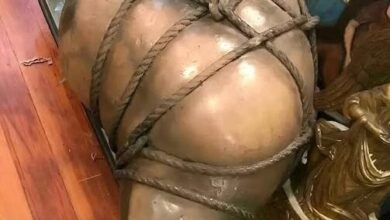
Then came a set of heavy engraved glass discs—each etched with floral patterns and weighing over a pound. They were guessed to be decorative coasters or candle bases. Instead, they turned out to be antique furniture casters. Placed beneath piano legs or heavy tables, they protected hardwood floors from damage. What looked ornamental had once been entirely practical.
In one household, a father posted an image of a curious plastic contraption discovered in a drawer. Neither he nor his wife recognized it. Within hours, someone identified it as a measuring cup holder—a simple device meant to stack and organize small measuring cups neatly. Mystery solved, domestic order restored.
A photograph of a metal frame bolted above a child’s bunk bed sparked brief alarm. Some wondered whether it was a safety modification. In truth, it was part of a themed bunk bed set—specifically designed to support a canopy that transformed the bed into a miniature spacecraft. A child’s imagination had once orbited there.
Other discoveries were less whimsical. One woman noticed small brown pellets beneath her husband’s pillow and feared insects. The internet calmly explained that aging memory foam can degrade, forming tiny clumps that escape through seams. Panic gave way to relief.
Another head-scratcher: a long chain strung with thick glass spheres, weighing nearly forty pounds. It appeared decorative but unwieldy. It was, in fact, a rain chain—an architectural alternative to downspouts. Rainwater travels along the chain’s surface, creating a soft cascade that’s both functional and soothing. What seemed bizarre was actually beautiful engineering.
A ceramic bowl with a precisely placed hole at the base puzzled a thrift-store shopper. It turned out to be a bulb forcer—a vessel used to grow hyacinths or other bulbs indoors. The bulb rests above water, encouraging roots to grow downward without submerging the plant entirely. Gardening once required patience and clever design.
From a jewelry box emerged a small disc attached to a chain—ornate, metallic, easily mistaken for decoration. It was part of a lady’s watch chain, intended to secure a pocket watch discreetly to clothing. Function intertwined with elegance.
Concern surfaced when someone spotted a small device pointed toward their backyard fence. With its lens-like appearance, it resembled a surveillance camera. Instead, it was an ultrasonic animal deterrent—designed to emit high-frequency sound waves that discourage stray animals without disturbing humans.
A hinged gold locket containing a mirror and a rotating inner plate turned out to be a powder compact. Before makeup bags and plastic cases, women carried pressed powder in decorative metal casings—combining practicality with artistry.
A gold-plated clip featuring a horse emblem and a cord sparked curiosity as well. It was identified as part of an early hearing aid system. The clip held a microphone that connected to a small amplifier, offering a glimpse into mid-20th-century assistive technology.
One college dormitory revealed a narrow, tiled wall alcove that baffled students. It wasn’t architectural error; it was a 1960s shared phone booth—a communal space where students once waited to call home.
A three-legged metal “rocket” found at a flea market? A mid-century bar tool stand. A solitary brick pillar deep in the woods? A boundary marker from a long-vanished housing development. A tennis racket attached to a chain and weighted ball? A net-measuring device—ensuring tennis courts met official height standards.
Individually, each object is small. Together, they form a mosaic of lived experience.
What makes these stories compelling isn’t just the solution—it’s the collaboration. A retired machinist in Canada might recognize a tool instantly. A grandmother in Spain may identify a hair accessory from her youth. A museum volunteer might recall seeing something similar in an exhibit decades ago. The internet, often criticized for noise, becomes a kind of distributed memory bank.
These rediscoveries do more than satisfy curiosity. They connect generations. They highlight durability in an age of disposability. They remind us that many objects were once built to last—and built with thought.
A strange metal gadget isn’t always junk. It may be a relic of ingenuity. A mysterious piece of glass might once have protected a parlor floor beneath a piano where someone practiced scales each evening. An odd ceramic bowl may have brightened winter windowsills with forced blossoms.
Every unidentified object carries a quiet question: What story did I belong to?
And increasingly, the internet answers.
So the next time you find something unfamiliar in a drawer, buried in a box, or tucked away in an attic, pause before discarding it. Photograph it. Ask. Somewhere, someone remembers.
Because sometimes solving the mystery of an object means rediscovering the people who once relied on it—and, in small but meaningful ways, rediscovering ourselves.