Hazel had always believed that family meant being there when people needed you.
So when her father suffered a serious health emergency, she did not hesitate. She emptied her savings account and used the money to help cover the medical costs. At the time, she did not think of it as a sacrifice. She thought of it as love.
Then came the next request.
And the next.
Groceries.
Utility bills.
Phone plans.
Insurance payments.
Car repairs.
Mortgage help for the family home.
Each time, Hazel told herself it was temporary. Her parents were struggling. Her relatives were going through difficult seasons. Someone needed to step in, and Hazel had always been the capable one.
She worked long hours as a financial analyst, spending her days helping companies organize money while her own life became smaller and smaller. She lived in a tiny apartment with thin walls and old carpet. She drove a car that rattled whenever the weather turned cold. She skipped vacations, delayed dental appointments, and told friends she was “just busy” whenever she could not afford to go out.
Still, she did not complain.
Loyalty, she believed, meant showing up.
Love meant helping.
Family meant carrying the weight when others could not.
Over time, though, the requests changed. They no longer sounded like emergencies. They sounded like expectations.
No one asked if Hazel could afford it.
No one asked what she had given up.
No one asked how she was doing.
They simply assumed she would handle it because she always had.
The turning point came during Thanksgiving season.
Hazel first noticed it in the family group chat. Everyone was discussing dinner plans. Her aunt asked about desserts. Her cousin mentioned bringing wine. Her mother talked about seating arrangements. Names were mentioned, times were confirmed, and side dishes were assigned.
Hazel read through the messages slowly.
Everyone had been invited.
Except her.
At first, she thought it had to be a mistake.
So she typed carefully.
What time should I come over?
The chat went quiet.
Then her cousin Ethan replied.
Oh, you thought you were invited?
A few laughing emojis followed.
Hazel stared at the screen, waiting for someone to correct him.
No one did.
Her aunt changed the subject.
Her mother stopped responding.
Her father said nothing.
Hazel felt heat rise behind her eyes, but she refused to argue in the chat. Instead, she called her mother.
The conversation lasted less than five minutes, but it changed something in her permanently.
Her mother explained, in the same gentle voice she used when asking Hazel for money, that the family thought it would be “better” if Hazel skipped Thanksgiving this year.
“Just until things calm down,” her mother said.
“What things?” Hazel asked.
There was a pause.
“Ethan still feels embarrassed about what happened at Olivia’s birthday.”
Hazel almost laughed.
Months earlier, Ethan had stood in front of the family bragging about his new job, his expensive watch, and how well he was doing. Hazel had not planned to say anything until he joked that some people in the family needed to “work smarter instead of always acting stressed.”
That was when Hazel quietly reminded him that she had paid his car insurance three months in a row.
The room had gone silent.
Ethan had been humiliated.
Apparently, that embarrassment mattered more than the truth.
“So I’m banned from Thanksgiving because I told the truth?” Hazel asked.
Her mother sighed.
“You know how sensitive Ethan is. You could apologize and make this easier.”
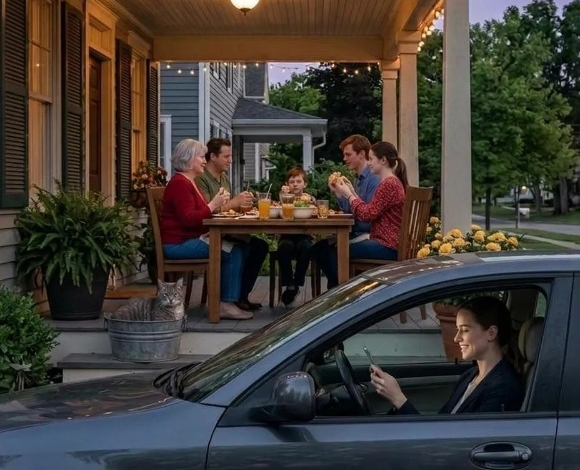
Hazel sat in her car outside her office, one hand still on the steering wheel, the other holding the phone to her ear.
She looked through the windshield at the gray November sky and finally understood.
The people who depended on her financially were willing to exclude her socially.
They wanted her money.
They wanted her silence.
They wanted her usefulness without her presence.
For years, she had tried to earn her place by giving more, helping more, sacrificing more. But acceptance had never been the reward. It had always been conditional.
And now, for the first time, she stopped trying to buy love from people who only valued what she provided.
That Thanksgiving night, Hazel went home alone.
She did not cry at first.
She took off her coat, placed her keys on the small table by the door, and stood in the quiet of her apartment. Through the wall, she could hear her neighbor’s family laughing over dinner. Somewhere downstairs, someone had burned something, and the smell drifted faintly into the hallway.
Hazel walked to her closet and pulled out the binder.
She had started building it months earlier, though she had not wanted to admit why.
Inside were receipts, bank statements, screenshots, transfer confirmations, and copies of every recurring payment she had covered for her family.
Mortgage payments.
Electric bills.
Phone plans.
Car insurance.
Grocery deliveries.
Emergency transfers.
Repair invoices.
Credit card bailouts.
Years of proof, organized by month.
She spread the documents across her kitchen table and looked at the full picture for the first time.
It was staggering.
While her relatives hosted dinners, bought new clothes, upgraded phones, and posted smiling photos online, Hazel had been quietly funding the structure beneath their comfort.
And still, they had treated her like an inconvenience.
She sat there for a long time, surrounded by evidence of her own exhaustion.
Then she understood the truth she had avoided for years.
She had confused sacrifice with love.
She had mistaken usefulness for belonging.
She had allowed family to become a debt she could never finish paying.
Hazel did not send a dramatic message.
She did not call Ethan.
She did not beg her mother to explain.
Instead, she opened her laptop.
One by one, she removed herself from every automatic payment linked to her accounts.
The mortgage contribution stopped.
The utility payments stopped.
The phone plan stopped.
The insurance payments stopped.
The shared streaming accounts, grocery subscriptions, and emergency credit card arrangements all disappeared from her responsibility.
Each cancellation felt small.
Then lighter.
Then powerful.
By midnight, the systems her family had relied on without gratitude belonged to them again.
The next morning, her phone started ringing before eight.
Her mother called first.
Then Ethan.
Then her aunt.
Then her father.
Then three cousins who suddenly remembered her number.
The messages came quickly.
Did something happen with the mortgage payment?
The phone bill bounced.
Mom says you removed the grocery card.
Why are you being like this?
This is not the time to be petty.
Family helps family.
Hazel read the messages without answering.
For once, their panic did not become her emergency.
The calls continued for days.
Some were angry.
Some were tearful.
Some were wrapped in guilt.
Her mother cried that Hazel was punishing everyone. Her father said she was overreacting. Ethan accused her of trying to ruin Thanksgiving because she could not handle a joke.
Hazel remained calm.
She saved every message.
Then she waited until she was ready.
A week later, she agreed to meet her parents at the family home.
When she arrived, her mother looked tired and wounded. Her father sat stiffly at the kitchen table, arms crossed, as though he were preparing to lecture her back into obedience.
Hazel placed the binder on the table between them.
“What is this?” her father asked.
“The truth,” Hazel said.
She opened it.
Page by page, she showed them what they had ignored.
The medical bills she paid after her father’s emergency.
The mortgage payments they claimed were “just temporary.”
The utilities that had been quietly drawn from her account for nearly two years.
The groceries.
The repairs.
The phone plans.
The insurance.
The emergency transfers no one ever repaid.
Her mother’s face changed slowly as the numbers accumulated.
Her father stopped looking angry.
For the first time, they could not pretend their comfort had been built entirely by their own effort.
“You never said it was this much,” her mother whispered.
Hazel looked at her.
“You never asked.”
Silence settled over the kitchen.
It was the same kitchen where Hazel had spent years bringing envelopes, checks, groceries, and solutions. The same kitchen where family photos hung on the wall as if love lived there naturally.
But love, Hazel realized, had become something she was expected to finance.
Her father cleared his throat.
“You could have told us you were struggling.”
“I did,” Hazel said quietly. “Not always with words. But I did. You just preferred me capable.”
Her mother began to cry.
“Are you really going to walk away from us?”
Hazel closed the binder.
“I am walking away from the role you gave me,” she said. “Not from love. From exploitation.”
Her father looked down.
Her mother covered her face.
Hazel stood.
Leaving that house hurt more than she expected. Boundaries did not erase grief. Self-respect did not make disappointment painless. But as she stepped outside into the cold air, she felt something she had not felt in years.
Peace.
Not happiness exactly.
Not yet.
But space.
In the months that followed, Hazel began rebuilding her life.
At first, it felt strange to spend money on herself. She bought new tires for her car and cried in the parking lot afterward, not because the purchase was sad, but because she had delayed basic safety for so long while paying other people’s bills.
She scheduled the dental appointment she had postponed twice.
She replaced the lumpy mattress in her apartment.
She started putting money back into savings.
Small choices began to return her to herself.
She reconnected with old friends she had drifted away from because she had been too tired, too ashamed, or too financially drained to keep up. She joined a weekend hiking group. She took herself to dinner without checking whether someone else’s emergency would empty her account first.
Her family still called sometimes.
Less often as months passed.
Her mother’s messages softened eventually, though they still carried guilt around the edges. Ethan never apologized. Her father sent one short text that said, We didn’t realize how much you were doing.
Hazel stared at it for a long time before replying.
Now you do.
That was all.
She did not know what the future of her family relationships would look like. She did not know whether real accountability would ever come. But for the first time, she was no longer organizing her life around the possibility that they might finally appreciate her.
Thanksgiving had begun as rejection.
It became freedom.
Hazel learned that boundaries are not cruelty.
They are not selfishness.
They are not betrayal.
Sometimes boundaries are the first honest thing a person does after years of being rewarded for disappearing.
Family can be love.
But love does not require financial self-destruction.
Support should not become servitude.
And peace, once protected, is worth more than any seat at a table where you are only welcome when you are paying the bill.
THE END.