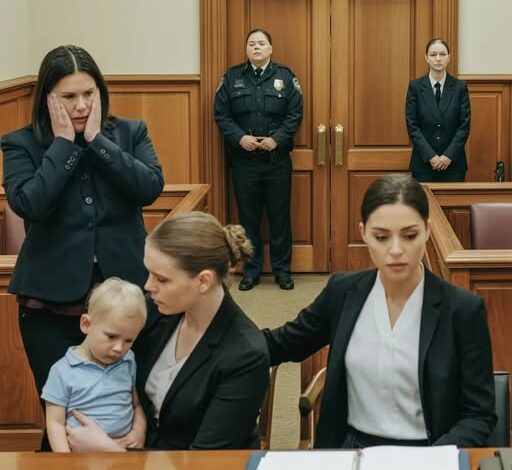
I thought I was giving my daughter a normal childhood.
That was the lie I told myself each time I dropped Sophie off at Oakridge Academy in my modest Honda, wearing cardigans and sensible shoes while other parents arrived in luxury SUVs and designer coats. I believed I was protecting her by keeping my professional life hidden, by allowing her to move through the world without the burden of being known as a federal judge’s daughter. I did not want teachers praising her because they feared me. I did not want classmates pretending friendship because of my title. I wanted her to be seen as herself—bright, curious, tenderhearted Sophie.
I was wrong.
My attempt to shield her from my power had left her vulnerable to theirs.
Oakridge Academy looked, from the outside, like the kind of place any parent would dream of sending a gifted child. Its stone buildings sat behind manicured hedges and iron gates, its brochures promised excellence, leadership, and character, and its tuition was higher than what many families in our city earned in a year. The waiting list was legendary. The parent body was a carefully curated collection of executives, old-money families, political donors, and people who seemed to measure a child’s worth by the influence attached to their last name.
The school’s mission statement spoke beautifully about nurturing exceptional minds for tomorrow’s world. But the real lessons at Oakridge were quieter and far uglier. Children learned who mattered and who did not. They learned which families were important, which ones were tolerated, and which ones could be pushed around. They learned that wealth could disguise cruelty as discipline and that reputation could turn abuse into “high standards.”
I had chosen Oakridge because Sophie was brilliant. By first grade, she was reading books meant for children years older than her. She asked questions about space, history, animals, and human behavior that left adults blinking in surprise. She built imaginary countries with laws, maps, and languages. She solved math puzzles for fun. I wanted her to be challenged. I wanted her mind to have room to grow.
Instead, something inside her began to shrink.
For months, I watched my daughter fade in ways I could not explain. Sophie, who used to run toward me after school with stories spilling out faster than I could follow, began walking to the car in silence. She stopped talking about her classmates. She flinched when doors slammed. She begged to stay home on school mornings, clutching her stomach and whispering that she did not feel well. At night, she woke up crying from nightmares she would not describe.
When I raised concerns, Principal Halloway treated me with the kind of polished condescension that men like him reserve for people they believe are beneath them.
“Mrs. Vance,” he said during our last conference, adjusting his silk tie as though preparing to deliver something merciful, “Sophie appears to be struggling. She seems disengaged. Perhaps even slow for our advanced curriculum.”
Slow.
The word struck me so hard I could barely breathe.
This was my Sophie—the child who could explain volcanoes, invent stories with twenty characters, and ask questions that made grown adults reconsider their answers. Yet there I sat, dressed like an ordinary mother, nodding politely while a man who had never truly seen my daughter described her as a liability to his school’s performance.
“Perhaps you should consider a specialist,” he continued. “Or tutoring. We do have standards to maintain.”
I should have challenged him then. I should have trusted the instincts that had carried me through years on the federal bench. I had seen institutional cruelty before. I knew the language of systems protecting themselves. I knew how abuse often arrived dressed as concern, procedure, and professional expertise.
But I wanted so badly to be just Sophie’s mother that I silenced the judge in me.
Then came the text.
It was a Tuesday afternoon, and I was in chambers reviewing briefs for a racketeering case when my personal phone buzzed. The message was from Sarah Martinez, one of the few Oakridge mothers who had ever treated me like a human being.
“Elena, come to the school now. I’m volunteering in the East Wing for the book fair. I heard screaming near the janitorial closets. I think it’s Sophie. Something is very wrong.”
I read the message once.
Then again.
Then a third time, as if the words might change if I stared long enough.
Screaming. Janitorial closets. Sophie.
My body wanted panic. My training demanded discipline. I closed my laptop, grabbed my keys, and drove to Oakridge faster than I had ever driven anywhere in my life. But by the time I reached the campus, something cold and familiar had settled over the fear. Whatever I found inside that school, I would need evidence. Documentation. A record that could survive denials, lawyers, donors, and the full weight of an institution built to protect itself.
I parked in the fire lane and walked into the East Wing.
That part of Oakridge was older than the rest of the campus, a dim corridor of unused classrooms, storage rooms, and narrow turns that felt less like a school and more like a place where secrets were meant to stay buried. As I approached the janitorial closet at the end of the hall, I heard a woman’s voice.
“You stupid, worthless girl!”
I stopped moving.
The voice belonged to Mrs. Gable, Sophie’s homeroom teacher. Award-winning Mrs. Gable. Beloved Mrs. Gable. The woman whose smiling photo appeared in the school newsletter under headlines about excellence and compassion.
“Stop crying,” she snapped. “This is pathetic. This is why people give up on children like you. You are unteachable. You are a burden.”
Then came the sound I will hear for the rest of my life.
A slap.
Sharp. Adult. Deliberate.
I pressed myself against the wall beside the door and pulled out my phone. My hands were steady now. Not because I was calm, but because the part of me that understood evidence had taken over. Through the small safety glass window, I began recording.
Inside the closet, my daughter was cowering in the corner, surrounded by cleaning supplies and metal shelves. Her face was wet with tears. One cheek was red. Her little body shook so violently I could see it through the glass.
Mrs. Gable towered over her.
As I watched, she grabbed Sophie by the upper arm and yanked her upright with enough force to leave finger-shaped marks. Sophie screamed, a raw, terrified sound that cut through every piece of restraint I had left.
“You will sit in this dark room until you learn how to behave like a human being instead of an animal,” Mrs. Gable hissed. “And if you tell anyone about our sessions, I will make sure you fail every subject. I will make sure no good school ever accepts you. Do you understand?”
I saved the video.
Then I stepped back and kicked the door with every ounce of strength I had.
The lock shattered. The door flew open. Mrs. Gable spun around, releasing Sophie so quickly my daughter stumbled backward into the shelving.
For one second, the teacher’s face went completely white. Then the mask returned. The professional smile. The smooth voice. The practiced lie.
“Mrs. Vance,” she gasped. “Thank goodness you’re here. Sophie was having one of her episodes. She became violent during class, so I brought her here for a calming timeout.”
I looked at my daughter’s cheek. At her arm. At the terror in her eyes.
“A calming timeout?” I said.
“Standard behavioral intervention,” Mrs. Gable replied, regaining confidence. “Sophie has been increasingly disruptive. Some children require firmer boundaries than others.”
I knelt beside my daughter and opened my arms. Sophie crawled into them like a wounded animal, burying her face in my neck.
“I’m sorry, Mommy,” she whispered. “I’m sorry I’m so stupid. I tried to be good.”
Something inside me went silent.
Not peaceful. Not numb.
Silent in the way a courtroom becomes silent just before a sentence is delivered.
I stood with Sophie in my arms and looked at Mrs. Gable.
“You locked my child in a closet,” I said. “You hit her. You called her worthless. You told her she was the reason people left.”
“I provided appropriate correction,” she said, her voice sharpening. “Your daughter has serious learning and behavioral problems.”
“Move.”
“I’m afraid I can’t allow you to remove her without proper authorization. School policy requires—”
“Move,” I repeated.
This time, she heard something in my voice that made her step aside.
But we did not get far.
Principal Halloway was waiting in the main corridor, flanked by a security guard, wearing the expression of a man who had handled many frightened parents and expected to handle one more.
“Mrs. Vance,” he said calmly, “I understand there has been an incident. Please come to my office so we can discuss Sophie’s behavioral challenges.”
“There is nothing to discuss,” I said. “I am taking my daughter home, and I am calling the police.”
His eyes hardened.
“If you attempt to remove Sophie without following protocol, we may have to contact Child Protective Services regarding concerns about the home environment contributing to her difficulties.”
There it was.
The threat beneath the polish.
He believed he had power over me because he thought I was exactly what I had allowed him to see: a quiet single mother, intimidated by authority, desperate for her daughter to remain in his expensive school.
“Five minutes,” I said.
In his office, surrounded by framed diplomas and photographs with donors, Halloway settled behind his massive desk. Mrs. Gable stood in the corner, arms folded, wearing the smug patience of someone waiting for a troublesome parent to be managed.
“Mrs. Gable informs me Sophie became violent during instruction,” Halloway began. “She had to be restrained for the safety of others.”
“She is eight years old,” I said. “She weighs sixty pounds.”
“Even small children can be dangerous when emotionally disturbed.”
I took out my phone and played the video.
Mrs. Gable’s voice filled the office. The insult. The threat. The slap. Sophie’s crying.
When it ended, Halloway did not look horrified. He looked inconvenienced.
“Context is everything in education,” he said. “Mrs. Gable is an award-winning teacher. Her methods may seem intense to parents unfamiliar with advanced behavioral correction.”
“You call that correction?”
“I call it necessary intervention. And I need you to delete that video.”
The room went still.
I stared at him, waiting for some sign that he understood what he had just said.
Instead, he leaned forward.
“Listen carefully, Mrs. Vance. We know your situation. A single mother trying to maintain access to an institution like this. We have been charitable in overlooking Sophie’s deficiencies, but if you release that video, we will expel her for violent behavior. We will make sure her permanent record reflects her inability to function in an academic setting. We will ensure every quality private school in the state knows exactly what kind of child she is.”
Mrs. Gable smiled.
“Who do you think people will believe?” she asked. “Oakridge Academy, or a hysterical mother with a troubled child?”
I looked from one to the other.
“So that is your final position?” I asked. “You are threatening to destroy an eight-year-old’s future unless I conceal evidence of child abuse?”
“Absolutely,” Halloway said. “And before you think about involving the police, you should know Chief Miller serves on our board. He understands our disciplinary philosophy.”
I lifted Sophie into my arms.
“Chief Miller is on your board?”
“Yes,” Halloway said, pleased with himself. “So do not bother calling 911.”
“Good to know,” I said. “He will be the first person named in the federal complaint for conspiracy to conceal systematic child abuse.”
Halloway blinked.
“Federal complaint?” he said. “What could you possibly know about federal law? You’re just a mother.”
At the door, I turned back and smiled for the first time since entering the school.
“I know enough,” I said. “See you in court, Principal Halloway.”
Three days later, the federal courthouse was packed.
The story had already broken. Not the full video, not yet, but enough: allegations of child abuse, administrative threats, and institutional cover-up at one of the most prestigious schools in the state. Reporters lined the hallway. Parents whispered in clusters. Oakridge’s attorneys arrived in dark suits with the confidence of men who believed money could still dictate the ending.
Halloway entered looking irritated rather than afraid. Mrs. Gable walked behind him, pale but composed. Their legal team surrounded them like armor.
I was already seated at the plaintiff’s table when they arrived, but their angle kept them from seeing me clearly. I heard Halloway whisper to his attorney.
“Let’s finish this quickly. She is probably representing herself.”
“All rise,” the bailiff called.
Judge Marcus Sterling entered the courtroom. He was known for his strict procedure, his intolerance for theatrics, and his absolute refusal to be impressed by wealth. He was also a colleague who had known me for fifteen years.
He looked at the docket.
“Vance versus Oakridge Academy, et al.”
Then he glanced toward the defense.
“Mr. Halloway. Mrs. Gable. Counsel.”
Finally, his eyes moved to my table.
“Good morning, Justice Vance,” he said formally. “I see District Attorney Penhaligon is appearing as co-counsel.”
The silence that followed was complete.
Halloway turned slowly.
For the first time, he saw me—not in a cardigan, not in the costume of harmlessness he had believed was reality, but in a navy suit, pearl necklace, and the professional stillness of a woman who had spent her life watching powerful men realize too late that they had miscalculated.
“Justice?” he whispered.
His attorney went gray.
“You did not tell me she was Elena Vance,” he hissed. “The federal judge who dismantled the Torrino crime family.”
“I didn’t know,” Halloway stammered. “She drives a Honda.”
I turned toward him.
“I told you I knew enough about the law,” I said. “I simply did not mention that I am the law.”
The collapse of Oakridge’s power took less than an hour.
District Attorney Penhaligon rose with a stack of folders that represented not only my daughter’s case, but the beginning of the end for an entire institution.
“Your Honor,” he said, “based on evidence collected by Justice Vance and corroborated by our investigation, the state is filing criminal charges against Mrs. Gable for felony child abuse, aggravated battery, and criminal confinement.”
Mrs. Gable made a small sound, like the air had been punched from her lungs.
“Additionally,” he continued, “Principal Halloway is being charged with extortion, criminal conspiracy, obstruction of justice, witness tampering, and operating a criminal enterprise designed to conceal abuse within Oakridge Academy.”
Halloway’s attorney stood in panic.
“Your Honor, this was supposed to be a civil hearing.”
“Not anymore,” Judge Sterling said.
Federal marshals entered the courtroom.
Halloway searched the gallery until his eyes found Chief Miller. But the police chief, who had once seemed like a shield, was staring at the floor with the fixed concentration of a man hoping invisibility might save him.
It did not.
The investigation widened quickly. Once Sophie’s story became public, other families came forward. Six at first. Then more. Children locked in closets. Children struck, humiliated, threatened with academic ruin. Parents pressured into silence. Non-disclosure agreements signed under fear. Records altered. Complaints buried. Families quietly pushed out when they became inconvenient.
Oakridge Academy had not been a school with one abusive teacher.
It had been a system.
And systems, once exposed to light, often rot faster than anyone expects.
Mrs. Gable eventually accepted a plea agreement that sent her to prison and guaranteed she would never again be trusted with children. Halloway, facing charges far beyond anything his connections could erase, received a longer sentence. Board members resigned. Donors vanished. The academy’s carefully polished reputation collapsed under the weight of what it had hidden for years.
Within months, Oakridge declared bankruptcy.
Within a year, the building had changed completely.
The stone fortress that once taught children hierarchy and fear became a community center. Its classrooms were opened to children from every neighborhood. After-school programs filled the halls. Tutors worked with students whose parents could not afford private help. The old plaques and portraits were removed. Above the entrance, a new inscription was placed:
A Place for Everyone.
As for Sophie, she healed slowly.
There is no dramatic moment when a child simply becomes unafraid again. Healing came in pieces. First, the nightmares stopped. Then she stopped flinching when someone raised their voice. Then she began telling stories again, long and elaborate ones, full of dragons, inventors, astronauts, and girls who saved entire kingdoms by noticing what everyone else missed.
Her new school was nothing like Oakridge. Roosevelt Elementary was public, diverse, imperfect, underfunded in the way public schools too often are, and filled with more warmth than Oakridge had ever managed to manufacture. Her teacher, Ms. Rodriguez, greeted every child by name. When Sophie struggled, she was helped. When she succeeded, she was celebrated. When she was quiet, someone asked why instead of labeling her difficult.
One morning, I stood outside the school watching Sophie run toward her friends, her backpack bouncing against her shoulders. She turned only once to wave.
“Have a good day, sweetheart,” I called.
“I will, Mom!”
And I believed her.
After she disappeared through the doors, I returned to my car and made the familiar transformation. The cardigan came off. The blazer went on. Sensible flats became judicial heels. Sophie’s mother became Justice Vance again.
People later asked me why I had hidden my title for so long. Why I had not walked into Oakridge on the first day and made sure everyone knew exactly who I was.
The answer is simple.
Power that announces itself often reveals only performance. If Oakridge had known I was a federal judge, they would have behaved beautifully in front of me. They would have treated Sophie like treasure, not because she deserved care, but because they feared consequence. By allowing them to think I was powerless, I gave them permission to show me who they truly were.
And they did.
They showed me their contempt. Their cruelty. Their arrogance. Their confidence that money, reputation, and connections could protect them from the harm they inflicted on children.
They were wrong.
Justice does not always arrive loudly. Sometimes it sits quietly in a parent conference wearing a cardigan. Sometimes it nods while gathering information. Sometimes it lets the powerful underestimate it long enough for them to become careless.
But when justice finally stands, it stands completely.
Today, Sophie knows something no child should have to learn so early, but something that may protect her for the rest of her life: adults can fail, institutions can lie, and powerful people can be cruel. But she also knows that truth matters. Evidence matters. Courage matters. And love, when sharpened by purpose, can become a force strong enough to bring down walls built by people who thought they were untouchable.
My most important title has never been Justice Vance.
It has always been Mom.
And if being her mother means wearing cardigans until predators mistake me for prey, then stepping into courtrooms and reminding them what power really looks like, I will do it every time.
Because the most dangerous mistake cruel people can make is assuming kindness is weakness.
The second most dangerous is assuming a mother is powerless simply because she has chosen not to show her strength yet.