A Stranger Helped Me Fix a Flat Tire on Route 9 Where My Son Went Missing Years Ago — What He Left Behind Changed Everything

For twenty years, Margaret refused to drive Route 9.
She avoided it in every season, in every circumstance, no matter how inconvenient the detour became. If a map suggested it as the fastest way, she chose another road. If someone mentioned the rest stop near mile marker forty-two, she changed the subject. That stretch of highway was not pavement to her.
It was the place where her life split in two.
Before Daniel disappeared.
And after.
He had been seven years old that day, sitting in the back seat in a red shirt, swinging his legs while she promised she would only be gone for a minute. He wanted a Sprite. She remembered that with a cruelty memory should not be allowed to have.
A Sprite.
Such a small thing.
She had stepped inside the rest stop store, bought the drink, and returned to the car with condensation already forming on the bottle.
Daniel was gone.
At first, everyone told her he could not have gone far. Children wandered. Children hid. Children got distracted by vending machines, bathrooms, birds near the fence line.
But Daniel did not come back.
The search began fast and loud. Police cars. Volunteers. Dogs. Flashlights moving through the trees behind the building. His photograph printed on flyers, then on local news, then on missing-child posters that curled and faded in windows long after hope had begun to thin.
For weeks, Margaret barely slept.
For months, she answered every phone call with a hand pressed to her chest.
For years, she carried the unanswered question like a second skeleton beneath her skin.
People eventually moved on because that is what people do when grief does not belong to them. Reporters stopped calling. Volunteers returned to their families. The sheriff retired. The rest stop reopened fully, repainted and ordinary, as if nothing sacred had been taken there.
But Margaret never returned to Route 9.
Not until last week.
A construction detour forced her onto the highway before she realized where the signs were leading her. By the time she understood, traffic had narrowed and there was nowhere to turn around. Her hands tightened on the steering wheel.
Mile markers passed like ghosts.
She tried not to look toward the rest stop when it appeared in the distance, but her eyes found it anyway. The same low building. The same line of trees. The same terrible stretch of ordinary road.
Then her front tire blew.
The car jerked violently toward the shoulder. Margaret gripped the wheel, heart slamming against her ribs, and managed to pull over beneath a gray afternoon sky. When the car stopped, she sat frozen behind the wheel.
Then the tears came.
Not delicate tears.
Not quiet ones.
The kind that had waited twenty years for the same road, the same air, the same helplessness.
She had no idea how long she sat there before an old pickup pulled behind her.
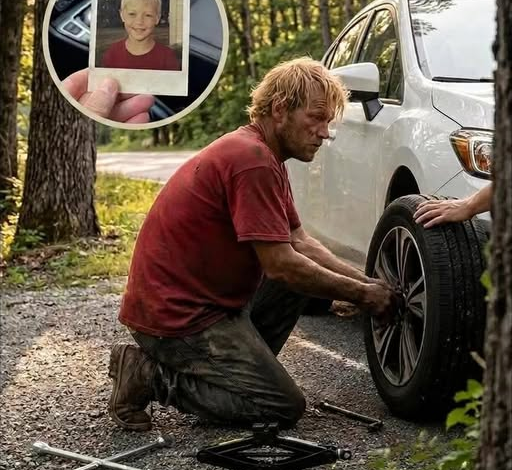
An older man stepped out.
He moved slowly but steadily, wearing a faded cap and work gloves tucked into his back pocket. He asked if she needed help. Margaret wiped her face quickly and tried to compose herself.
“I have a spare,” she said.
He nodded and changed the tire without making conversation. There was something almost careful about him, as if he understood silence better than comfort. When he finished, he stood, wiped his hands on a rag, and looked at her for the first time fully.
“You should be all right now, Margaret.”
Her body went cold.
She had never told him her name.
Before she could speak, he turned and walked back toward his truck. She called after him, but he did not answer. A passing semi roared by, shaking the shoulder, and by the time she looked again, the pickup was already pulling away.
Margaret stood beside her car, trembling.
Only after she got back inside did she see the Polaroid on the passenger seat.
It had not been there before.
Her hands shook as she picked it up.
The photograph showed Daniel at seven years old.
Red shirt.
Round cheeks.
Hair falling into his eyes.
The image was faded but unmistakable.
On the back, written in blue ink, was an address.
Margaret drove straight to the retired sheriff’s house.
Sheriff Alan Reeves had been younger when Daniel vanished, but grief had aged him in Margaret’s memory as much as time had. He opened the door with surprise, then concern when he saw her face.
She handed him the Polaroid without a word.
The change in his expression was immediate.
He looked at the picture.
Then at the address.
Then back at Margaret.
“Where did you get this?” he asked.
She told him everything.
The detour.
The tire.
The old man.
Her name.
The photograph.
Sheriff Reeves sat down slowly.
For the first time in twenty years, Margaret saw fear in his face.
“You cannot go there alone,” he said.
“Why?”
“That address belongs to relatives of Roy Bell,” he replied. “He worked maintenance along Route 9 back then. We questioned him during the investigation.”
Margaret’s throat tightened.
“And?”
“There was never enough to hold him,” Reeves said. “He had an outstanding warrant in another county, minor stuff, but enough to make him nervous. He disappeared not long after.”
Margaret looked down at the photograph.
“You think he knew something.”
“I think,” Reeves said carefully, “that someone wants you to find out now.”
He told her to wait. He said he would make calls. He said they needed to do this properly.
Margaret heard him.
Then she left anyway.
By evening, she was standing on the porch of a small house at the edge of a nearby town, staring at the address from the Polaroid. The yard was cluttered with bicycles, flowerpots, and a broken plastic wagon. A dog barked somewhere behind the fence.
When she knocked, a woman in her thirties opened the door.
She looked tired but kind.
“Yes?”
“My name is Margaret,” she said, though her voice barely held. “I’m looking for someone connected to this photograph.”
She held out the Polaroid.
The woman looked at it.
Her face changed.
Behind her, a little boy ran into the hallway holding a toy truck. He stopped when he saw Margaret.
And Margaret stopped breathing.
The shape of his face.
The eyes.
The way his hair fell forward.
For one impossible second, she was looking at Daniel again.
The woman noticed.
“That’s my son,” she said, confused. “Caleb.”
Margaret swallowed.
“And the man in the photograph?”
The woman looked down at the Polaroid again.
“That’s my husband,” she whispered. “Danny.”
The name hit Margaret like a blow.
Danny.
Not Daniel.
Not the name she had screamed across parking lots and fields and police stations.
But close enough to hurt.
The woman’s name was Kate. She let Margaret inside after a long silence, though fear moved through every part of her face.
Slowly, painfully, pieces began to surface.
Kate’s husband had been raised by a man named Roy Bell, though he rarely spoke of his childhood. Roy had always claimed that Danny’s mother abandoned him, that there were no records because the family had moved often, that asking questions only opened old wounds.
Danny had grown up quiet around certain topics.
He had no birth certificate that made sense.
No baby pictures before age seven.
No clear memory of where he came from.
Margaret showed Kate the missing-child flyer she still carried in her wallet, folded so many times the creases had become permanent.
Kate covered her mouth.
The little boy watched them from the hallway, still holding his truck.
“Where is he?” Margaret asked.
Kate gave her the address of the lumberyard where Danny worked.
Margaret found him near closing time, stacking boards beneath fluorescent lights.
He was a grown man now.
Broad-shouldered.
Weathered.
A scar near his chin.
But when he turned toward her, Margaret saw the child beneath the years so clearly that her knees almost gave way.
“Daniel,” she whispered.
He frowned.
“My name’s Danny.”
She tried to explain. The rest stop. Route 9. The red shirt. The missing child reports. The mother who had never stopped searching.
He listened with guarded confusion, as though she were telling him a story about someone else.
“I don’t remember that,” he said.
Margaret expected pain.
She did not expect how much.
Then she saw the gas station across the road.
Without thinking, she walked there and bought a cold Sprite.
When she returned, she held it out to him.
He stared at the bottle.
Condensation slid down the plastic.
His face changed.
Not all at once.
In fragments.
His hand closed around the drink.
“I had one,” he whispered.
Margaret could not breathe.
“I was wearing red.”
“Yes,” she said, tears spilling down her face.
“There were trees behind the building,” he said slowly. “I thought I saw something. Or someone. I went around back.”
His voice shook.
“I got lost.”
Margaret stepped closer.
His eyes filled.
“And you came back,” he whispered.
“I came back,” she sobbed. “I never stopped coming back.”
He looked at her then, not as a stranger, but as someone reaching across twenty years of stolen memory.
“Mom?”
The word broke both of them.
Margaret held her son in the parking lot of a lumberyard while the evening traffic passed behind them, unaware that an entire life had just returned from the dead.
Later that night, Margaret, Daniel, and Kate searched through Roy’s old belongings stored in their garage.
At first, they found only tools, work gloves, tax papers, and rusted coffee cans filled with nails.
Then Daniel pulled a locked metal box from behind a stack of old tarps.
Inside were newspaper clippings.
Missing-child reports.
Copies of Daniel’s photograph.
A map of Route 9.
And a handwritten note.
Roy’s confession.
He had found Daniel crying near the trees behind the rest stop. Daniel was lost, frightened, and unable to explain clearly where his mother was. Roy had planned to take him to the police. Then he remembered the warrant.
He panicked.
One decision became two.
Two became a lie.
A lie became a life.
He took Daniel home, renamed him Danny, and raised him as his own.
In the note, Roy wrote that he had meant to come forward many times. But each year made the truth heavier and the punishment more certain. He claimed he loved the boy.
Margaret read that line and felt something cold pass through her.
Love did not erase theft.
Love did not return birthdays.
Love did not give back school plays, lost teeth, first dates, graduations, fevers, scraped knees, or twenty years of waiting for a phone call that never came.
Roy’s fear had stolen a lifetime from both of them.
Still, Daniel had survived.
That truth stood beside every other truth.
The next morning, Margaret woke in Daniel’s guest room to the sound of small footsteps.
Caleb appeared at the doorway holding a sheet of dinosaur stickers.
“Grandma?” he asked shyly. “Do you want one?”
Margaret stared at him.
The word opened something in her chest she thought had died long ago.
She held out her hand.
“I would love one.”
He placed a green dinosaur sticker on the back of her hand with great seriousness.
In the kitchen, Daniel stood making coffee. He looked uncertain, overwhelmed, and achingly familiar. Kate touched his shoulder as she passed him, and he looked at Margaret with eyes still searching for a bridge between the life he had known and the life stolen from him.
Margaret knew healing would not be simple.
There would be legal questions.
Anger.
Grief.
Memory gaps.
Counseling.
Hard conversations.
There would be days when Daniel felt like her son and days when he felt like a stranger wearing Daniel’s face.
She would never get back his eighth birthday.
Or his first bike ride without training wheels.
Or the sound of his teenage voice changing.
Or the moment he became a man.
But she had this.
A kitchen.
A grandson.
A cold bottle of Sprite in the refrigerator.
A son who was alive.
Later, standing near the window while morning light spread across the floor, Margaret looked at the dinosaur sticker on her hand and finally allowed herself to breathe.
Route 9 had taken everything from her once.
After twenty years, it had given something back.
Not the past.
But a future.
THE END.