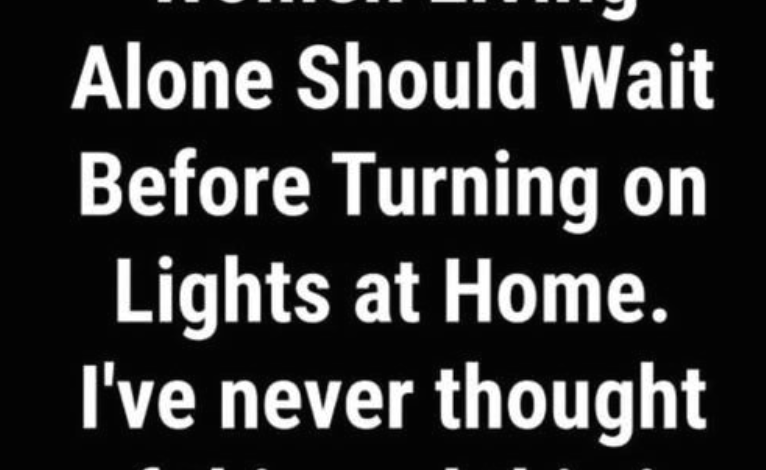
In an era dominated by smart alarms, doorbell cameras, motion sensors, and digital locks, it’s striking that one of the most resonant safety reminders circulating in early 2026 required no technology at all. A viral video shared by a woman named Mary Alice offered advice so simple it almost seemed counterintuitive: when arriving home alone at night, don’t turn on the lights immediately. In a digital landscape overflowing with sensational warnings and high-tech solutions, her message stood out for its calm practicality, focusing on personal awareness and intentional behavior rather than panic or gadgets.
Her insight struck a chord with those living alone in apartments, small houses, or compact urban spaces, where privacy can feel fragile. Humans are conditioned to associate light with security. Flipping the switch the moment we step inside is instinctive—light signals comfort, control, and a reprieve from uncertainty. But Mary Alice emphasized a subtle truth: when lights blaze on instantly in a dark environment, they announce presence. To anyone observing from outside, that sudden glow can reveal not only that someone is home but often exactly where they are.
This “instant light reflex,” as it might be called, is predictable. And predictability can reduce personal advantage. Sudden illumination provides outsiders with information: the occupant is inside, likely distracted with routine tasks, perhaps placing keys or checking their phone. By contrast, stepping inside and remaining in darkness for a brief moment keeps that information private. The home stays silent, still, unreadable. Arrival has occurred, but it has not been broadcast. That brief pause shifts control back to the person inside.
Mary Alice described that insight as stemming from lived experience rather than formal training. One evening, she sensed she might be observed—not because of a clear threat, but because of that subtle internal alert many recognize. Instead of reacting reflexively, she entered her home and stayed still. In darkness, she allowed her senses to adjust. Without interior lights creating a “fishbowl” effect—making her visible from outside while blinding her to the exterior—her eyes adapted naturally. She listened, scanned the ordinary sounds of her home, and confirmed nothing was amiss before revealing herself with light.
That quiet pause created a buffer between instinct and action. Darkness became an ally rather than an obstacle. It allowed her to orient herself, breathe, and assess her surroundings before lighting up her space. By embracing those few seconds of stillness, she reclaimed a measure of agency and control.
As her video spread online, it sparked broader conversations about vulnerability, habit, and awareness. Many viewers shared similar experiences—the unease of walking home at night, unlocking doors in dim hallways, or feeling exposed through uncovered windows. The discussion was not rooted in fear but in reflection: how much of our daily behavior is automatic, and how might those habits inadvertently reveal patterns to others? People began considering how predictable their movements might appear from the outside.
For residents of smaller homes or dwellings with large, ground-level windows, the advice was particularly poignant. Compact spaces can feel exposed, and controlling light becomes both a practical and psychological strategy. Entering in darkness allows a moment of assessment—ensuring no unusual activity outside—before becoming a focal point of visibility.
The broader appeal of Mary Alice’s message lies in empowerment. Modern security culture often frames safety as a function of devices—cameras, alarms, sensors. While those tools are valuable, her reminder underscores that awareness is equally crucial. Choosing when to be seen is a form of autonomy. Safety does not always require fear; it can come from cultivating presence and intentionality. How we move through space can be as protective as any technology.
In a society that prizes visibility, transparency, and constant connectivity, the idea of “staying dark” for even a few moments feels almost rebellious. In an age where routines, locations, and lives are broadcast through social media, notifications, and predictable patterns, her advice reminds us that strength can lie in selective invisibility. Sometimes security is less about announcing our presence and more about controlling when and how we appear.