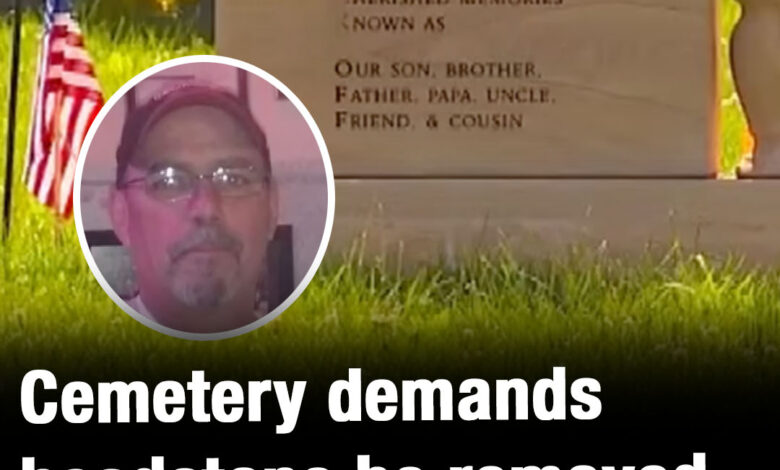
When Steven Paul Owens’ family chose the acrostic phrase for his headstone, they were not trying to shock strangers or disrespect the dead.
They believed they were honoring him exactly as he had lived.
To them, the hidden message captured the man better than any polished tribute ever could. It reflected his dry humor, his stubborn personality, his rough-edged tenderness, and the strange affectionate language that only families fully understand. From Steven, a phrase like “f**k off” did not always mean rejection. Sometimes it meant closeness. Sometimes it meant you had been accepted. Sometimes it was the kind of gruff, familiar joke that said more about love than softer words ever could.
So when his relatives arranged the inscription, they saw it as a final private laugh shared with someone they were grieving.
Not vandalism.
Not cruelty.
Not an attack on sacred ground.
Grief, in their case, did not arrive only through tears and solemn language. It arrived through humor — the kind of dark, defiant humor that helps people survive loss when ordinary comfort feels too fragile. The acrostic became a way of keeping Steven’s personality alive in a place usually shaped by restraint. It was mourning disguised as mischief. Love hidden inside irreverence. A final inside joke carved into stone.
But cemeteries are complicated places because they are never entirely private.
A grave belongs emotionally to a family, but physically it exists in shared space. Other mourners walk past it. Children notice it. Visitors stop nearby to grieve their own dead. What feels intimate and meaningful to one family can feel jarring or inappropriate to another.
That was where the conflict began.
For the trustees of Warren-Powers Cemetery, the hidden phrase represented something very different from what the family intended. They did not see only a grieving family’s private joke. They saw a line being crossed in a place meant for quiet reflection, dignity, and communal sorrow.
Their concern was not simply about one word or one stone.
It was about precedent.
If one family could hide profanity in a memorial, what would prevent another from going further? What would stop future headstones from becoming more provocative, more sarcastic, more confrontational? Could a cemetery gradually shift from a place of remembrance into a contest of shock value, where each inscription pushed harder than the last?
Those questions mattered to the trustees because cemetery rules are often built around shared expectations. Families may grieve differently, but the space itself depends on a fragile agreement: that memorials should honor the dead without disturbing the grief of others.
The trustees worried about children discovering the hidden message. They worried about families visiting nearby graves and feeling uncomfortable. They worried that people might avoid purchasing plots close to a stone they considered offensive. They worried, more broadly, that allowing one exception would weaken their ability to maintain standards for everyone else.
To them, the issue was not whether Steven had been loved.
Clearly, he had.
The issue was whether private love gave a family the right to place an inside joke in a public cemetery when that joke used language others might find disrespectful.
That is what made the dispute so painful.
Both sides believed they were defending something sacred.
Steven’s family believed they were defending memory — not a sanitized version of him, but the real man, with all his humor, sharpness, affection, and flaws intact. They did not want a generic tribute that could have belonged to anyone. They wanted his marker to sound like him.
The cemetery trustees believed they were defending the dignity of the space itself. They were responsible not only for one grave, but for every family who came there to mourn. In their view, a cemetery could not function if every memorial became an unrestricted expression of personal style, especially when that expression might offend or unsettle others.
At the heart of the argument was a deeper question:
Who gets to decide what respect looks like after death?
For some families, respect means formality. It means scripture, dates, beloved roles, and carefully chosen words that fit within tradition.
Loving father.
Devoted husband.
Forever in our hearts.
For other families, respect means honesty. It means remembering someone as they actually were, not as a cemetery template might prefer them to be. It means preserving the jokes, the rough edges, the phrases, the contradictions, and the personality that made the person irreplaceable.
Steven’s headstone sat directly between those two understandings.
To his family, the acrostic was tender because it was true to him.
To the trustees, it was inappropriate because truth still had to live within boundaries.
And years later, that tension remains unresolved in a way that feels almost symbolic. The stone still stands. The hidden message remains. So does the discomfort around it.
The argument has outlived the initial shock because it touches something larger than one cemetery or one family. It asks whether graves are primarily private memorials for the people who loved the deceased, or public monuments that must obey a shared code of conduct.
The answer is not simple.
A grave marker is personal, but it is not invisible.
A cemetery is public, but it is filled with private pain.
A family’s grief is sacred, but so is another family’s need for peace.
That is why the Owens headstone continues to provoke debate. It forces people to confront the messy reality of mourning: love is not always polite, memory is not always tasteful, and grief does not always speak in language suitable for everyone.
Sometimes the words that mean the most inside a family sound offensive outside it.
Sometimes the truest tribute to a person is exactly the one strangers least understand.
And sometimes a cemetery, meant to hold final answers, becomes the setting for a question nobody can fully settle.
In Warren-Powers Cemetery, Steven Paul Owens’ headstone remains both memorial and argument.
To his family, it is one last laugh with a man they loved deeply.
To the trustees, it is a warning about what happens when private expression presses too hard against public reverence.
And between those two views sits the stubborn, painful truth at the center of the dispute:
The dead belong to those who loved them.
But cemeteries belong, in some measure, to everyone who comes there carrying grief.