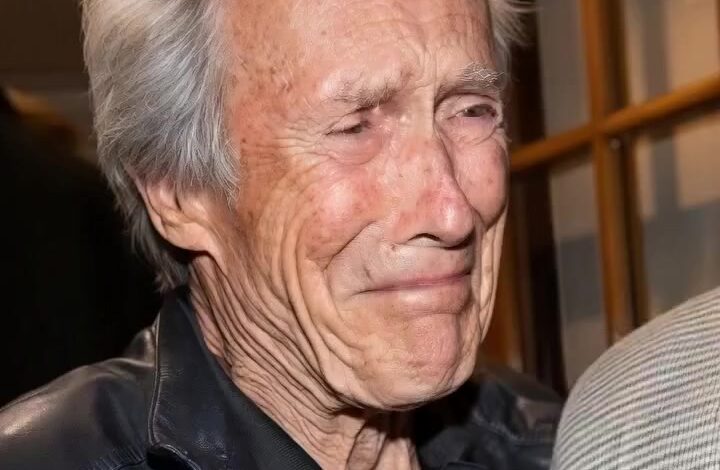
For generations of moviegoers, Clint Eastwood never seemed like someone who could become fragile.
He moved through cinema history with a presence that felt almost carved from stone. The narrowed eyes. The slow, controlled voice. The silence that could feel more threatening than shouting. The stillness of a man who seemed impossible to rush, impossible to frighten, and impossible to break.
Even people who never followed westerns closely understood what Clint Eastwood represented.
Strength.
Control.
Endurance.
A kind of weathered masculinity that did not explain itself.
He became one of those rare figures whose image stretched far beyond the films themselves. To some, he was the gunslinger emerging through desert dust. To others, he was the hard-edged detective standing alone against corruption. Later, he became the aging man carrying regret, grief, and stubborn dignity through quieter, more reflective stories.
The characters changed over time.
But the impression remained the same:
Clint Eastwood endured.
That is why reports of serious health struggles surrounding him land with such unusual emotional weight. The reaction is not only about celebrity. It is about the strange way certain public figures become tied to people’s private sense of permanence.
Audiences age with them.
They remember watching them with parents, grandparents, friends, or spouses. They remember old television broadcasts, rented tapes, theater seats, familiar lines, and the particular silence that settled over a room when Eastwood appeared onscreen. His face became part of cultural memory, and cultural memory often resists the idea that its icons can weaken.
In memory, Clint Eastwood is always standing.
Always watching.
Always waiting.
Always walking toward danger without flinching.
So when the public is asked to imagine him not as a legend, but as a man facing the limits of the body, something shifts emotionally.
The myth becomes human.
His children’s statement carried that tension carefully. They did not offer every medical detail, and perhaps that restraint mattered. What they made clear was enough: their father is facing serious health challenges and receiving ongoing care.
But beneath the words, what many people heard most clearly was not panic.
It was protection.
The statement felt less like a public announcement and more like a family drawing close around someone they love. They asked for compassion. For privacy. For understanding. For the space to navigate a painful chapter without turning every detail into public property.
That request matters because illness changes the relationship between celebrity and audience.
Public figures spend decades becoming symbols. They become larger than ordinary life. Their faces sell tickets, shape trends, define eras, and carry meanings far beyond themselves. But sickness strips that mythology down very quickly.
Suddenly, the icon becomes simply a person.
Someone’s father.
Someone’s grandfather.
Someone sitting through appointments.
Someone surrounded by worried family members.
Someone needing care, patience, and tenderness.
That transition can feel jarring because Clint Eastwood’s public image has always been connected so deeply to resilience.
From the beginning, his career revolved around men who survived harsh worlds through nerve, silence, and willpower. The “Man with No Name” barely spoke, yet seemed to command every duel before it began. Dirty Harry became one of American cinema’s most famous embodiments of relentless toughness, a figure defined by suspicion, force, and uncompromising moral certainty.
For decades, Eastwood seemed to understand the power of restraint. He did not need long speeches to dominate a scene. He could shift the entire atmosphere with a glance. His characters often carried violence, loneliness, and pain without asking anyone to soften the world for them.
That was part of the legend.
But what made his later career especially meaningful was that he eventually allowed age itself to enter the story.
He did not simply try to preserve the illusion of youth. Instead, he began exploring what happens when the men who once appeared invincible are forced to confront consequence, regret, weakness, and memory.
Unforgiven dismantled the mythology of violence.
Million Dollar Baby explored grief, mercy, and unbearable moral choices.
Gran Torino turned an aging, isolated man into someone forced to rediscover connection in the final stretch of life.
Again and again, Eastwood’s later work returned to a quieter truth:
Strength is not the absence of pain.
Sometimes strength is what remains after pain has done its damage.
That is why this current chapter feels so poignant. The man who spent a lifetime portraying endurance is now facing the most universal truth there is: every body eventually becomes vulnerable, no matter how powerful the legend around it may be.
Age reaches everyone.
Even the people who once seemed immune to it.
Still, his children’s message also emphasized resilience, and that word feels almost inseparable from Clint Eastwood. Not only because of his screen persona, but because of the career he built across decade after decade in one of the most unforgiving industries in the world.
Few entertainers have remained culturally relevant for so long. Eastwood moved from television to westerns, from acting to directing, from action icon to Oscar-winning filmmaker, from box-office draw to elder statesman of American cinema. He survived changing film eras, shifting public tastes, political controversy, and an industry that often discards aging stars as soon as they no longer fit the image of youth.
He kept working.
That alone became part of the mythology.
Actor.
Director.
Producer.
Composer.
Storyteller.
Again and again, he adapted without entirely surrendering the qualities that made him recognizable. Discipline. Calm. Focus. Control. A stubborn refusal to disappear.
People who worked with him often described him as steady, efficient, and deeply committed to the work. That steadiness appears to be something his family recognized privately as well. His children spoke not only of his public achievements, but of his presence in their lives — the guidance, the example, the quiet force of someone who had been an anchor for them.
That difference matters.
Fans remember the films.
Families remember the man between them.
They remember advice given without cameras present. They remember humor, habits, routines, ordinary conversations, and the feeling of someone’s voice in a room. They remember the version of a person the public never fully gets to see.
Illness makes those private things feel suddenly fragile.
That may be why so many public reactions have carried tenderness rather than simple curiosity. People have revisited old scenes, favorite performances, interviews, and lines that shaped their understanding of him. They are not doing this because nostalgia can change medical reality. They are doing it because memory is one of the few ways people know how to hold onto someone whose presence has mattered to them from a distance.
For Clint Eastwood, that emotional imprint stretches across generations.
He represented a certain kind of American cinematic figure: reserved, severe, capable, morally complicated, often wounded beneath the surface. His characters did not always ask to be liked. They were not always gentle. Sometimes they were troubling. Sometimes they reflected values that modern audiences now question more critically.
But even criticism acknowledges weight.
Eastwood’s screen presence mattered because it could not easily be ignored. He became part of the vocabulary of film itself — a shorthand for toughness, silence, danger, regret, and survival.
Now, as uncertainty surrounds his health, those decades of accumulated memory feel newly precious.
There is another layer to the sadness too.
Clint Eastwood belongs to a shrinking generation of Hollywood giants whose careers connect modern audiences to earlier worlds of cinema. Through him, viewers can still trace a line back to the western boom, the gritty crime dramas of the 1970s, the old studio era, the rise of the actor-director, and a slower style of movie stardom that existed before celebrity became constant digital exposure.
His career contains pieces of several vanished eras.
That makes concern for him feel larger than concern for one actor alone. It feels like watching a bridge to the past grow fragile.
When figures like Eastwood age, audiences are forced to confront not only personal mortality, but cultural mortality as well. Entire styles of filmmaking, entire ideas of stardom, entire ways of watching movies seem to recede with them.
Still, the most human part of this moment remains the simplest:
He is not facing it alone.
Whatever the public may feel, his family is closest to the reality of it. They are the ones navigating appointments, conversations, worry, hope, and the daily tenderness that illness requires. They know him not as an icon frozen in memory, but as a father and grandfather living through a difficult chapter with the people who love him nearby.
That is the part that cuts through the mythology.
Because in the end, fame does not protect anyone from needing what every person needs when life becomes uncertain.
Comfort.
Patience.
Privacy.
Love.
A hand nearby.
A room where you are not expected to perform strength.
The public sees Clint Eastwood as a legend.
His family sees the man.
And somewhere between those two identities rests the emotional force of this moment.
Millions of fans are hoping that the same quiet steel that defined so much of his public life still remains within him now. Maybe that hope is partly projection. Maybe audiences are reaching for the stories they know best — the lone figure who keeps standing, the old fighter who refuses to surrender, the weathered survivor walking forward despite impossible odds.
But that is what Clint Eastwood has represented for so long.
Survival.
Not easy survival.
Not untouched survival.
Survival marked by age, loss, consequence, and pain.
So as uncertainty surrounds this difficult chapter, people are holding onto the image they have carried for decades: a man who endured when the world expected him to fall, a figure who made silence feel powerful, and a storyteller who taught generations that strength often looks quietest when it is most tested.
The legend may now be facing human frailty.
But perhaps that does not diminish him.
Perhaps it completes the story.
Because even the strongest figures eventually remind us that endurance is not about being unbreakable forever.
It is about meeting vulnerability with whatever courage remains.