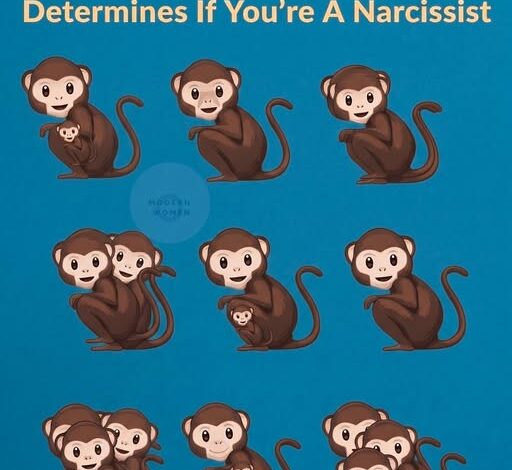
Stop what you are doing for a moment, because the internet has found another psychological “test” so simple, so strange, and so oddly addictive that people everywhere are questioning what it says about them.
At first glance, it looks harmless.
Just a drawing of brown monkeys arranged in a busy pattern.
Nothing dramatic.
Nothing threatening.
Nothing that should make anyone rethink their personality.
And yet, according to the viral claim spreading across social media, the number of monkey faces you spot in the image may reveal something unsettling about your inner life. Are you secretly self-absorbed? Are you emotionally balanced? Or are you the kind of deeply sensitive person who notices everyone and everything before thinking of yourself?
The answer, supposedly, is hidden in plain sight.
That is why the image has become so irresistible.
People love personality tests because they promise quick access to something we all secretly want: a clearer explanation of ourselves. We take quizzes about attachment styles, love languages, personality types, emotional intelligence, childhood wounds, leadership styles, and hidden fears. We click because we want a label, a mirror, a shortcut to understanding why we are the way we are.
A visual puzzle makes that temptation even stronger.
It feels objective.
You are not answering emotional questions. You are not choosing between vague statements. You are simply looking at an image and counting what you see. That makes the result feel strangely credible, even when the science behind it is thin or nonexistent.
The monkey test works because it disguises entertainment as revelation.
The rules are simple: stare at the image for about fifteen seconds and count every monkey face you can find. Not just the obvious ones. Look for the smaller faces too — the hidden ones tucked into the design, the baby monkeys clinging to larger figures, and the faces that seem to appear only after your eyes adjust to the pattern.
Then your number places you into one of three supposed personality categories.
If you count exactly nine monkeys, the viral explanation claims you are seeing only the most obvious figures. According to the story attached to the puzzle, that may suggest narcissistic tendencies. The idea is that you focus on the big picture so strongly that you miss subtle details, especially the smaller figures hidden inside the scene.
In the dramatic language of the internet, this supposedly means you move through life as the main character.
You notice what is large, obvious, and directly relevant to you. You act quickly. You trust your first impression. You may be confident, decisive, and efficient, but you might also overlook emotional nuance. The viral interpretation paints this result as a warning sign: maybe you are so focused on your own path that you fail to notice the people quietly depending on you.
It is an intense conclusion to draw from a monkey picture.
But that is exactly why people keep sharing it.
If you count somewhere between ten and fourteen monkeys, the test places you in the so-called balanced zone. According to the viral narrative, this means you noticed more than the obvious figures but did not obsessively search every corner of the image. You saw the main monkeys and picked up on some of the smaller ones, suggesting a healthy mix of awareness and practicality.
In this interpretation, you are empathetic without losing yourself.
You care about others, but you still maintain boundaries. You notice people’s needs, but you do not drown in them. You are thoughtful, steady, observant, and emotionally available without becoming overwhelmed by every hidden detail around you.
The internet loves this category because it feels reassuring.
Not too selfish.
Not too intense.
Not oblivious.
Not overburdened.
Just balanced.
Then there is the final group: the people who count fifteen, sixteen, or even seventeen monkeys.
According to the viral test, these people are the opposite of narcissists. They are described as empaths — highly sensitive, deeply observant individuals who notice not only the obvious figures, but the hidden ones pushed into the background. They are said to be emotionally tuned in, careful, compassionate, and almost unable to ignore what others miss.
On the surface, this sounds flattering.
You see what others overlook.
You recognize vulnerability.
You are aware of the quiet figures in the shadows.
But the test usually attaches a warning to this result as well. If you saw nearly every monkey, it suggests you may overthink, overanalyze, and exhaust yourself by trying to notice every need in every room. You may be the person who senses tension before anyone speaks, checks on others before being asked, and carries emotional weight that was never fully yours to carry.
That makes the test feel more layered than a normal puzzle.
It flatters and unsettles at the same time.
But before anyone starts diagnosing themselves based on cartoon monkeys, it is important to slow down and return to reality.
An optical illusion cannot determine whether someone is a narcissist.
It cannot diagnose Narcissistic Personality Disorder. It cannot measure empathy with clinical precision. It cannot reveal your moral character, your capacity for love, or your emotional depth based on a fifteen-second glance at an illustration.
Narcissistic Personality Disorder is a complex mental health condition involving long-term patterns of grandiosity, need for admiration, difficulty with empathy, and interpersonal dysfunction. It cannot be identified through a viral image, a social media quiz, or a quick visual count. Diagnosis requires careful evaluation by a trained mental health professional, not a monkey puzzle on a phone screen.
So why do people see different numbers?
The answer is not hidden narcissism.
It is visual processing.
Our brains are designed to work efficiently. They constantly take shortcuts to organize the overwhelming amount of information entering through our eyes. Instead of examining every detail equally, the brain groups similar shapes together, focuses on the most prominent forms, and quickly decides what matters most.
This is why some people immediately see the large monkey faces and stop there.
Their brains have identified the main pattern and moved on.
That does not make them selfish.
It may simply mean they process images quickly and efficiently, prioritizing the dominant structure over smaller hidden details.
Other people naturally search longer. Their brains enjoy detail, pattern disruption, and hidden elements. They may be more patient with visual complexity, more suspicious of first impressions, or simply more interested in puzzles. That does not automatically make them more empathetic or morally superior.
It just means they looked differently.
Someone who sees nine monkeys may be efficient.
Someone who sees fourteen may be moderately detail-oriented.
Someone who sees seventeen may enjoy careful visual scanning.
None of those results proves whether a person is kind, selfish, sensitive, manipulative, generous, or emotionally mature.
The danger comes when entertainment begins pretending to be psychology.
Viral tests often work by taking a tiny behavior and attaching an enormous meaning to it. They turn a visual habit into a personality judgment. They make people feel exposed, praised, or accused based on something that may have more to do with lighting, screen size, attention span, image quality, or whether they had coffee that morning.
Still, there is a reason these puzzles keep spreading.
They are fun.
They give people something easy to compare. They create quick conversations. They make group chats light up with arguments over who saw what first. They let people laugh at themselves and each other without needing anything too serious at stake.
And sometimes, they do reveal something — just not what they claim.
They may show how patient you are with visual puzzles.
They may show whether you trust your first impression.
They may show how much time you are willing to spend searching for hidden details.
They may show whether you enjoy proving the internet wrong.
That is useful in its own small way.
But it is not a clinical truth.
At the end of the day, the monkey test is best understood as a playful optical challenge, not a window into your soul. It can spark curiosity, conversation, and a little friendly competition, but it should not be used to label yourself or anyone else as narcissistic, balanced, or empathic.
Human beings are far more complicated than that.
Your personality cannot be reduced to the number of animals you count in a busy drawing. Your empathy is shown in how you treat people, how you listen, how you repair harm, how you respect boundaries, and how you respond when someone else is vulnerable.
Not in whether you spotted a baby monkey hiding in the corner of an image.
So take the test if you want.
Send it to your friends.
Compare answers.
Laugh about who saw nine and who insisted there were seventeen.
Argue over whether one face “counts.”
But do not let a viral puzzle decide your self-worth.
The monkeys may be fun.
They are not your mirror.