Build a door if they won’t give you one.
I was eleven the first time Aunt Linda wrote that sentence to me.
It came in one of her cards, tucked between a birthday message and a folded five-dollar bill. At the time, I did not understand what she meant. Doors were things adults opened and closed. They were part of houses, not lives.
Still, I kept the card.
I kept all of them.
They lived in a box under my bed, tied together with an old ribbon, the way children preserve things that feel important before they know why. Over the years, Aunt Linda’s blue-ink messages became a private language I carried without fully understanding.
You are not the problem.
Keep the receipts.
Do not let them rename your work.
Build a door if they won’t give you one.
By the time I was nineteen, with a Stanford acceptance letter taped to my bedroom wall and my parents canceling my graduation party to protect my sister Amber’s feelings, I understood every word.
The cancellation happened on a Wednesday.
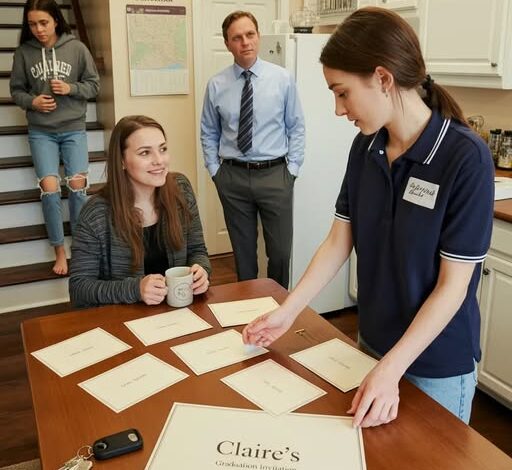
Amber had come home from a friend’s house and found the centerpiece samples I had picked up from the dollar store sitting on the kitchen table. They were cheap glass jars, cream ribbons, and small artificial flowers I had arranged myself because I knew better than to ask for anything expensive.
But Amber had a complicated relationship with things that were not about her.
So she cried.
She told my parents I was trying to make her feel left behind. She said it was unfair that I got to have something big when she was struggling. She said everyone would compare us. She said my party would make her feel like a failure.
My parents spent the evening mediating her pain.
I spent the evening doing math homework at the kitchen table while it happened, because what else was I supposed to do?
I had spent most of my adolescence learning to exist beside the weather system created by Amber’s feelings about my life. I had gotten good at it in the way people get good at things that hurt them repeatedly.
You learn the muscle memory of disappearing.
You learn to keep your face still.
Your voice even.
Your movements small.
Your needs smaller.
In our family, attention had always been a fixed resource, and Amber was the largest line item in the budget.
By Thursday morning, my mother told me gently that maybe a smaller dinner would be better.
Fewer people.
Less fuss.
Something intimate.
“We can still make it special,” she said, “without making it so much.”
What she meant was: we are asking you to reduce yourself until Amber is comfortable with the size of you.
I said okay.
I said it the way I had been saying okay my entire life — carefully, quietly, without expression. My family always interpreted that tone as agreement. It was not agreement. It was management.
It was the quiet calculation of a person who had learned that objection did not lead to resolution. It only led to escalation.
That night, I sat at my desk and looked at my Stanford letter for a long time.
The seal.
The formal language.
The words: We are pleased to inform you.
Behind it, paper-clipped neatly, was the printed email confirming my full scholarship.
I had earned it myself.
My application.
My essays.
My test scores.
My after-school jobs.
My weekends at the library.
My careful savings.
My quiet hope.
My parents had not helped me apply. They had not even known I was applying until a week before the decisions came out. I had not told them because by junior year I had already learned that hope is safer when kept private around people who have a complicated relationship with your success.
That sounds strategic.
It was not entirely strategic.
It was also what self-protection often looks like before you know to call it that: a gradual narrowing of what you share until the only things left are the ones no one else can damage with the wrong reaction.
College applications turned out to be something I was very good at keeping to myself.
That night, I thought about Aunt Linda’s cards.
I pulled the box from under my bed and read them again, one by one. The blue ink. The firm handwriting. The sentences that had always felt too serious for birthday cards and holiday envelopes.
Build a door if they won’t give you one.
For the first time, I understood that it was not encouragement.
It was instruction.
So I took out a piece of paper and wrote her a letter.
I kept it factual, the way Aunt Linda would have wanted. I told her I had gotten into Stanford. I told her about the scholarship. I told her I had been saving money from weekend shifts since I was sixteen, enough to cover my deposit, my flight, and the first few months of incidentals if I was careful.
Then I told her about the graduation party.
I told her what had happened to it.
Finally, I wrote the sentence that made my hand pause.
If things at home become unstable, can I list you as my emergency contact?
I stared at that line for almost a full minute.
Then I sealed the letter before I could talk myself out of sending it.
At ten-thirty that night, I walked to the mailbox at the end of the street and dropped it in.
Two weeks later, my parents found the envelope.
They came to my room to tell me the party was officially canceled. Not reduced anymore. Not modified. Canceled.
A family dinner instead.
Just us.
Amber needed support right now, they said. I was strong. I could handle it. I always handled things so well.
That last sentence had followed me my entire life.
You handle things so well.
As if being capable meant I was safe to deprive.
As if managing pain without making everyone uncomfortable was a personality trait rather than a skill I had developed because no one else was managing anything for me.
I let them finish.
Then I said, “I mailed Aunt Linda the truth.”
Nobody moved.
My mother’s voice lost its usual smoothness.
“What truth?”
My father stepped into my room.
“Give me the envelope.”
“No.”
That word had always carried different weight in our house depending on who said it.
Amber’s no meant she was fragile.
My no meant I was difficult.
“You are still under my roof,” my father said.
“And I am leaving it,” I answered.
Then I opened the folder on my desk.
It had been sitting there for two weeks, waiting for exactly this conversation.
I laid the documents out one at a time.
Campus housing confirmation.
Bank statement.
Summer bridge program email.
Printed bus schedule.
My shift calendar, every Saturday circled in red.
Twenty months of Saturdays.
My father picked up the bank statement first.
His expression changed when he reached the balance.
“How did you save this much?”
I told him the truth.
“I did it while everyone was talking about Amber.”
My mother flinched.
Amber, standing halfway up the stairs, looked down.
My father picked up the Stanford acceptance letter, and I moved faster than I expected to. I put my hand flat over the page before he could lift it.
He stared at my fingers.
“You don’t get to touch that,” I said.
His laugh came out wrong.
Sharp. Thin. Almost nervous.
“You’re acting like we abused you.”
There it was.
The family trapdoor.
The moment when someone suggests the wound is not large enough, and suddenly the bleeding becomes bad manners.
I did not argue.
Instead, I pulled out one more page.
A list.
Every application fee I had paid myself.
Every shift I had worked.
Every school event they had missed because Amber had a recital, a crisis, or a conflict.
Every time her wants had been treated as needs while my needs were treated as optional.
New phone: $899.
Dance trip: $1,240.
Car repair after she backed into a mailbox: $1,700.
Stanford deposit: paid by me.
Application fees: paid by me.
Graduation invitations: designed, printed, and paid for by me.
“These aren’t receipts,” I said.
My mother looked at the page with trembling hands.
“Then what are they?”
“A map.”
“A map to what?”
I looked at her.
“To the door I built.”
That was when Amber came into the room.
She was barefoot, hoodie sleeves pulled over her hands, her face smaller somehow without the performance that usually filled it.
“Did you write Aunt Linda about me?” she asked.
I looked at my sister for a long moment before answering.
For years, I had thought Amber was the thing that had happened to me. The person who had taken the attention that should have been shared. The person whose feelings rearranged every room, every holiday, every celebration, every decision.
But standing there in my doorway, she looked less like a villain and more like a girl who had been taught that helplessness was useful. That in our family, the person who needed the most managing received the most love.
That did not make what she had done harmless.
It only meant the damage was older than either of us.
“I wrote Aunt Linda about me,” I said. “You were just part of the weather.”
My mother immediately turned toward Amber when her eyes filled.
The reflexive pivot.
The same movement I had watched my whole life.
But then Amber surprised all of us.
“No,” she said.
The word came out harder than expected.
My mother froze.
Amber looked at the folder on my desk, then at me.
“Were you really going to leave?”
“I am really going to leave.”
“But graduation is in ten days.”
“I know.”
“And the party?”
I laughed once.
It did not sound happy.
“You got what you wanted.”
For the first time in my memory, Amber looked ashamed.
Not enough to undo anything.
But enough for the mask to slip.
“I didn’t think they’d actually cancel it,” she whispered.
My father said loudly, “This is not your fault.”
Amber turned to him.
“Then whose is it?”
Nobody answered.
That was the first honest family meeting we ever had.
At eleven-fifteen that night, after my parents finally left my room, I texted Aunt Linda one sentence:
I need the door now.
She replied in under a minute.
I’m leaving at 2. Be ready.
She drove four hours through rain in a navy sweatshirt and old jeans, her hair clipped back, no makeup, no announcement.
My father opened the front door in the morning and went completely still.
Aunt Linda looked past him.
“Where is she?”
My mother appeared behind him.
“This is family business.”
Aunt Linda said, “I’m family.”
Then she stepped around both of them and came upstairs.
My suitcase was already packed.
Two duffel bags.
One backpack.
The folder.
Amber was sitting on the hallway floor outside my room, knees drawn to her chest, watching me zip the last pocket. She had not slept.
Aunt Linda stood in my doorway and looked at the Stanford letter on the wall, the empty hangers, the cap and gown folded neatly across my bed.
Then she looked at me and said, “Oh, sweetheart.”
That nearly broke me in a way the yelling never had.
Kindness was always the thing I had the least defense against.
I had spent so many years learning how to be untouched by the opposite.
My father tried to block the stairs.
Aunt Linda told him to move.
She did not raise her voice. She did not need to. She spoke with the calm of someone who had decided before she ever got in the car.
“You’re encouraging her to destroy this family,” my father said.
“No,” Aunt Linda replied. “I’m helping her survive it.”
My mother was crying by then.
“We can still have the dinner,” she said.
I stopped on the stairs.
“The dinner was never the point.”
My father’s face hardened.
“You’ll come crawling back when you realize the world doesn’t care about your feelings.”
I looked at him for a moment.
“That’s fine,” I said. “I already learned how to live without people caring.”
Amber followed us to the porch.
The morning was dark and wet. Rain had come through the night, leaving the driveway slick and the air smelling like grass and cold pavement.
Just before I got into Aunt Linda’s car, Amber touched my sleeve.
“I’m sorry,” she said.
It was small.
Late.
Insufficient for everything it was trying to address.
But it was not nothing.
I nodded.
Then I left.
I did graduate.
Aunt Linda sat in the front row with a bouquet of yellow tulips and cried so hard the woman beside her offered tissues.
My parents did not come.
Amber did.
She stood near the back in a blue dress, holding one of the cream invitations I had thought my mother had thrown away. She did not try to hug me afterward. She only said, “You looked happy up there.”
“I was,” I told her.
She nodded like that answer hurt and helped at the same time.
Then she handed me a small envelope.
Inside was eighty-six dollars in cash.
“I sold my phone case collection,” she said. “I know it’s not enough for anything big.”
I looked at the money in my hand.
Then I looked at her.
“It’s enough to mean something.”
It was the first time in my memory that my sister had given me something without making sure everyone was watching.
Stanford was not the transformation the acceptance letter had made it seem it might be.
It was hard.
Harder than I expected.
Scholarships covered tuition, but not every hidden cost of belonging. Not winter coats, printer fees, dorm supplies, unexpected books, medicine, bus rides, or the quiet humiliation of realizing other students had parents who shipped care packages because they noticed when their children were tired.
Some nights I ate instant noodles in the dorm kitchen while students FaceTimed families who asked about classes, roommates, weather, laundry, and whether they were eating enough.
I had known those families existed.
Living beside them was different.
It created a silence inside me I had to learn to interpret correctly. That silence was not proof I was unsuited for the life I had chosen. It was information about what I had been deprived of.
The academic work was harder than I had anticipated and exactly as demanding as I needed.
At home, I had always been good at school in the quiet way of students who succeed without fanfare. High grades. Papers returned without comment because nothing was wrong with them. No celebration. No special dinner. No one asking how I had done it.
At Stanford, the work noticed me.
Professors wrote comments in the margins that I read twice because I did not trust them the first time. Classmates asked me to explain my thinking in ways that suggested my thinking was worth understanding.
That should not have felt extraordinary.
It did.
Aunt Linda called every Sunday.
Not long calls. Not dramatic ones.
Just steady questions.
Did you eat?
Are your shoes holding up?
Do you need anything practical?
Tell me one thing you learned this week that made your brain light up.
That last question saved me more than once.
Sometimes I answered it for twenty minutes, sprawled on my dorm room floor, talking about a lecture, an article, a line from a book, or something a professor had said. Aunt Linda listened without interrupting, without redirecting, without making my excitement too large for the room.
Attention is not complicated.
It is just rare.
Before I had it consistently, I had not understood how much of my energy had been spent surviving its absence.
By winter, the summer bridge research project I had joined had become something more personal. I started studying first-generation scholarship students and the fragile months between acceptance and arrival — the period when family instability could quietly derail everything.
The research was personal.
I did not hide that.
By spring, it had become a presentation.
By fall, my team submitted the project to a national youth research grant competition.
We won.
A local news station ran a short feature. Stanford put us in a student spotlight.
The headline was simple:
Stanford Student Builds Support Tool for Teens Leaving Unstable Homes.
In the clip, I said, “Sometimes the hardest part is not getting accepted. It is believing you are allowed to go.”
My parents saw it on the evening news.
Amber called to tell me how it landed.
My father had been standing with the remote in his hand. My mother sat down slowly when my face appeared on screen. When Amber turned up the volume, they heard me speak about the summer before college, about the loneliness of living in the gap between where you had been and where you were going.
My father turned off the television before the segment ended.
Amber turned it back on.
The calls began two days later.
My mother first.
Then my father.
Then my mother again.
I let them ring until Sunday afternoon, when I was sitting beneath a eucalyptus tree outside the library with a book I had not managed to read.
My mother’s voice was careful when I answered.
Rehearsed.
“We saw you on the news,” she said.
“I heard.”
“You looked beautiful.”
I closed my eyes.
Some compliments arrive so far past their expiration date that they feel like mail forwarded from an address you moved out of years ago.
“Thank you,” I said.
Then my father came on the line.
He sounded older than angry.
That was new.
“We made mistakes,” he said.
I waited.
“We should have come to graduation. We should not have canceled the party.”
Another silence.
Then the sentence I least expected from him:
“I don’t know how to fix this.”
It was the first true thing he had said to me in years.
So I gave him one back.
“You don’t fix it by wanting me back,” I said. “You fix it by becoming someone I can safely visit.”
My mother started crying.
I did not comfort her.
That was new too.
It was not cruelty. It was the recognition that I had spent most of my life doing other people’s emotional maintenance, and stopping felt violent only because I had been trained to believe it was my job.
I did not go home for Thanksgiving that year.
I went to Aunt Linda’s apartment.
She made a roast that was too salty and a salad that was mostly croutons. She poured me one glass of wine and asked about three professors by name because she remembered the stories I had told her.
Amber came too, unexpectedly.
She brought a store-bought pie and a quiet that was different from her usual quiet. Less performed. More present.
She apologized to Aunt Linda for believing everything our father had said about her.
Aunt Linda accepted the apology and handed her a potato peeler.
“Healing should still involve labor,” she said.
Amber laughed.
It was unexpected and real.
By Christmas, Amber was in therapy.
By spring, she had moved out of our parents’ house and into a shared apartment with two women from community college.
My mother texted me a photograph of the graduation decorations she had found in the garage: the banner I made, the dollar-store centerpiece samples, and a handful of balloons half-deflated against a shelf.
I did not ask what she did with them.
My father mailed a check.
Two thousand dollars.
The note said: For the deposit I should have helped with.
I deposited it.
Then I donated the same amount to the bridge program’s emergency fund for first-generation students facing unexpected costs in their first semester.
Some money should keep moving until it reaches the people who needed it most.
I came home two years after I left.
Not to move back.
Not to perform forgiveness I had not reached.
I came to visit, on my terms, for one autumn weekend when the drive was good, my work was done, and I felt, for the first time, that I could walk into that house without needing anything from it.
There is a difference between visiting a place and returning to it.
I needed to be certain which one I was doing.
I was visiting.
I had a return ticket.
My life was elsewhere, built by my own hands, and no one in that house had the power to make it smaller anymore.
By then, the research project had grown into something I had never anticipated. What began as a campus presentation had become a small nonprofit — nothing elaborate, just a network of peer mentors and an emergency fund for first-generation students facing family instability around college transitions.
Three universities had reached out about piloting the model.
Aunt Linda agreed to join the advisory board.
“I’ll only do it if I’m allowed to be honest when something isn’t working,” she said.
“That’s the only reason I asked you,” I told her.
When I walked into my parents’ house that weekend, the Stanford article was framed in the hallway.
It hung beside Amber’s old dance recital photos.
Beside it, finally, were my honor cords from sophomore year.
My father stood near the frame with the expression of a man unsure whether he had earned the right to be proud of something he had once tried to shrink.
I let him stand there with that uncertainty.
I did not resolve it for him.
That was another kind of freedom: knowing which silences to fill and which to leave alone because filling them would cost too much.
Amber opened the door wider before either of our parents could make the moment into something it was not.
“You’re here,” she said.
“I told you I would be.”
Dinner was quiet in the careful way of people learning one another’s new edges.
Nobody asked me to minimize anything.
At one point, my mother started to describe Amber as having been “sensitive back then.”
Amber put her fork down.
“No,” she said. “I was selfish. You don’t have to soften it.”
My mother looked startled.
Then she nodded.
Progress is not always beautiful.
Sometimes it is just one person refusing the old story long enough for a new one to begin.
After dinner, I went upstairs to my old room.
The Stanford letter was gone from the wall, but the tape marks remained — four pale rectangles on blue paint where the corners had held.
I touched one with my fingertip.
Aunt Linda appeared in the doorway behind me.
“You okay?”
I looked around the room where I had learned to plan quietly. Where I had built folders and lists and private exits. Where I had worked in the hours available to me and saved what I could and hoped only in ways no one could interrupt.
I thought about the letter in the mailbox at ten-thirty at night.
The documents laid out on my desk.
The morning rain.
The suitcase in Aunt Linda’s car.
The first time I let myself believe the door was real.
“Yes,” I said. “I think I am.”
Downstairs, I heard Amber laugh at something my mother said.
My father’s voice followed, quieter than I remembered, shaped differently around the edges.
Not fixed.
Nothing was fixed, not in the way people use the word when they mean erased or reversed.
But different.
Moved slightly toward something that might someday be worth building on.
I walked out of that room carrying nothing from it.
I did not need what was in there anymore.
The proof had served its purpose.
The map had led somewhere real.
And the door — the one Aunt Linda had been telling me to build since I was eleven years old, the one I finally made from a folder, a sealed envelope, a bank statement, and Saturdays circled in red — belonged to me now.
I was the one who decided when to open it.
I was the one who decided when to walk through.
And for the first time in my life, nobody else got a vote.