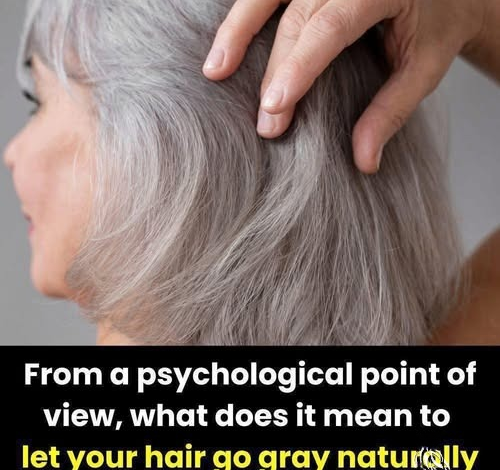
What begins as a small, almost practical decision—skipping one salon appointment, delaying the next dye job, letting the roots show for just a little longer—can slowly become something much larger than expected. At first, it may feel temporary, even accidental. A busy week passes. Then another. The silver begins to appear more clearly at the temples, along the part, around the face. What once might have triggered panic or a quick call to the hairdresser instead becomes an invitation to pause.
The mirror, once treated like a place of correction, begins to change its purpose. It is no longer only where she searches for what needs to be hidden, softened, covered, or fixed. It becomes a place of recognition. She starts to see not a woman losing something, but a woman revealing something. The lines near her eyes, the silver strands catching the light, the softened edges of her face—these are not failures of beauty. They are records. They speak of years spent caring, working, loving, enduring, grieving, laughing, rebuilding, and surviving. They are evidence that life has touched her and that she has continued forward, visibly changed but not diminished.
Still, the world around her does not suddenly become gentler simply because she has chosen honesty. There are stares that last a little too long. There are comments disguised as compliments, remarks about bravery, surprise, or how “not everyone could pull that off.” There are people who say nothing at all, though their eyes linger at her hairline or scan her face as if trying to measure how much she has “let go.” The culture that taught her to cover age does not disappear overnight. It still whispers that youth is value, that softness is weakness, that gray hair is surrender.
But something inside her begins to shift anyway. Her posture changes before anyone else’s opinion does. She stops moving through the world with the same urgency to be approved. She becomes less interested in performing a version of herself designed to make others comfortable. The fear of being seen as older, tired, unfinished, or “letting herself go” loosens its grip. In its place comes a quieter kind of confidence—one that does not need to announce itself loudly because it is rooted deeper than appearance.
This new beauty is not the polished kind that depends on constant maintenance or outside permission. It is less controlled, less edited, and more alive. It carries texture, history, and self-possession. It does not erase the woman she was before; it gathers every version of her and allows them all to exist at once. The young woman who once cared about being admired, the busy woman who tried to keep everything together, the tired woman who hid signs of strain, and the older woman now learning to stand in her own truth—they all remain present in the silver.
Her gray hair is not an accusation against women who choose color, nor is it a rejection of beauty, femininity, or care. It is not a rule, a protest, or a demand that anyone else follow. It is simply her decision to stop treating herself as a problem that must be continuously managed. It is a visible line drawn in favor of her own peace. A choice to belong to herself before belonging to anyone else’s expectations.
And perhaps that is why the transformation feels so powerful. The change is not only on her head; it moves through the way she carries herself, the way she enters a room, the way she meets her own reflection without flinching. What began as roots growing in becomes a deeper return. Not to youth, not to who she used to be, but to a self no longer willing to disappear beneath the fear of being judged. In allowing the gray to show, she allows the truth to show too: that aging is not a vanishing, but another form of arrival.