Principal Calls Mother to School After Discovering Daughter Secretly Purchased New Sneakers for a Classmate in Need

My heart was pounding so hard it felt as if it might break through my ribs as I drove toward the school, every red light and slow-moving car feeling like an obstacle placed there to torture me. My hands gripped the steering wheel until my knuckles turned white. All I could think about was Emma—my sweet, quiet Emma—and the call I had received from the principal’s office. They had not explained much, only that I needed to come immediately. That was enough to send every terrible possibility racing through my mind.
As I hurried through traffic, another memory kept forcing its way forward: the broken piggy bank I had found in her room the day before. At first, I had been confused. Then concerned. Emma was not careless with her things, especially not the little ceramic pig she had kept on her dresser for years. When I asked her what had happened, she had looked up at me with those wide, honest eyes—the kind of eyes that made lying seem impossible—and confessed the truth.
She had been saving every cent she could find. Birthday money from grandparents, coins earned from chores, the small bills I occasionally gave her for snacks or treats. She had hidden it all away, not for a toy, not for something trendy the other kids had, not for herself at all. She had been saving it for Caleb, the new boy in her class.
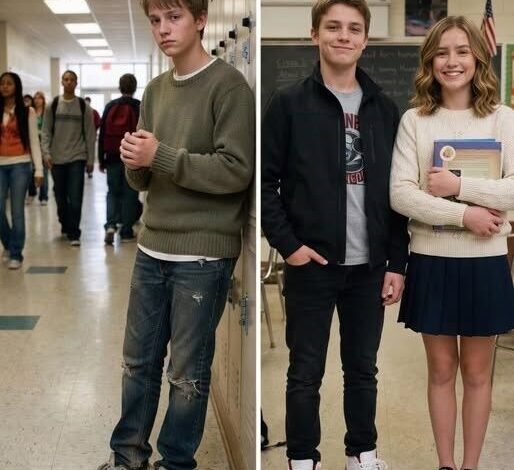
I knew the name only vaguely. Emma had mentioned him once or twice, always with a softness in her voice. He was the boy who sat alone sometimes, the boy whose clothes never quite fit, the boy whose shoes were so worn that the soles had started separating from the fabric. She told me the other children whispered about him in the hallways. Some laughed. Some stared. Some pretended not to notice. But Emma noticed everything.
What had stayed with her most was his shoes. They were literally held together with strips of duct tape, wrapped clumsily around the toes and sides as if someone had tried desperately to make them last just a few more weeks. Emma had watched him walk carefully, as though each step carried embarrassment. And somehow, without telling me, without asking anyone for attention or praise, she had decided that he deserved better. She did not want anyone to clap for her. She did not want to be called generous. She simply wanted Caleb to walk into school with dignity.
By the time I reached the building, my fear had become almost unbearable. I rushed through the front doors and down the hallway, barely noticing the faces that turned toward me as I passed. When I finally burst into the principal’s office, breathless and trembling, I expected chaos. I expected to find Emma crying, or a teacher scolding her, or some stern explanation about rules, theft, disruption, or whatever policy her kindness had somehow violated.
But what I found was stranger than anything I had imagined.
The principal stood near the doorway, his face pale and serious, but not angry. His expression held something closer to awe. He lifted one hand and gestured toward the inner office. His voice dropped to a whisper.
“Someone is here to see her,” he said. “He wouldn’t give his name at first, but he said you might know him.”
A cold, uncertain feeling moved through me. I stepped past him and pushed the door open, my legs suddenly heavy beneath me. For one suspended second, the room seemed to blur around the edges. Emma sat quietly in a chair near the corner, her hands folded in her lap, calm in the way only children can be when they do not fully understand the size of what they have done.
Then I saw the man standing near the desk.
I had not seen him in years. Time had changed him. His shoulders were more bent, his face more worn, his eyes shadowed by exhaustion and shame. But I knew him. He belonged to a chapter of my life I had almost convinced myself was closed forever. He was Caleb’s father.
He stood there holding a shoebox in both hands as if it weighed far more than cardboard and rubber. His fingers trembled around the edges. Inside were the new sneakers Emma had bought for his son.
For a moment, no one spoke. Then his face crumpled.
He explained, through broken words and tears, that he had come to the school furious and terrified. He had thought Caleb had stolen the shoes. He had seen them that morning and demanded to know where they came from, but Caleb had only cried and said a girl from school had helped him. His father had not believed him. Pride, fear, and desperation had twisted together in his mind until all he could think was that his son had done something wrong.
But when he arrived at the school, ready to return the shoes and apologize for what he believed Caleb had done, the truth came out. Emma had bought them herself. She had used her own savings. She had noticed a suffering child when so many others had looked away.
The man covered his face with one hand and began to weep openly. He said he had not known how deeply his son was hurting. He had been so consumed by survival—rent, food, bills, work, shame—that he had missed the daily humiliation Caleb was carrying into school. He had been trying to hold his family together with nothing but exhausted hands and a breaking heart. And somehow, a little girl had seen what he could not bear to look at.
The principal stood silent, his earlier authority softened into humility. There was no lecture waiting. No punishment. No formal reprimand. The office, which had first felt like a place of judgment, had become something else entirely. It had become a room where pride broke open, where kindness revealed pain, and where a struggling father finally found the courage to ask for help.
Emma looked from one adult to another, still not fully aware that her small act of mercy had shifted something much larger than a pair of shoes. To her, it had been simple. Caleb needed help. She had something to give. So she gave it.
In that moment, the terror that had carried me through the drive drained out of me and was replaced by something fierce and warm and almost painful in its intensity. Pride rose in my chest until I could barely breathe. We spend so much time worrying that our children are too tender for a harsh world. We tell ourselves they must toughen up, protect themselves, learn not to feel so much. But Emma reminded every adult in that room that softness is not weakness. Sometimes softness is the only thing strong enough to reach places that fear and pride cannot.
Her kindness had not just put shoes on a boy’s feet. It had restored a measure of dignity to a child who had been quietly suffering. It had opened the eyes of a father drowning in his own shame. It had reminded a school full of rules and procedures that humanity must come before policy. And it had reminded me that children are often watching more closely than we realize—not for what is convenient, but for what is right.
We did not leave the principal’s office that day with a punishment or an apology letter or a warning about boundaries. We left with a different kind of lesson, one that no textbook could have taught. Sometimes the smallest acts of grace travel farther than we can see. Sometimes a broken piggy bank can become the beginning of healing. And sometimes a child’s quiet decision to help another child walk with dignity can remind everyone around her what it means to be human.