My 12-Year-Old Daughter Cut Her Hair to Support a Classmate With Cancer — What Happened Next Left the Entire School Talking

Three months after losing my husband, Jonathan, I was still trying to understand how a house could feel so full of memories and yet so painfully empty. His coat still hung by the door because I could not bring myself to move it. His coffee mug sat untouched in the cabinet, exactly where he always left it. Some mornings, I still woke up expecting to hear the sound of him moving around the kitchen, humming under his breath while the coffee brewed.
But there was only silence.
Grief had changed everything. It had turned ordinary rooms into places I avoided and simple routines into reminders of everything we had lost. I was trying to be strong for our 12-year-old daughter, Letty, but some days I could barely hold myself together. Jonathan had always been the steady one, the one who knew how to make us laugh even during the worst moments of his cancer treatments. Without him, I felt like I was walking through life without a map.
So when the school principal called me one afternoon and said I needed to come in right away, fear gripped me before he even finished speaking.
“Is Letty hurt?” I asked, already grabbing my keys.
“No,” he said quickly. “She’s safe. But something unusual has happened.”
Then he said the words that made my blood run cold.
Six grown men had come to the school asking for my daughter by name. They had all mentioned Jonathan.
For a moment, I could not breathe. Jonathan had been gone only three months. We were still raw, still broken, still trying to survive the aftermath of his death. The thought of six men showing up at Letty’s school and asking for her felt terrifying. My mind raced through every possibility, each one worse than the last.
I drove across town with shaking hands, convinced that grief had found a new way to hurt us.
But I did not yet know that the real beginning of that day had happened the night before, in our bathroom, when I found Letty standing in front of the mirror with a pair of scissors in one hand and a fistful of her own hair in the other.
At first, I froze.
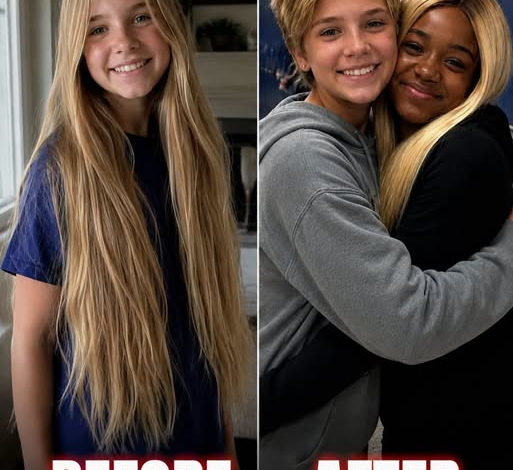
Her long hair, the hair Jonathan used to braid clumsily when she was little, had been chopped unevenly around her shoulders. Strands lay scattered across the sink and floor. Letty’s eyes were red, but her expression was strangely determined, as though she had done something frightening but necessary.
“Letty,” I whispered. “What did you do?”
Her bottom lip trembled. For a second, she looked like she might fall apart. Then she lowered the scissors and said, “I wanted to help Millie.”
Millie was a girl in her class. I knew a little about her. She had been through cancer treatments recently and had only just returned to school. Letty had mentioned her a few times, always quietly, always with concern.
Through tears, Letty explained that Millie’s hair had not grown back the way she hoped. Some students had started making comments, not always loud enough for teachers to hear, but cruel enough for Millie to feel them. That day, Letty had found her crying alone in the bathroom.
“She said she didn’t want everyone staring at her anymore,” Letty said. “She said she just wanted to feel normal.”
The word normal broke something inside me. Our family had spent so long wishing for normal while Jonathan was sick. Normal dinners. Normal weekends. Normal mornings without medicine bottles, hospital calls, and fear sitting at the table with us. Letty had seen more pain than a child should have to see, and somehow, instead of letting it harden her, she had let it make her kinder.
She told me she had researched hair donation online. She thought if she cut her own hair, it could be used to help make a wig for Millie. She had not understood the process completely. She had not known how much hair was needed or how donations were handled. All she knew was that her friend was hurting, and she had something she was willing to give.
I wanted to scold her for using scissors by herself. I wanted to tell her she should have come to me first. But when I looked at her uneven haircut and tear-streaked face, all I could see was Jonathan.
He would have understood her heart immediately.
Instead of getting angry, I pulled her into my arms and held her while she cried.
The next morning, I took her to a local salon before school. I explained what had happened to the stylist, who listened with tears in her eyes. She carefully fixed Letty’s hair into a shorter, softer style and helped us contact someone who worked with wigs for children. By what felt like a miracle, a small wig that matched Millie’s hair color was available through a donation network connected to the salon.
Letty carried it to school like it was made of glass.
She was nervous the whole ride. She kept asking if Millie would be embarrassed, if the gift would make her feel worse, if she had done the wrong thing. I told her that kindness offered with love is never wrong, even when we are unsure how it will be received.
By lunchtime, I thought the emotional part of the day was behind us.
Then the principal called.
When I arrived at the school, my stomach was tight with dread. The receptionist gave me a careful look and led me toward the principal’s office. I could hear voices before I reached the door. Deep voices. Men’s voices. My fear returned instantly.
The principal opened the door, and I stepped inside.
The first thing I saw was Letty. She was sitting in a chair, looking overwhelmed but safe. Beside her stood Millie, smiling shyly while wearing the wig. Her mother was next to her, crying quietly with one hand pressed to her mouth.
Then I saw the six men.
They were not strangers.
They were wearing work jackets from the factory where Jonathan had spent most of his adult life. I recognized their faces from company picnics, hospital visits, and the stories Jonathan used to tell over dinner. They were his coworkers, his friends, the men who had stood beside him during long shifts and later during long treatments.
One of them, a broad-shouldered man named Frank, stepped forward. His eyes were wet.
“We’re sorry if we scared you,” he said gently. “We heard what Letty did. We had to come.”
I looked from him to the others, confused and emotional.
Frank explained that Millie’s mother knew someone at the factory. When the story of Letty’s haircut spread, it somehow reached Jonathan’s old crew. They recognized Letty’s name immediately. They knew Jonathan’s daughter had done something that sounded exactly like the kind of thing he would have done.
One by one, they began telling stories.
They told Letty how Jonathan used to give up his overtime shifts to men who needed extra money for rent. How he once repaired a coworker’s car in the factory parking lot after a night shift because the man could not afford a mechanic. How he collected donations for a family whose house had burned down but never let anyone know he had started it. How he talked about me and Letty constantly, with so much pride that everyone at work felt like they knew us.
Each story felt like a piece of him being handed back to me.
For three months, I had been surrounded by the absence of Jonathan. But in that office, surrounded by the people he had loved and helped, I felt his presence more strongly than I had since the day we lost him.
Then Frank reached into his jacket and pulled out an envelope.
My name was written on the front.
In Jonathan’s handwriting.
My knees nearly gave out.
Frank placed it on the principal’s desk and said, “He asked us to give this to you when the time was right. We weren’t sure when that would be. Today felt right.”
My hands shook as I opened it.
Inside was a letter from Jonathan. His words blurred almost immediately through my tears. He wrote that he knew I would try to carry everything alone after he was gone. He wrote that I had always been brave, but that being brave did not mean refusing help. He told me to let people love us. To let his friends show up. To let Letty keep her soft heart, even if the world sometimes made softness feel dangerous.
Then he wrote something that made me press the letter against my chest.
“Our girl is going to lead with love. Don’t stop her. Just help her aim it somewhere it can grow.”
Frank then explained the rest.
Before Jonathan died, he had quietly started a small fund with some of the men from work. At first, it was meant to help families dealing with cancer-related expenses: rides to treatment, groceries, bills, wigs, child care, whatever people needed most. Jonathan had contributed to it even while he was sick himself.
None of us had known.
After hearing what Letty had done for Millie, the men decided the fund’s next gift should go to Millie’s family. It would help cover medical costs, school support, and anything else they needed while they continued rebuilding their lives after treatment.
Millie’s mother broke down completely then. She hugged Letty so tightly that my daughter started crying too. The principal wiped his eyes and pretended to look through papers on his desk. Even the men, tough factory workers who looked like they had weathered every kind of hardship, stood there with tears running down their faces.
And I stood in the middle of it all, holding Jonathan’s letter, finally understanding.
My husband was gone, but his goodness had not disappeared. It had moved through people. It had stayed behind in quiet acts, in remembered kindness, in the hearts of friends, and now in our daughter.
Letty had not just given Millie a wig. She had carried forward the best part of her father. She had taken the pain our family knew too well and turned it into comfort for someone else.
That day, I had rushed to the school afraid that another painful chapter was beginning. Instead, I walked into a room filled with proof that love does not end the moment a life does.
Sometimes, it waits.
It waits in letters left behind. It waits in friends who remember. It waits in children brave enough to care deeply. It waits in a single act of kindness that brings people together when they need it most.
As I watched Letty and Millie holding hands, I felt Jonathan everywhere.
In the men who had come to honor him. In the letter he had written for the day I would need it. In the fund he had created to help strangers. And most of all, in our daughter, whose heart had somehow grown larger in the middle of loss.
For the first time in three months, the silence he left behind did not feel quite as empty.
It felt as though his love had found a way back into the room.