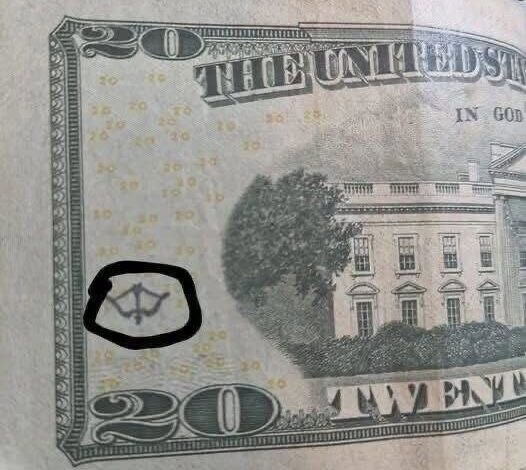
Most people handle paper money without ever giving it much attention. A bill passes from a wallet to a cashier, from a register to a customer, from one pocket to another, often hundreds or even thousands of times before it leaves circulation. We usually notice only the obvious details: the denomination, the portrait, the serial number, or perhaps a security strip if we are checking whether the bill is genuine.
But every so often, someone looks more closely and notices something unusual.
It might be a small star, a stamped symbol, a tiny arrow, a circle, a square, a set of initials, or a strange mark that does not seem to belong on the bill. At first, these markings can look suspicious. They may appear as though someone defaced the currency, altered it, or added a hidden message. Some people wonder if the bill is counterfeit. Others imagine that the mark could be part of a secret code or a sign that the money has passed through something mysterious.
In most cases, however, the explanation is much more practical—and much more interesting.
Many of these small symbols are connected to a long tradition known as “chop marks.” These markings have roots that stretch back centuries, long before modern banking, credit cards, wire transfers, or digital payments existed. Far from being random graffiti, they are part of a fascinating history of trade, trust, and verification.
Long before paper money became common, merchants around the world faced a serious problem: how could they know whether the coins and precious metals they received were real?
In ancient trading networks, especially across parts of Asia, commerce often depended on silver, gold, and other valuable metals. A coin’s value came not only from what was stamped on its surface, but from the metal itself. If a coin was counterfeit, underweight, clipped, or made with impure metal, a merchant could lose money immediately.
Because of that, traders developed their own methods of testing and confirming value. After examining a coin, checking its weight, and determining that it was genuine, a merchant might stamp it with a personal mark. This mark served as a kind of approval seal. It told future traders that the coin had already been inspected and accepted by someone whose judgment was trusted.
Over time, some coins collected several of these marks. Instead of making the coin less useful, the marks could actually increase confidence in it. A coin covered with respected verification stamps had passed through many hands and survived repeated inspection. Each mark became part of the coin’s reputation.
This was a practical solution in a world where trust had to be built one transaction at a time.
As trade expanded and economies changed, paper currency gradually became more common. But paper money brought a different set of challenges. Unlike silver or gold, paper could not be weighed for metal content. It relied heavily on trust in the issuing authority, the quality of printing, and the ability of merchants to recognize genuine notes.
In places where many currencies circulated side by side, especially in busy trading regions, merchants and money changers continued using marks as a way to show that a bill had been examined and accepted. Instead of stamping coins, they stamped paper notes with inked symbols, business seals, characters, initials, or simple geometric shapes.
The purpose remained the same: verification.
A merchant who accepted a bill might add a small stamp to show that the note had passed inspection. Later, another merchant who recognized that stamp might feel more comfortable accepting the same bill. The mark functioned almost like a signature, saying, “This has been checked.”
This practice became especially common in areas where foreign currency moved through markets frequently. The U.S. dollar, in particular, became widely used beyond the borders of the United States. As international trade grew during the nineteenth and twentieth centuries, American banknotes circulated through ports, exchange houses, marketplaces, and businesses around the world.
Because U.S. dollars were often trusted and accepted in global commerce, they sometimes accumulated markings from merchants, banks, and money changers in other countries. A bill might begin its life in the United States, then travel through several foreign markets, changing hands many times before someone eventually noticed the tiny symbols it had picked up along the way.
To someone unfamiliar with the practice, those marks might look random. But to the people who used them, they had a clear purpose.
They were signs of trust.
A small arrow, star, dot, circle, stamp, or symbol usually does not contain a secret message. It generally identifies a person, shop, exchange house, or trading business that previously handled and approved the bill. Different merchants used different designs, which is why the markings can vary so much. Some were simple and plain. Others reflected local writing systems, cultural symbols, or business seals.
The variety of these marks tells a larger story. It shows how money moved across borders, through different communities, and between people who needed reliable ways to trust what they were receiving.
Even today, marked bills can still appear in circulation. Modern currency has advanced security features, and banks have sophisticated methods for detecting counterfeits, but traditional practices do not always disappear overnight. In some cash-heavy regions, merchants may still stamp bills as a quick way to identify money they have already inspected or accepted. In busy markets, where speed matters and cash changes hands constantly, a familiar mark can still serve as a practical shortcut.
For most people, finding a small stamp on a bill does not mean the money is worthless.
This is a common misunderstanding. A bill with a minor stamp or mark generally keeps its face value and can still be used in ordinary transactions. Banks and businesses often treat small marks as part of normal circulation, especially if the bill is otherwise intact and recognizable. Of course, a bill that is badly damaged, torn, burned, or heavily altered may be treated differently, but a small verification stamp is usually not enough to destroy its value.
For collectors, however, those marks can make a bill more interesting.
Currency collectors and historians often look at marked bills as objects with stories attached to them. A clean, unmarked note may be attractive because of its condition, but a marked bill can be fascinating because it shows evidence of movement. Each stamp hints at a place the bill may have traveled, a business that may have handled it, or a market where it may have been used.
In that sense, the marks act like footprints.
A single bill may have crossed borders, passed through exchange counters, been carried by travelers, used in trade, stored in cash drawers, and returned to circulation again and again. The markings left behind offer visible clues to that journey. They remind us that money is not static. It moves constantly, connecting strangers through ordinary exchanges.
That is what makes these symbols so historically meaningful. They are not just marks on paper. They are evidence of human trust.
Trade has always depended on confidence. A buyer must trust that money has value. A seller must trust that the bill or coin being offered is genuine. Before digital databases and instant authentication systems, people had to create their own ways of building that trust. Chop marks and verification stamps were one of those methods.
They show how communities solved practical problems with simple tools. A small stamp could reduce doubt. A familiar symbol could make a transaction easier. A merchant’s reputation could travel with the money itself.
In some ways, these marks were an early form of decentralized verification. No single computer system tracked the bill. No instant notification confirmed the transaction. Instead, trust was built through repeated human judgment. Each mark represented someone saying, “I examined this, and I accepted it.”
That gives these small symbols a surprising amount of meaning.
They also remind us that ordinary objects often carry hidden histories. A dollar bill may seem like nothing more than a piece of paper used to buy coffee, pay for parking, or leave a tip. But before it reaches your hand, it may have traveled farther than you imagine. It may have passed through cities, countries, banks, markets, shops, and countless personal transactions.
Every crease, stain, fold, and stamp can be part of that story.
A small mark that looks strange at first may be a trace of global commerce. It may represent a merchant’s trust, a traveler’s purchase, a money changer’s inspection, or a business practice passed down through generations. What appears to be a random symbol may actually connect the bill to a much older tradition of trade and verification.
That is why marked currency can be so intriguing. It turns something ordinary into something worth noticing. It invites people to slow down and look more carefully at an object they usually handle without thought.
In a world where money is becoming increasingly digital, these physical marks feel even more significant. Today, transactions often happen through cards, phones, apps, and invisible electronic systems. We rarely see where our money has been or who handled it before us. Paper currency, especially when marked, still carries visible signs of movement and human contact.
A stamped bill is a reminder that money has always been more than a number. It is part of a relationship between people. It moves through trust, need, labor, exchange, and shared belief in value.
So the next time you notice a strange symbol, stamp, or small marking on a bill, do not immediately assume it is a mistake, a code, or a sign that the money is fake. It may simply be part of a centuries-old tradition that helped merchants and traders verify currency in a world where trust had to be earned by hand.
That tiny mark may have no mystery in the dramatic sense, but it does have a story.
It may point to a marketplace far away, a money changer’s counter, a merchant’s seal, or a journey through international trade. It may show that the bill has lived a life beyond the one you see in the moment.
In the end, these small markings remind us that history often hides in plain sight. Sometimes it is not found only in museums, archives, or old books. Sometimes it is tucked into a wallet, passed across a counter, and stamped quietly on the surface of a bill.
One small mark at a time, money tells the story of where it has been, who has trusted it, and how people across generations have found ways to exchange value in a complicated world.