The moment Sophie pressed the folded note into my palm, I tried to smile like a brave mother.
I failed.
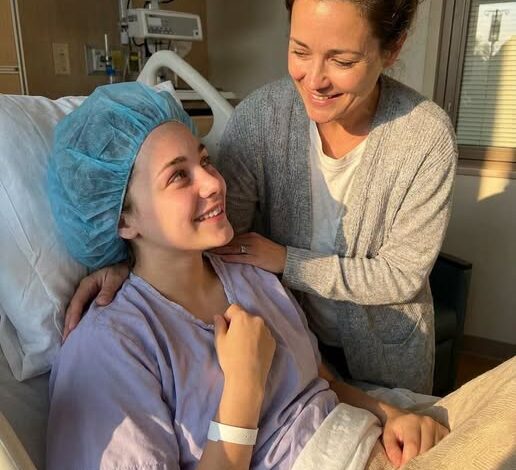
She was seventeen, lying beneath the harsh white lights of the pre-op room, her skin pale against the hospital sheets and her hair tucked messily under a surgical cap. She looked too young to be there. Too small, somehow, despite the fact that she had spent the past year showing more courage than most adults I knew.
Her fingers were cold when they curled around mine.
“Mom,” she whispered.
I leaned closer, forcing my voice to stay steady. “I’m right here.”
She slipped the note into my hand and closed my fingers around it.
“Just in case,” she said.
My throat tightened immediately.
“No,” I said, shaking my head. “We’re not doing that.”
But Sophie gave me the tired, knowing look she had developed after months of tests, hospital stays, specialists, medications, and whispered conversations she was never supposed to hear. Illness had taken pieces of her childhood, but it had also made her observant in a way that broke my heart.
“Promise me,” she said. “Don’t open it unless something goes wrong.”
I wanted to refuse. I wanted to tell her there would be no reason to open it because everything would be fine. I wanted to be the kind of mother who could still protect her child from fear by sounding certain enough.
Instead, I nodded.
“I promise.”
She relaxed a little, as if the note had been heavier than paper.
Then the nurses came in. They checked monitors, adjusted lines, asked final questions, and began preparing to take her down the hall. Sophie squeezed my hand once more before they wheeled her away.
“I love you,” she said.
“I love you more,” I answered, because that had always been our phrase.
The doors closed behind her, and I stood there long after she disappeared.
For the next forty minutes, I sat in the waiting room pretending to read the same paragraph in a magazine over and over. The folded note rested inside my purse like something alive. Every few minutes, my hand moved toward it, then stopped.
I had promised.
Then, less than an hour after they took her back, the hallway changed.
A nurse hurried past, then another. A doctor appeared from behind the double doors, speaking quickly into a phone. Someone called for a specialist. A cart rattled by too fast. The air shifted in that terrifying way hospital air shifts when calm becomes urgency.
I stood.
No one looked at me.
That was when I knew.
Something had gone wrong.
My hands shook as I reached into my purse. The folded paper felt impossibly small. I opened it in the corner of the waiting room, beneath a television no one was watching.
The first sentence nearly took the strength from my legs.
“If I don’t wake up, ask Dad why the hospital called him before they called you.”
For a moment, the words blurred.
Grant.
Her father.
The man who had not lived in our home for six years. The man who had missed birthdays, parent-teacher meetings, school plays, flu seasons, late-night pharmacy runs, and the long terrifying months when Sophie’s condition first began stealing her strength. The man whose absence had become so familiar that I had stopped expecting anything different.
And yet somehow, according to Sophie, his name was high enough in her medical records that the hospital would contact him before me.
I kept reading.
“I know you think he’s gone. He isn’t. Not completely. There are things you don’t know. There are things he didn’t tell you. I tried to understand it by myself, but I’m tired, Mom. I’m tired of adults hiding things and calling it love.”
I sat down hard.
The waiting room moved around me, but I could not hear anything except my own breathing.
Six years of resentment rose inside me all at once. Six years of being the parent who stayed. Six years of making the appointments, remembering the medications, filling out forms, fighting insurance, calling doctors, holding Sophie through pain, and pretending I was not terrified.
Grant had disappeared from the daily work of fatherhood, and now his name was somehow buried inside the very system that had become my whole life.
I pulled out my phone and called him before I could talk myself out of it.
He answered on the second ring.
“Claire,” he said.
Not surprised.
Not confused.
Not even asleep.
My voice came out sharper than I intended. “Why would the hospital call you before me?”
There was silence.
Then he said, “Is Sophie okay?”
That was when I knew he already understood too much.
“They rushed doctors down the hall,” I said. “I don’t know what’s happening. But she gave me a note, Grant. She knew something. What did she know?”
He exhaled slowly.
“I’m on my way.”
“No,” I snapped. “You don’t get to just say that. You don’t get to appear after six years and act like you belong here.”
“I know,” he said quietly. “But I’m coming anyway.”
He arrived forty minutes later, looking tense, pale, and much older than the man I remembered leaving our driveway with one suitcase and a thousand unfinished excuses. His hair had more gray. His shoulders seemed narrower. But what struck me most was the way he looked toward the operating doors.
Not casually.
Not guiltily.
Fearfully.
Like a father.
I hated him for that.
I hated that he still had the right to be afraid for her.
“What did you do?” I asked.
Grant looked at the note in my hand and closed his eyes.
“She found out?”
“She found something. Now you’re going to tell me the rest.”
We sat in a far corner of the waiting room, beneath a window overlooking the hospital parking lot. For a few seconds, he said nothing. Then the truth began coming out in pieces.
He had been helping pay for Sophie’s treatment.
Not directly. Not openly. Not in any way I could refuse.
Through the hospital billing office, through anonymous payments, through arrangements made quietly with people who knew just enough to keep his name from appearing on the statements I saw.
At first, I could not process it.
“You paid?” I said.
“Some of it.”
“For how long?”
“Since the diagnosis.”
The anger that hit me was almost dizzying.
“You let me think I was doing this alone.”
“I knew you wouldn’t take money from me.”
“You were right,” I said. “But that didn’t give you the right to hide.”
His face tightened.
“I didn’t know how to come back.”
That excuse should have made me furious. It did. But beneath the anger, something else was growing, something colder and more frightening.
Because Sophie’s note had not only mentioned money.
It had mentioned secrets.
“What else?” I asked.
Grant looked away.
“What else, Grant?”
His voice dropped.
“I have it too.”
I stared at him.
“The same condition,” he said. “The hereditary one. The doctors think it came from my side.”
For a moment, the room seemed to tilt.
Sophie’s illness had felt like lightning striking from nowhere. Rare, cruel, unfair. We had searched for answers, filled out family histories, chased specialists, and sat through explanations that always seemed to end with more uncertainty. And now he was telling me the answer had been walking around inside him all along.
“You knew?” I whispered.
“Not at first. I found out after I left.”
“After you left,” I repeated, because those words suddenly held more weight than they ever had.
He pressed his hands together, knuckles white.
“I started having symptoms. I got tested. When they confirmed it, I panicked. Then when Sophie got sick, I knew.”
My voice broke. “And you still stayed away?”
“I thought I was protecting her.”
I laughed once, but there was no humor in it.
“Protecting her from what? From having a father?”
“From seeing what might happen to her,” he said, his voice cracking. “From watching me decline and thinking that was her future. I thought if she didn’t see me sick, she could fight without that image in her head.”
I looked at him, stunned by the terrible arrogance of it.
“You thought your absence would hurt less than the truth?”
He covered his face.
“I know how it sounds.”
“No,” I said. “You don’t. Because you weren’t there when she asked why you stopped calling as much. You weren’t there when she cried after school because other girls had fathers at events and she didn’t. You weren’t there when she was diagnosed and asked if she had done something wrong. You weren’t there for any of the fear you claim you were trying to spare her.”
His shoulders shook once.
“I was afraid.”
“So was she,” I said. “So was I.”
Before he could answer, a surgeon appeared.
I stood so quickly the chair scraped the floor.
There had been complications, but Sophie was stable. The next few hours would matter. They were moving her to recovery, and we could see her soon.
I should have felt relief only. Instead, I felt relief tangled with betrayal, exhaustion, rage, and the sharp ache of knowing my daughter had gone into surgery carrying a secret that should never have belonged to her.
When Sophie finally woke, her lips were dry and her voice was weak.
“Mom?”
I took her hand carefully. “I’m here.”
Her eyes moved toward the doorway.
“Did you read it?”
I nodded.
Her gaze filled with tears. “Is he here?”
“Yes.”
She closed her eyes.
“I didn’t want to make everything worse.”
“You didn’t,” I said, though we both knew that wasn’t entirely true. The truth had made everything harder. But maybe some things need to break open before they can heal.
Sophie swallowed.
“I found his name on a payment record,” she whispered. “Months ago. I thought it was a mistake, but then I kept looking. I asked questions when nurses thought I wasn’t paying attention. I figured out he was helping.”
I brushed her hair back from her face.
“Why didn’t you tell me?”
“Because you were already carrying everything.”
That sentence almost broke me.
She was seventeen, sick, scared, facing surgery, and still trying to protect me.
“And then I found out about his condition,” she said. “Not everything. Just enough. I thought maybe he stayed away because of me.”
“No,” I said immediately. “No, sweetheart.”
“But he did stay away.”
I had no answer for that.
She turned her face toward me.
“I didn’t write the note to punish him. I wrote it because I was tired of secrets. Everyone keeps acting like hiding things makes them kinder. It doesn’t.”
I kissed her hand.
“You’re right.”
When I brought Grant into the room, he stopped just inside the door as if afraid to come closer. Sophie looked at him for a long moment. He looked back at her, and every hidden year seemed to stand between them.
“Hi, Soph,” he said.
Her eyes filled again.
“Do you have it too?”
He nodded.
“Were you ever going to tell me?”
His mouth opened, but no answer came.
That silence was an answer.
I stood beside Sophie’s bed and looked at him.
“Love hidden in secret is not the same as showing up,” I said. “You may have helped pay bills. You may have thought you were protecting her. But Sophie deserved truth. She deserved a father who trusted her enough to be honest.”
Grant’s face crumpled.
“I’m sorry,” he said.
Sophie looked at him steadily.
“I don’t need you to disappear because you’re scared,” she said. “I’m scared too.”
That was the beginning.
Not forgiveness. Not healing. Not some miraculous repair of six years of absence.
Just the beginning.
Recovery was slow. There were setbacks, painful appointments, physical therapy, medication changes, and long nights when Sophie cried from frustration. But this time, Grant did not hide behind billing offices or anonymous payments. He came to appointments. He sat in waiting rooms. He learned the names of medications. He brought groceries without pretending someone else had sent them. He answered questions, even the ones that made him ashamed.
Sophie did not let him off easily.
She asked why he left. She asked why he stopped calling. She asked why he thought his fear mattered more than hers. Sometimes his answers helped. Sometimes they weren’t enough. Sometimes she asked him to leave the room, and he did. But the next day, he came back.
That mattered.
I did not promise instant forgiveness either. There were days I could barely look at him without remembering every night I had sat beside Sophie alone. There were moments when his help made me angry because it reminded me how much easier things might have been if he had offered it openly sooner.
But honesty changed the air around us.
It gave us something solid to stand on, even when the ground still hurt.
For years, I believed I was the only one carrying the weight of our family’s pain. I believed Grant’s absence meant indifference. I believed Sophie’s silence meant she did not notice as much as I feared.
I was wrong about all of it.
Grant had been carrying fear and shame. Sophie had been carrying secrets. I had been carrying resentment and exhaustion. Each of us thought we were protecting someone else, but all we had really done was build walls around the same hurt.
Sophie’s note tore those walls down.
It was not gentle. It was not easy. It did not erase the damage.
But it told the truth.
And once the truth was finally in the room, we could stop pretending silence was love.
We could begin the harder work of showing up.
Not perfectly.
Not all at once.
But honestly.
And after everything we had lost to fear, that honesty became the first real medicine any of us had been given.