My Daughter-in-Law Took Ownership of My Son’s $4 Million Home — But a Hidden Discovery Changed Everything

The day we buried my son, I believed I had already reached the deepest point of grief.
I thought there could be no pain worse than standing beside his grave, listening to the final words spoken over the child I had loved, raised, and watched become a man.
But I was wrong.
Only a few hours after the funeral, I stood in the kitchen he had loved most, surrounded by memories that seemed to breathe from every corner of the house. The old clock on the wall. The blue bowl he always used for cereal. The worn chair where he used to sit with a cup of coffee after long days at work.
To me, every object held a piece of him.
To my daughter-in-law, Melissa, they seemed to mean something very different.
She stood across from me with a calmness that felt almost cruel. She did not yell. She did not cry. She simply told me the house belonged to her now and that I needed to leave.
At first, I thought I had misunderstood her.
Surely she could not mean that day.
Not the day we had buried him.
But then I saw the two suitcases sitting by the door.
They had been packed quickly, without care, filled with whatever she had decided I was allowed to take. Before I could even find the words to ask what was happening, she told me I could go to the old mountain cabin my son had owned for years.
The cabin.
A place unfinished, neglected, and nearly forgotten.
A place no one had spoken about in ages.
I asked for only one thing before leaving. A framed photo of my son from his graduation day. It had sat on the hallway table for years, and every time I passed it, I remembered the pride in his smile.
Melissa refused.
She said everything in the house stayed with the house.
So I left with the suitcases at my feet and a grief so heavy I could barely breathe. As I walked down the long driveway, away from the home where so much of my son’s life still lived, I felt as though I was being erased from the world he had built.
The trip to the cabin felt endless.
By the time I arrived, the sun had begun to sink behind the trees. The cabin looked worse than I remembered. The windows were cracked. The porch sagged beneath my steps. Dust covered nearly every surface inside, and the furniture looked as if it had not been touched in years.
It did not feel like a home.
It felt like a place where forgotten things went to disappear.
Still, it was all I had.
I carried my suitcases inside and unpacked the few belongings Melissa had allowed me to take. Then, from beneath a sweater, I pulled out the graduation photo I had quietly slipped into my bag when no one was watching.
I knew it was wrong.
But leaving that picture behind felt impossible.
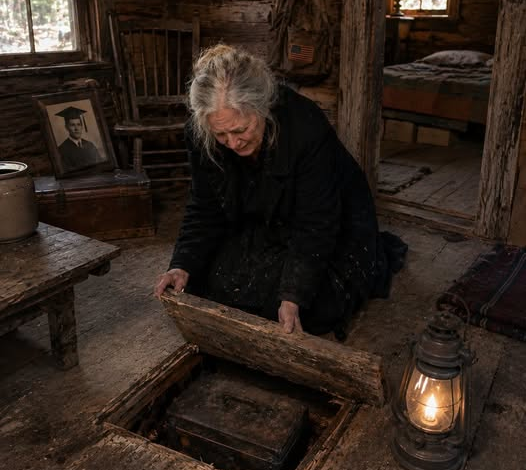
I placed it on a small wooden altar my son had built years earlier. He had made it with his own hands, back when he still believed the cabin might one day become a peaceful retreat. The wood was rough, but sturdy, and I could still see the care he had put into it.
While cleaning around the altar, my hand brushed against an old candlestick.
It fell.
The sound it made stopped me immediately.
It did not strike solid wood.
It echoed.
Hollow.
I froze, then slowly knelt down and tapped the floorboards beneath the altar. One of them shifted slightly under my fingers.
My heart began to pound.
I pried it loose and found a metal box hidden beneath the floor.
It had been sealed carefully.
But what made my breath catch was the writing across the top.
It was my son’s handwriting.
“Mom. Only if she sends you here.”
For a long moment, I could not move.
The cabin no longer felt abandoned.
It felt planned.
It felt like my son had been waiting for me.
With trembling hands, I opened the box.
Inside were documents, a key, a flash drive, and a letter addressed to me.
I unfolded the letter first.
As I read, my son’s voice seemed to fill the room. He explained that he had prepared everything long before his death because he feared that one day, after he was gone, I might be pushed aside. He wrote that he hoped he was wrong. He hoped Melissa would honor his wishes. But if she did not, he wanted me to know I was not helpless.
The cabin, the altar, the hidden compartment—none of it had been an accident.
It had all been part of his plan.
Among the documents was something Melissa clearly had not expected. While she believed she had inherited my son’s multimillion-dollar home without conditions, the papers told a different story.
The transfer of the house came with responsibilities.
She was required to honor certain commitments involving my care, my housing, and my access to my son’s belongings. If those conditions were violated, her claim to the property could be challenged.
My son had thought of everything.
He had even included the name and contact information of a legal professional who knew exactly what to do.
For the first time since the funeral, I did not feel completely powerless.
In the days that followed, grief and action became tangled together. There were meetings, phone calls, documents, signatures, and long conversations I never imagined I would have to endure. Each step was painful, but each one also reminded me that my son had not left me unprotected.
Then came the video.
The lawyer played it for me in a quiet office.
There was my son, sitting at his kitchen table, wearing the gray sweater he loved. He looked tired, but calm. His voice was steady as he explained why he had created the safeguard.
He said he knew love could become complicated after death.
He said people sometimes changed when property, grief, and money entered the same room.
Then he looked directly into the camera and said he wanted to make sure I would never be treated like a burden.
That was when I broke.
Because while I had been mourning the loss of my son, he had somehow still been caring for me.
As the legal process moved forward, the truth became impossible to ignore. The cabin was deemed unsuitable for me to live in. My rights were recognized. My son’s belongings were returned to me. Melissa’s actions were challenged, and the promises attached to the home could no longer be dismissed.
Months later, I stood once again in my son’s kitchen.
The same clock hung on the wall.
The same blue bowl sat in the cabinet.
The graduation photo was back where it belonged.
For a long time, I simply stood there, letting the silence settle around me. The house no longer felt like a place I had been forced out of. It felt like a place my son had reached back from beyond the grave to return to me.
That was when I finally understood the true purpose of the hidden box beneath the cabin floor.
It was never really about the house.
It was not about money.
It was not about winning a dispute.
It was about love.
It was my son’s final act of protection.
A message carefully hidden in the one place he knew I might end up if everything went wrong.
Even after he was gone, he had found a way to stand beside me.
And in the middle of my grief, that truth gave me something I thought I had lost forever.
A reason to keep going.