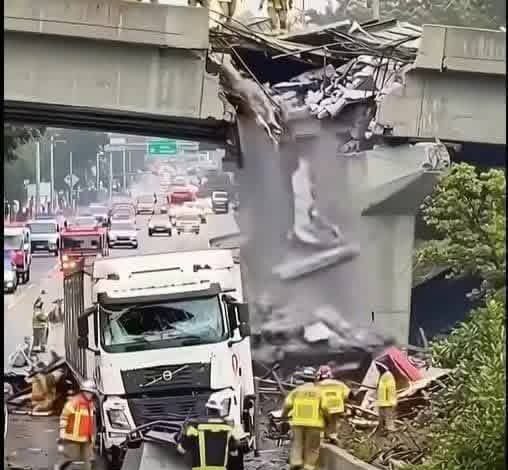
On what seemed like an ordinary Friday morning, Richmond, British Columbia, was suddenly disrupted by a serious traffic incident. At about 7:15 a.m., a commercial truck struck the Cambie Road overpass on Knight Street after its dump trailer remained raised while the vehicle attempted to pass beneath the bridge.
The trailer failed to clear the overpass and became lodged against the structure. The force of the crash was strong enough to separate the truck cab from the trailer, sending the vehicle skidding across the roadway. Fortunately, no injuries were reported. Still, the crash immediately raised concerns about the safety of the overpass and forced officials to close all southbound lanes.
Provincial engineers and city officials quickly arrived at the scene to assess the damage. Their main priority was determining whether the bridge could safely support traffic again. Although the roadway falls under provincial jurisdiction, Richmond municipal engineers assisted with the inspection and response. The trailer remained pressed against the overpass well into the morning while crews worked to stabilize the area, clear debris, and make the scene safe.
Police warned drivers to expect major delays and encouraged them to use alternate routes. The closure caused traffic problems throughout the area, affecting commuters, commercial vehicles, and local businesses that depend on reliable transportation routes.
The Richmond Road Safety Unit began investigating the collision in cooperation with the Ministry of Transportation and Infrastructure. Structural engineers examined the bridge for visible and hidden damage, including cracks, shifted joints, weakened supports, and internal stress that might not be immediately obvious. Even when a bridge appears stable from the outside, impacts of this kind can affect its long-term strength.
Truck collisions with overpasses have become a repeated concern in British Columbia. In recent years, several incidents in the Lower Mainland and Fraser Valley have involved raised truck beds, misjudged loads, or drivers failing to account for vehicle height. These crashes have raised questions about driver training, route planning, signage, and infrastructure safety.
While driver error is often a major factor, experts note that the issue is more complex. Some overpasses may have unclear clearance signs, and resurfacing projects can sometimes reduce available height. Older infrastructure may also be more vulnerable to damage when struck by large commercial vehicles.
Industry groups have called for stronger prevention measures. The British Columbia Trucking Association has supported the use of over-height detection systems, which can warn drivers before they reach low bridges. These systems may use sensors, lasers, or infrared technology to detect vehicles that are too tall for an upcoming overpass.
Fleet operators have also been urged to improve training and safety checks. Drivers should confirm trailer height, secure hydraulic systems, and ensure equipment is fully lowered before entering public roads. GPS-based fleet monitoring and route-planning tools can also help prevent trucks from traveling under bridges they cannot safely clear.
Engineers warn that overpass impacts can cause more than surface damage. A collision may loosen joints, strain internal reinforcements, or weaken support systems. For that reason, each incident requires a careful inspection before traffic can resume. In some cases, temporary repairs or reinforcement may be needed before the road can reopen safely.
The Knight Street closure also showed how one crash can affect an entire regional transportation network. Richmond is an important link between Vancouver, Delta, the Fraser Valley, and nearby commercial areas. When a major route is shut down, deliveries may be delayed, logistics costs can rise, and drivers are forced onto smaller roads. Businesses depending on daily shipments may experience disruptions, while residents face longer commutes.
Transportation experts say preventing these incidents will require a combination of technology, education, and accountability. Over-height detection systems, real-time GPS tracking, regular driver training, and updated infrastructure inspections can all help reduce risk. Safety specialists also emphasize that responsibility must be shared among drivers, trucking companies, engineers, and government agencies.
The Richmond crash has renewed policy discussions about bridge safety and freight transportation. As commercial traffic increases and infrastructure ages, there is growing pressure to modernize bridges, improve signage, and require better warning systems on major trucking routes. Some experts have suggested integrating bridge clearance databases directly into truck navigation systems to reduce the chance of human error.
The incident serves as a reminder that a single mistake can disrupt an entire region. The financial and logistical consequences of overpass collisions can be significant, with repair costs sometimes reaching millions of dollars. For governments and transportation agencies, prevention is often far less expensive than emergency repairs and long-term reconstruction.
For the trucking industry, the message is equally clear. Stronger training, better equipment checks, improved route planning, and modern safety technology are essential for reducing preventable crashes. Heavy commercial vehicles play a vital role in the economy, but their movement through aging infrastructure requires constant attention and care.
In the end, the Knight Street incident was contained without injuries, but its lessons are important. Protecting critical roads and bridges depends on vigilance, cooperation, and investment in prevention. Drivers, fleet managers, engineers, and public officials all have a role to play in keeping transportation systems safe.
The Richmond overpass crash stands as a warning that safety cannot depend on luck alone. It requires preparation, awareness, and a shared commitment to preventing the same mistakes from happening again.