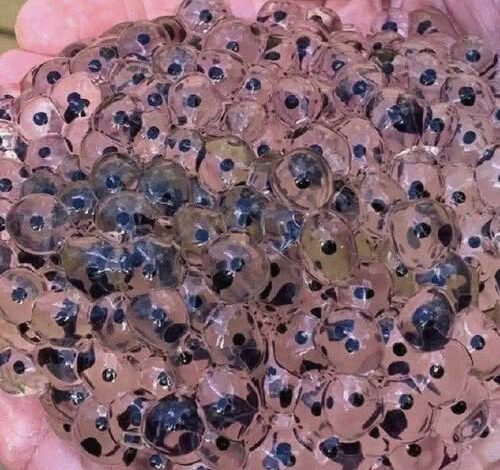
Early one morning, after a night of steady rain, 64-year-old farmer Thomas walked through his soybean field to inspect the soil and check for standing water.
At first, everything seemed ordinary.
The rows were damp.
Small puddles had collected in low spots.
The air carried the earthy smell that always follows a heavy rainfall.
But near a shallow temporary rain pool, Thomas noticed something unusual just beneath the surface of the soil.
It was a small cluster of clear, jelly-like eggs.
They were not bird eggs.
They were not insect cocoons.
And they did not look like anything he had ever seen in his fields before.
The tiny eggs were soft, translucent, and grouped together in a way that immediately caught his attention. Many people might have poked them, moved them, or dismissed them as something strange but unimportant. Thomas did something different.
He left them exactly where they were.
Then he took several clear photos and contacted a local biologist for advice.
What began as a quiet farm observation soon became an important reminder of how much life exists just beneath our notice — and how changing weather patterns, temporary wetlands, and human-managed land can create unexpected habitats for wildlife.
When the biologist reviewed the photos and later visited the site, the mystery became clearer. The eggs were identified as belonging to a species of tree frog, most likely the gray tree frog or a closely related species.
Gray tree frogs are small amphibians known for their ability to adapt to different environments. They are often found in wooded areas, wetlands, gardens, and places near shallow water. During rainy periods, they may take advantage of temporary pools to lay eggs, especially when conditions are moist enough to protect developing embryos.
For Thomas, the discovery was surprising.
He had farmed that land for years and had seen plenty of wildlife — deer tracks, birds, insects, snakes, and the occasional turtle. But he had never thought of his soybean field as a possible nursery for frogs.
The biologist explained that temporary rain pools can be extremely important for amphibians. These shallow bodies of water may last only days or weeks, but they can provide safe breeding spaces. Because they are temporary, they often contain fewer fish and predators than permanent ponds, giving frog eggs and tadpoles a better chance of survival.
That small patch of wet soil, which might have seemed insignificant to most people, had briefly become part of a larger ecological system.
The discovery also pointed to something bigger: wildlife is constantly adapting.
As landscapes change due to farming, development, rainfall patterns, and shifting temperatures, animals often move into new or unexpected spaces. Some species may struggle when habitats disappear, while others search for small opportunities wherever they can find them.
In this case, a rain-filled depression in a soybean field became a suitable place for frog reproduction.
The presence of the eggs did not mean the field had suddenly become a permanent wetland. But it did show that even working farmland can support pockets of biodiversity when conditions are right. Small natural features such as ditches, puddles, tree lines, grassy borders, and drainage areas can become valuable shelter or breeding spaces for insects, birds, amphibians, and other wildlife.
Thomas’s decision not to disturb the eggs mattered.
By pausing and asking an expert instead of destroying the cluster, he helped protect a small but meaningful part of the local ecosystem. His curiosity turned a strange discovery into a learning moment, not only for him but for others who heard the story.
The biologist encouraged him to leave the area alone until the eggs hatched or the water naturally dried. If the conditions remained favorable, the eggs could develop into tadpoles and eventually young frogs. If the pool disappeared too quickly, some might not survive — a common risk for amphibians that rely on temporary water.
Still, the discovery was valuable.
It showed how nature often appears quietly, without warning, in places people least expect. A farm field is not only a place of crops and machinery. It can also become a temporary home for hidden life.
The story also reminds us that observation is one of the simplest but most powerful tools in understanding the natural world. Thomas did not need special equipment to make the discovery. He only needed to notice something unusual, respect it, and ask questions.
That kind of awareness can make a real difference.
Farmers, gardeners, hikers, and homeowners often encounter small mysteries outdoors — strange eggs, unfamiliar tracks, unusual plants, or unexpected animal behavior. Not every discovery is rare, but many can teach us something about the environment around us.
In Thomas’s case, a cluster of jelly-like eggs became more than a curiosity.
It became a sign of adaptation.
A reminder of the importance of temporary habitats.
And proof that even ordinary landscapes can hold extraordinary surprises.
The eggs in the soybean field were not monsters, pests, or anything dangerous. They were the beginning of new life — fragile, quiet, and easy to overlook.
By choosing curiosity over fear and care over disturbance, Thomas helped reveal a small story of survival unfolding beneath the soil.
Real wonder does not always arrive dramatically.
Sometimes it appears after rain, hidden in a field, waiting for someone to look closely enough to notice.