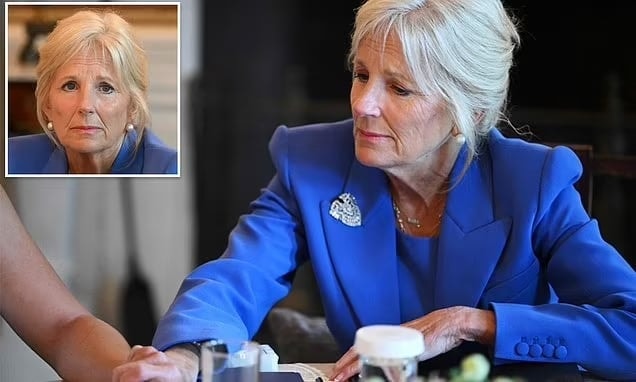
In the stately surroundings of the White House East Room, an announcement unfolded that would redefine the traditional boundaries between domestic symbolism and global diplomacy. In a stunning and historic move, the United States Senate confirmed Jill Biden as the next U.S. Ambassador to Ukraine. The decisive 97–2 vote marked the first time in American history that a sitting First Lady would assume a Senate-confirmed diplomatic role of such magnitude, reshaping the perception of the presidential spouse from ceremonial partner to active agent of foreign policy.
Standing beside her husband, Joe Biden, Dr. Biden accepted the confirmation with visible emotion. The moment carried enormous geopolitical weight. As Ukraine continues its defense against Russian aggression, the appointment is widely interpreted as an unmistakable signal of American commitment—pairing symbolic presence with strategic intent. Rather than framing the assignment as a departure from her existing role, Dr. Biden described it as a continuation of promises made during her earlier visits to the war-affected region.
In her remarks, she recalled walking through Kyiv as air-raid sirens echoed in the distance and meeting educators and families striving to maintain normalcy amid devastation. She emphasized that her mission would extend beyond diplomacy in its narrowest sense. As an educator by profession, she signaled a focus on rebuilding Ukraine’s educational systems and supporting children and teachers navigating trauma and displacement. For Dr. Biden, the ambassadorship represents not just a political post, but a humanitarian undertaking rooted in restoration and resilience.
Secretary of State Antony Blinken, who advanced the nomination, described her as uniquely equipped for the challenge. While the State Department continues managing military coordination and alliance strategy, the new ambassador is expected to serve as a bridge between hard security policy and human-centered recovery efforts. Her portfolio is anticipated to include initiatives aimed at strengthening schools, expanding mental health resources for displaced families, and reinforcing civil institutions weakened by war.
Perhaps most striking was the overwhelming bipartisan support. In an era often defined by deep partisan divides, the 97–2 confirmation signaled rare consensus. Even critics of the administration acknowledged the symbolic and strategic gravity of the decision, suggesting that the stakes in Ukraine transcend domestic political fault lines. The vote effectively granted Dr. Biden a strong mandate as she prepares to step into one of the most sensitive diplomatic theaters in the world.
Reaction from Kyiv was immediate. Volodymyr Zelensky publicly welcomed the news, referencing previous meetings with the First Lady and underscoring the trust built between the two nations. In cities like Kyiv and Lviv, where American support has carried both material and moral significance, the appointment was viewed as an affirmation that the United States intends to remain closely engaged. European allies, particularly in Eastern Europe, interpreted the move as a reinforcement of long-term partnership rather than short-term assistance.
Predictably, Moscow’s response was critical. Russian officials characterized the appointment as escalatory, arguing that placing a member of the President’s immediate family so close to the conflict zone intensifies tensions. Western analysts, however, suggest that the symbolism is deliberate: it conveys that U.S. involvement is personal, visible, and unwavering.
Another notable dimension of the transition is Dr. Biden’s intention to maintain her identity as an educator. Sources close to her office indicate she plans to continue aspects of her teaching responsibilities remotely from the U.S. embassy in Kyiv. The commitment reflects her longstanding belief that education remains foundational, even in times of crisis. It also serves as a broader message—that learning, civic life, and hope must endure even under extraordinary pressure.
In the coming weeks, her preparation is expected to include high-level briefings at the Pentagon and consultations with NATO partners in Brussels. Her mission will encompass more than representation; it will involve direct engagement with a nation fighting for sovereignty and stability. The appointment challenges conventional limits on the role of a First Lady, suggesting that in a modern geopolitical landscape, the presidential spouse can operate as a fully empowered diplomatic envoy.
As she concluded her remarks in the East Room, Dr. Biden invoked a line from Amanda Gorman about courage and light—words that have frequently echoed during defining moments of the current administration. With that, the longtime educator from Delaware stepped into a new chapter of public service.
The world’s attention now turns to Kyiv, where her presence will symbolize not only diplomatic continuity but also an evolving understanding of leadership itself—one in which empathy, expertise, and executive authority converge on the global stage.