A Whispered Warning on a Restaurant Receipt Exposed a Charming Stranger’s Double Life and Uncovered a Pattern of Deception That Turned an Ordinary Date Into a Lesson in Vigilance, Courage, and the Quiet Power of Women Looking Out for One Another

Sometimes life pivots on the smallest moments — a lingering glance, a subtle shift in tone, or, in my case, two hurried words scribbled on the back of a restaurant receipt:
Be careful.
That was it.
Looking back, the evening began innocuously. No flashing lights, no dramatic soundtrack — just a Thursday night, a new dress, and the mild flutter of nerves that comes with meeting someone for the first time.
He called himself Deacon.
We’d met online weeks earlier. His messages were witty, attentive but not overwhelming, asking about my work, my hobbies, my favorite corners of the city. Dinner at a cozy restaurant he claimed to love seemed harmless. I agreed.
The restaurant was warm, softly lit, the sort of place where conversations linger and glasses clink in the background. He greeted me with an easy smile, a hug slightly too familiar for a first meeting.
Still, nothing alarming.
Over dinner, he spoke at length about himself: entrepreneurial ventures, travels, betrayals by former partners, misunderstood relationships. He painted himself as unlucky but resilient. I nodded politely, attempting to steer the conversation toward mutual topics, but it drifted back to him. I chalked it up to nerves. People fill silence with stories — harmless, right?
The food was good. The wine decent. On the surface, just another first date — slightly off, but not enough to leave.
Then the bill arrived.
Deacon reached for it with theatrical confidence. “My treat,” he said smoothly.
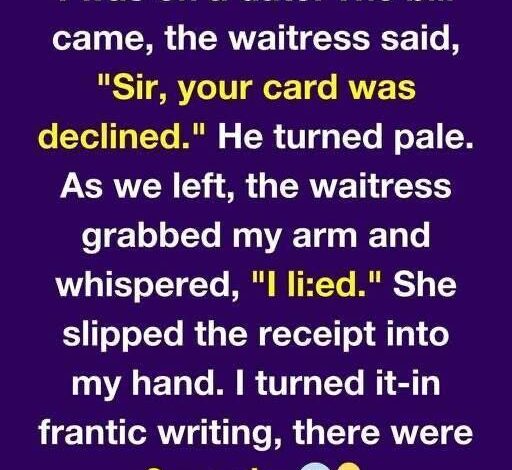
Moments later, the waitress leaned in. “Sir, your card was declined.”
Color drained from his face. He glanced at me, chuckling awkwardly. “Must be a banking error,” he muttered.
I reached for my purse, ready to cover it. But the waitress slipped the receipt into my hand. Our fingers brushed. Her eyes met mine.
“I lied,” she whispered.
Before I could react, she walked away, leaving me stunned.
Deacon pretended to call his bank, muttering about fraud alerts. Convincing, just believable enough. We left the restaurant, night air cooler than before.
“Are you okay?” he asked, feigning concern.
“I’m fine,” I said.
He suggested a drink elsewhere, somewhere quieter, more private. I declined and left.
Once safely in my car, I unfolded the receipt:
Be careful.
My heart raced. Suddenly the waitress’s whisper made sense. I replayed the evening — the self-centered monologues, the convenient card decline, the subtle suggestion that I could help him out.
Curiosity overrode doubt. I searched his name. Initially, nothing suspicious appeared. Then I tried reverse image searches, social media variations, phone lookups.
The illusion cracked.
“Deacon” wasn’t real. He was Marvin.
Online forums revealed a pattern: women describing similar encounters — charming men, stories of misfortune, a conveniently declined card, a request for temporary help. Sometimes small theft, sometimes more. Screenshots confirmed the stories matched his face, his smile, his recycled narratives.
I realized how close I had come.
The waitress hadn’t embarrassed him. She hadn’t caused a scene. She had intervened quietly, a small act of vigilance that redirected my path entirely.
I decided to finish the story but with caution. I invited him over again, this time removing valuables — jewelry, electronics, anything tempting.
He arrived, carried a cheap bottle of wine, and slipped into the same well-rehearsed routine: financial woes, housing troubles, minor favors.
I let him speak. Then I stood.
“I know who you are, Marvin.”
His smile faltered. For a moment, I saw calculation, maybe irritation. Then he shrugged.
“You got me,” he said flatly. No apology. No denial. Just acknowledgment.
He left.
Afterward, I reached out to other women online. Screenshots, details, timelines — we connected. Shame dissolved. Isolation no longer protected him.
I never saw the waitress again, but I think of her often. She didn’t just warn me. She acted. Her small gesture rippled outward, breaking the cycle.
Predators rely on isolation, on convincing each target that she is alone. Connection dismantles that strategy. Awareness spreads faster than deception.
That night taught me more than caution. It taught me to trust subtle discomfort, to question narratives that fit too neatly, to notice what feels rehearsed. It also reminded me how powerful small gestures can be: a whisper, a note, a shared screenshot.
I still go on dates. I still believe most people are genuine. But now I listen more closely — not just to words, but to instincts, tiny hesitations in my chest.
Because sometimes danger doesn’t arrive with flashing lights. Sometimes it orders wine, tells a charming story, and waits for you to open the door.
And sometimes, if you’re lucky, someone else is watching — ready to slide a receipt across the table and remind you:
Be careful.