In the world of holistic health, some of the strangest techniques are often the most effective.

Dave Setzer didn’t exactly fit the image of a spiritual guide or a modern-day mystic. He didn’t wear flowing robes, chant in a low voice, or sit cross-legged on a mountaintop. Instead, he looked exactly like what he was: a meticulous, pragmatic former U.S. Army engineer with a mind trained to analyze circuits, frequencies, and the invisible threads of energy that surround us. After leaving the military, Setzer spent years investigating a phenomenon he came to call “dirty electricity”—the high-frequency electrical noise that courses through our homes, workplaces, and public spaces, often unnoticed but potentially disruptive to our bodies and minds. He became fascinated with the subtle ways electromagnetic fields, emitted by Wi-Fi routers, 5G towers, and the ubiquitous power lines overhead, might interact with the human nervous system, leaving some people feeling inexplicably frazzled, wired, or perpetually drained.
When Setzer stepped onto a modest stage to demonstrate his methods, he held in his hands not some futuristic gadget or a glowing piece of tech, but something almost laughably ordinary: a roll of aluminum foil. The audience, a mix of curious skeptics and people desperate for relief from constant mental buzzing, leaned in. He didn’t wave it like a wand or claim it had mystical properties. Instead, he explained, in his precise, almost clinical way, that our bodies often function like antennas. They pick up stray electromagnetic signals from the devices we depend on, the towers we live under, and the electrical wiring that powers our homes. Over time, these invisible currents can create a subtle but persistent tension in the nervous system—like being perpetually on edge, even when everything seems calm on the surface.
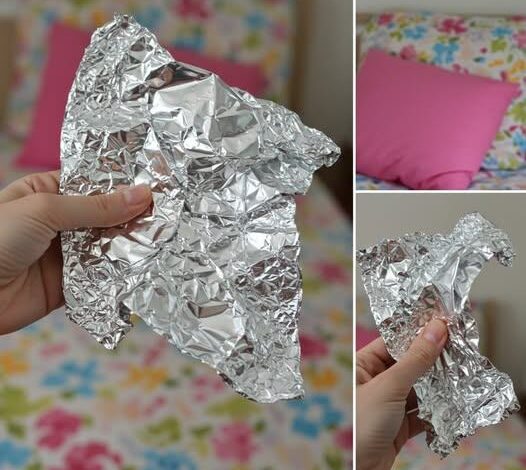
The technique he demonstrated, which he affectionately called the “foil cleanse,” was astonishingly simple, almost shocking in its ordinariness. Participants were instructed to remove their shoes and stand or sit with bare feet planted on the ground. A sheet of aluminum foil, large enough to cover the soles of the feet, would then be shaped and draped over the hands, sometimes extending to the back of the neck or shoulders, creating a makeshift shield. For 10 to 20 minutes, they were to remain in this position, deliberately disconnecting from their phones, laptops, and other active electronic devices, and simply allowing themselves to be present with the sensation of their own bodies.
What followed, according to many in attendance, was a peculiar, almost immediate effect. Some described it as a sudden weight pressing down on their limbs, followed by a gentle, almost surprising sense of calm. Others spoke of a feeling like static had drained away from their skin and nervous system, leaving a quiet, grounded clarity in its place. It was, in essence, a micro-ritual of restoration—a way to consciously disengage from the constant hum of the modern world and reconnect with the body’s natural rhythms.
Whether one interprets this practice as a form of grounding, a crude type of electromagnetic shielding, or simply a placebo effect powered by intention and focus, its appeal seems undeniable. In a culture dominated by endless notifications, unrelenting screens, and the subtle but relentless energy of digital life, Setzer’s foil ritual offers something increasingly rare: a deliberate, mindful pause. It’s a chance to reset, to release accumulated tension, and, even briefly, to remember what it feels like to simply be human in a world that rarely stops moving. For some, that’s enough to make the ritual feel powerful, restorative, and oddly essential.