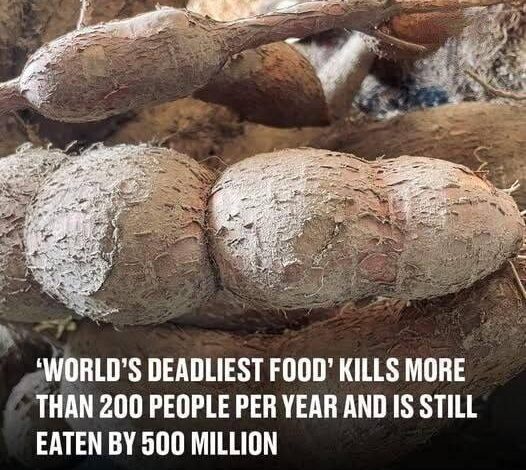
The relationship between humanity and its food is often a delicate dance of survival, adaptation, and risk. While most of us view dinner plates as sanctuaries of nourishment, there exists a global staple that carries a hidden, lethal potential. Consumed by over half a billion people worldwide, this resilient crop thrives where others wither, yet improper preparation can result in a quick and agonizing death. This is the story of cassava—a vegetable often called one of the “world’s deadliest foods,” despite being the lifeblood of entire civilizations.
Cassava, also known as manioc or yuca, is a woody shrub native to South America, though its influence now spans Africa, Asia, and Latin America. Nigeria leads the world in production, and hundreds of millions of tonnes are harvested annually to feed growing populations. Beneath its rugged exterior lies a natural chemical defense: the ability to produce hydrogen cyanide.
This toxin exists in the form of cyanogenic glycosides. When cassava cells are crushed, chewed, or consumed raw, these compounds break down into hydrogen cyanide—a potent poison that interferes with cellular respiration. Cassava comes in two primary varieties: “sweet” and “bitter.” Sweet cassava contains relatively low cyanide levels, often manageable with basic cooking. Bitter cassava, however, can contain upwards of 1,000mg of cyanide per kilogram—enough that even one underprepared root can be fatal.
The World Health Organization estimates that cassava poisoning claims around 200 lives annually. While modest compared to the half a billion who eat it daily, these deaths underscore the dangers of rushing preparation, especially during famine, poverty, or social crisis. Properly processed, cassava is as safe as a potato; mismanaged, it becomes a deadly risk.
Humans have long mastered this challenge. Indigenous communities in South America developed meticulous techniques to “tame” the plant over centuries. Preparation often involves peeling, grating, and soaking the roots in water for up to 24 hours, allowing toxins to leach out or evaporate. Pressing, roasting, or sun-drying completes the process, transforming a potentially lethal root into safe staples such as farinha, fufu, or tapioca. This ingenuity reflects a deep understanding of chemistry and patience passed down through generations.
Yet cassava’s resilience also creates a dangerous paradox. Its drought resistance makes it a last-resort crop during famine. Hungry populations may skip critical preparation steps, exposing themselves to acute or chronic cyanide poisoning. In 2017, during a severe economic crisis in Venezuela, reports surfaced of families dying after consuming improperly processed bitter cassava. Chronic exposure to low cyanide levels—particularly when combined with protein-deficient diets—can lead to neurological disorders such as tropical ataxic neuropathy or konzo, an irreversible paralytic disease disproportionately affecting children and young women.
Despite these hazards, cassava is essential to global food security. It efficiently converts sunlight into calories, requires minimal pesticides, and can remain in the ground for years as a living pantry. Today, it forms the base of bubble tea pearls, gluten-free starches, and the daily diets of some of the world’s most vulnerable communities. Cassava is neither villain nor savior—it reflects the conditions of those who rely on it. Where preparation knowledge and stability exist, it is a miracle; where hunger and chaos prevail, it can become a silent threat.
Unlike exotic “deadly delicacies” such as fugu, cassava’s danger lies not in rarity or expense, but in accessibility. It relies on traditional knowledge, careful technique, and communal patience. It is a testament to humanity’s ability to manipulate natural chemistry to survive, and to the resilience of communities that have relied on it for centuries.
Looking ahead, as climate change and erratic agricultural yields challenge global food systems, cassava’s role will only grow. Ensuring access to clean water, education on proper processing, and food security infrastructure will be crucial. The world’s “deadliest” food, paradoxically, is also one of its most vital—proving that with knowledge, care, and time, even a toxic root can become a gift of life.