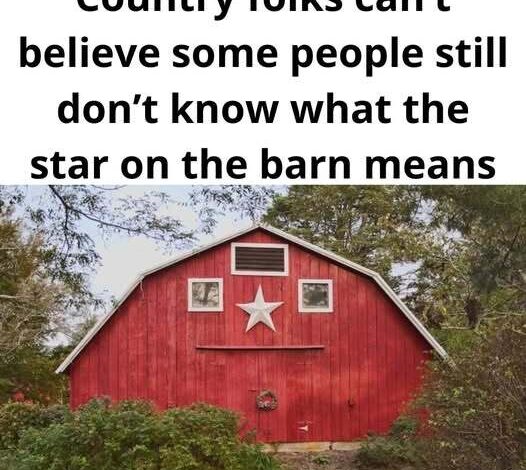
Long before barn stars became common decorative pieces hanging on suburban houses and country-style cafés, they carried a much deeper meaning for the Pennsylvania Dutch farmers who first placed them on the sides of their barns. For these early settlers, the stars were not simply ornaments. They were symbols—visual expressions of belief, tradition, and hope that blended centuries-old European folklore with the realities of life in rural America.
Many of these farmers had immigrated from German-speaking regions of Europe in the 17th and 18th centuries. They brought with them not only their farming knowledge and craftsmanship but also a rich tradition of symbolic art. When they arrived in Pennsylvania and began building barns across the countryside, they found new ways to incorporate those traditions into their daily lives. One of the most recognizable expressions of that heritage became the painted or carved star placed high on a barn’s exterior.
Each star design was chosen carefully. The number of points, the colors used, and even the placement on the barn all carried symbolic meaning. A six-pointed star might represent harmony and balance, while an eight-pointed star could symbolize abundance or protection. The colors were equally meaningful. Red often stood for strength and vitality, blue represented peace or protection, green symbolized growth and fertility, and white conveyed purity or spiritual guidance.
These designs were closely related to what are known today as “hex signs,” circular patterns painted on barns that combined geometric shapes, flowers, stars, and other folk symbols. Although historians still debate whether hex signs were originally meant to ward off evil spirits or simply serve as decorative art, many farmers believed the symbols offered a form of protection and blessing. In communities where survival depended heavily on the weather, livestock health, and successful harvests, even small gestures of hope carried great significance.
Barn stars and hex signs often echoed patterns seen in Pennsylvania Dutch quilts, weaving together art forms that were both practical and symbolic. Quilts, like barn stars, were not merely decorative objects. They were expressions of family heritage, craftsmanship, and cultural identity. The repetition of certain geometric shapes—diamonds, stars, rosettes, and wheels—created a visual language that could be recognized and understood within the community.
Placed on the front of a barn or near the peak of its roof, a star quietly watched over the farm. Farmers believed that the symbol might bring protection from storms, safeguard animals in the fields, or encourage a healthy harvest. In an era when life was shaped by unpredictable seasons and hard labor, these signs served as small reminders that faith, beauty, and perseverance could exist together.
Over time, as communities modernized and beliefs evolved, the mystical meanings attached to barn stars gradually faded. Advances in science and agriculture replaced many of the old superstitions that once guided rural life. Yet the stars themselves did not disappear. Instead, they slowly transformed from protective symbols into cultural artifacts.
By the 20th century, barn stars had become treasured pieces of folk art. Artisans began recreating them on wooden plaques, metal cutouts, and painted panels. Tourists visiting Pennsylvania Dutch Country admired the designs and began bringing them home as souvenirs. What had once been a quiet symbol of farm life became an enduring icon of rural American heritage.
Today, barn stars can be found far beyond the barns of Pennsylvania. They hang on the sides of suburban homes, decorate garden sheds, and appear in farmhouse-style interior design. Some are crafted from weathered metal to mimic the look of traditional barn hardware, while others are brightly painted in colors inspired by historic hex signs.
Although many people today see them simply as charming decorations, these stars still carry a quiet connection to their past. Each one echoes the beliefs and traditions of the farmers who first created them. They represent a time when people expressed hope and gratitude through simple, handmade symbols placed carefully on the buildings that sustained their families.
Even now, when a metal star is mounted on the wall of a modern porch or a quilt-pattern block is painted on the side of a newly built barn, it carries with it a subtle sense of continuity. It links the present to a history shaped by hard work, faith, and creativity.
In that way, barn stars are more than rustic decoration. They are small pieces of living history—silent tributes to the generations of farmers who believed that beauty could exist alongside labor, that art could live on the walls of working buildings, and that a simple star painted on red boards could watch over the land with quiet hope.