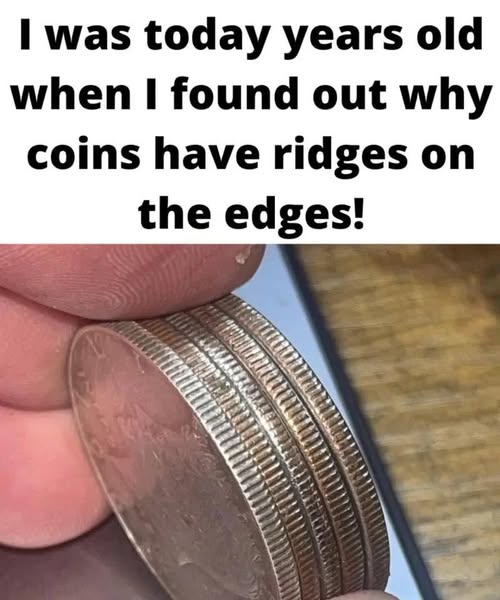
You’ve held them countless times, yet likely never thought twice. Coins pass through hands at grocery stores, slip into parking meters, drop into tip jars, or flip in moments of indecision. They’re so familiar that they fade into the background of daily life.
But run your thumb along a coin’s edge and you’ll feel something deliberate—tiny, evenly spaced grooves. These ridges aren’t decorative or accidental; they’re the legacy of a time when money itself was vulnerable, and trust in currency had to be engineered into its design.
When Money Was Metal
For centuries, coins were valuable for their metal content: gold, silver, copper. That intrinsic value made them susceptible to a crime called coin clipping, where thieves shaved tiny amounts of metal from the edges, melted it down, and profited. One coin might lose only a fraction of a gram, almost impossible to detect—but across thousands of coins, the loss was substantial.
Clipped coins circulated like normal money, eroding public confidence. Merchants grew suspicious, trade slowed, and regions experienced monetary instability. By the late 17th century, England faced a severe silver coin shortage caused largely by clipping. Something had to change.
Isaac Newton and the Mint
In 1696, Isaac Newton, famed for gravity and calculus, became Warden of the Royal Mint. He approached the problem like any scientific challenge: with careful observation, measurement, and practical solutions.
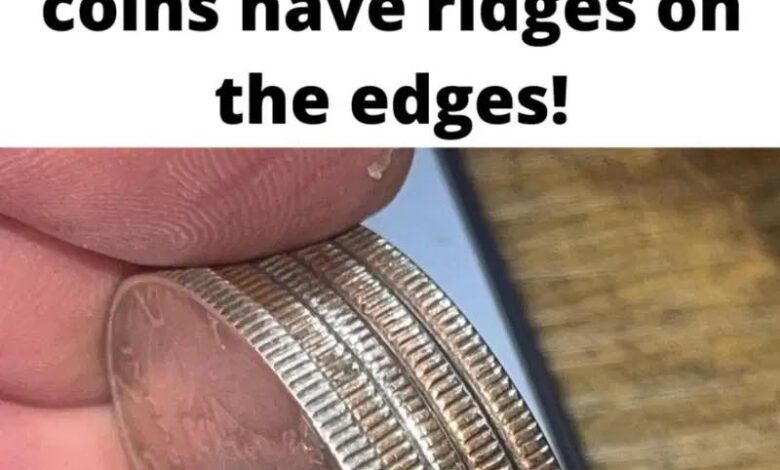
The innovation was simple yet brilliant: reeding, the addition of evenly spaced grooves along the coin’s edge. Clipping would now damage the pattern, making tampering obvious. Counterfeiters lacked the precision to replicate the grooves, and the design became a silent, self-enforcing safeguard. Newton oversaw recoinage with these reeded edges and helped prosecute offenders, stabilizing the currency.
Why Edges Still Matter
Though modern coins are no longer precious metal, ridges persist because their utility evolved:
- Machine recognition: Vending machines, coin counters, and parking meters rely on edge patterns.
- Accessibility: The blind or visually impaired can distinguish denominations by touch.
- Standardization: Uniform edges help coins stack, roll, and operate smoothly in automated systems.
- Historical continuity: The design preserves familiarity and trust across generations.
Not all coins are ridged. Pennies and nickels are smooth because they historically contained little intrinsic value, making clipping unnecessary. Smooth edges signal low-value coins, reeded edges signal ones worth protecting—a tactile lesson that endures.
A Legacy of Trust
The grooves on coins do more than prevent theft. They shape how money feels and sounds, providing sensory feedback that subtly reinforces trust. Damaged edges trigger suspicion, a reflex learned from centuries of history embedded in design.
This principle of invisible protection appears everywhere: watermarks on bills, holograms on credit cards, tamper-evident packaging, serial numbers on documents. The most effective safeguards often work quietly, unnoticed until they fail.