The Middle East has reached a volatile breaking point as reports confirm a direct Iranian retaliatory strike against U.S. military assets in the Persian Gulf. For decades defined by shadow wars and proxy conflicts, the region now faces a new era of open state-to-state confrontation. The Islamic Revolutionary Guard Corps (IRGC) claimed responsibility for a series of “precision responses” targeting the U.S. Navy’s 5th Fleet headquarters in Manama, Bahrain—a strike that has sent shockwaves through global capitals and financial markets.
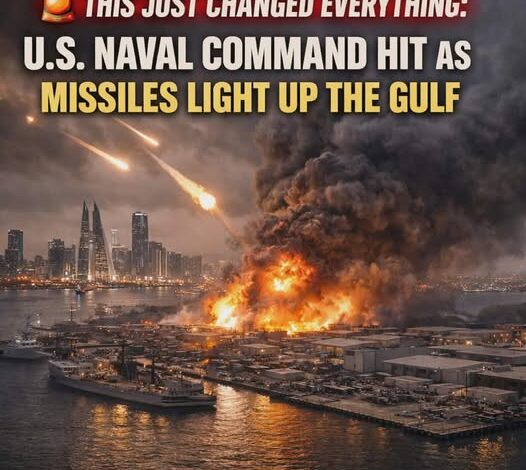
The epicenter of the crisis is Naval Support Activity (NSA) Bahrain, a sprawling base that serves as the command hub for U.S. maritime operations across the Middle East, Central Asia, and parts of Africa. Housing more than 8,000 U.S. personnel and their families, the facility is crucial for securing the world’s vital oil shipping lanes. Witnesses in Manama reported a massive explosion near the base, followed by thick black smoke and the blaring of air raid sirens, while images circulated widely on social media.
Early reports suggest significant structural damage to facilities linked to the 5th Fleet’s command infrastructure. Though initial U.S. statements indicate no confirmed casualties, the psychological and strategic impact is undeniable. For the first time in decades, a primary U.S. naval hub has been directly targeted by Iranian forces, breaking previously assumed “red lines.”
The strike comes in direct retaliation for a coordinated U.S.–Israeli offensive earlier in the day, dubbed “Epic Fury” by analysts. That operation reportedly deployed stealth technology and long-range munitions to strike Iranian missile sites and IRGC command centers—intended to weaken Tehran’s regional power projection but instead provoking a dangerous escalation. By hitting the 5th Fleet headquarters, Iran is signaling its willingness to risk a broader regional war to maintain deterrence.
The repercussions were felt instantly across the Gulf. Neighboring countries raised defense alerts, while U.S. embassies in Kuwait, the UAE, and Qatar issued “shelter-in-place” advisories. Diplomats describe the region as “extremely fragile,” with back-channel communications between Washington and Tehran reportedly inactive.
Economic fallout followed quickly. Brent Crude prices surged as traders assessed the risk of disruption to the Strait of Hormuz, the world’s most critical energy chokepoint. Analysts warn that continued escalation could trigger a supply shock reminiscent of the 1970s, as the Persian Gulf becomes an active combat zone.
Strategically, the strike represents a major shift. For years, U.S.–Iran tensions remained in the “gray zone,” limited to cyberattacks, maritime harassment, and proxy conflicts. The attack on NSA Bahrain removes plausible deniability and forces Washington to choose between large-scale retaliation or a perceived diplomatic retreat.
Reports of a 13-nation coalition preparing to secure maritime corridors underscore that the international community is bracing for sustained engagement. Yet, the presence of such a force increases the risk of miscalculation, where a single incident could spark a much wider conflict.
Humanitarian concerns are also mounting. NSA Bahrain is located near densely populated areas, and the proximity of the strike to civilian infrastructure has heightened fears for both U.S. personnel and local residents. For the 8,000-plus Americans stationed there, the day’s events have shifted their mission from regional security to immediate survival.
Diplomatic pressure is mounting, with the United Nations and European Union calling for an immediate ceasefire. Yet with black smoke rising over a key U.S. naval command, the momentum appears to favor action over negotiation. The IRGC’s strike may redefine the Middle East’s geopolitical map for years to come.
In Washington, the President convened an emergency National Security Council meeting to assess options. Military transport planes carrying reinforcements and specialized medical units have been deployed from the U.S. and Europe to the Gulf, while Iranian state media continues to broadcast images of the strikes, framing them as a defense of national sovereignty.
As the situation remains fluid, the world watches closely, aware that every moment could determine whether the region spirals into full-scale war or finds a path toward de-escalation. The black smoke over Bahrain has become an ominous symbol of an increasingly uncertain and dangerous future.