Gang finds unusually spiky creatures in nest – takes a closer look and jaws drop when they realize what kind of animals they are – OMG

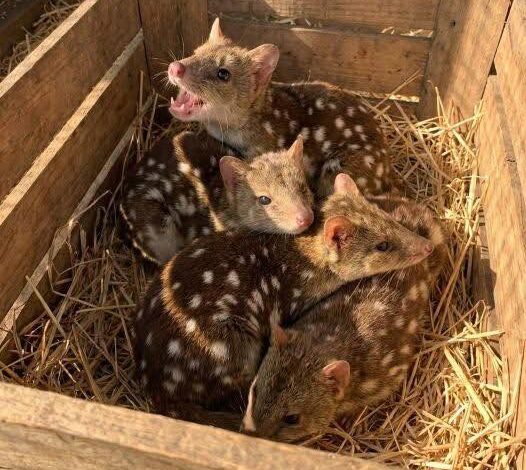
In the rust-colored soils of Mt Gibson, the arrival of western quoll joeys represents far more than a routine conservation milestone — it stands as a quiet but powerful act of resistance against extinction. These tiny marsupials, scarcely larger than a hand, embody years of planning, patience, and persistence. Every tentative step they take and every faint nighttime call echoing across the sanctuary signals that a carefully orchestrated effort — combining reintroduction, predator management, and habitat restoration — is beginning to succeed where earlier attempts struggled.
For ecologist Georgina Anderson and her field team, observing these young quolls has become both a scientific achievement and an emotional reward. Through motion-sensing cameras and late-night monitoring, they watch the joeys emerge from dens, test their instincts, and gradually learn the rhythms of a landscape that had nearly lost them forever. They are reclaiming spaces once emptied by invasive predators and ecological disruption — slipping into burrows, navigating rocky outcrops, and learning to hunt beneath the cover of darkness.
Their presence is fragile progress rather than a final victory. Beyond the sanctuary’s boundaries, threats remain constant. Feral cats and foxes continue to roam much of Australia’s interior, and shifting climate patterns bring new uncertainty to already delicate ecosystems. A single breach in predator control or a prolonged environmental stress could still jeopardize these gains. Yet the sight of a new generation thriving offers something conservationists rarely receive so clearly: proof that intervention, when sustained and strategic, can turn the tide.
This small litter represents a turning point — not just for the species, but for the broader philosophy of wildlife recovery. It demonstrates that extinction is not always an inevitable conclusion, and that landscapes once stripped of native life can again support it with the right stewardship. In a country where many species have vanished silently, the western quoll’s return provides a different narrative — one shaped not by loss, but by resilience.
Across the sanctuary, their tracks now stitch delicate patterns through the dust, reminders that survival is still possible. These joeys are more than biological data points; they are living symbols of what can happen when science, commitment, and hope converge. In their bright eyes and cautious movements lies the promise that Australia’s natural heritage can be rebuilt — one careful step at a time.