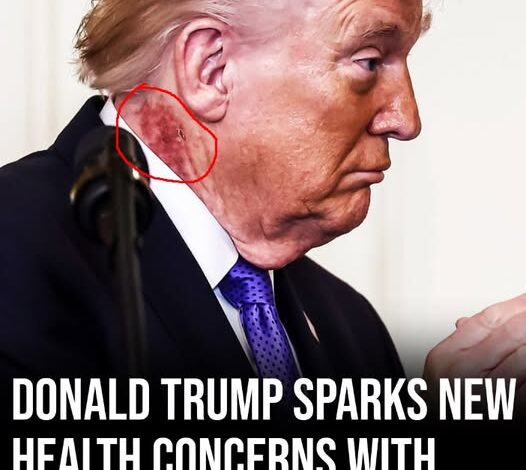
Fresh close-up photographs taken during a solemn Medal of Honor ceremony at the White House have once again thrust President Donald Trump’s health into the center of public conversation. The event, meant to honor extraordinary military valor, instead sparked a wave of online speculation after images captured what appeared to be a pronounced red, scabbing rash along the right side of the president’s neck. The irritated patch extended from just behind his ear toward the hairline, its visibility heightened under the bright ceremonial lighting.
Within hours, the images circulated widely across social media platforms, where zoomed-in screenshots and side-by-side comparisons fueled renewed debate about the condition of the oldest sitting president in U.S. history. For critics and supporters alike, visible physical changes—no matter how minor—have become subjects of intense scrutiny.
The White House responded quickly. The president’s physician released a statement describing the mark as a temporary reaction to a commonly prescribed topical cream used as a preventative skin treatment. According to the explanation, the medication was applied for a brief period—approximately one week—but residual redness and mild irritation were expected to linger even after use stopped. The administration characterized the reaction as routine and not indicative of any broader medical concern.
Still, the explanation did little to quiet online speculation.
Observers noted that the neck irritation appeared alongside another recurring visual detail: the bruising on the president’s right hand that has been visible in recent months, occasionally concealed with cosmetic coverage. The White House has previously attributed that bruising to frequent handshaking and the side effects of high-dose daily aspirin, which can increase susceptibility to minor bruising. Trump has also publicly acknowledged living with chronic venous insufficiency, a circulatory condition that can cause swelling or discoloration in the lower extremities, though it is generally manageable with treatment.
Individually, each of these issues has been described as medically common, particularly in older adults. Collectively, however, they have become symbolic flashpoints in a broader political conversation about age, stamina, and transparency in presidential health reporting.
The scrutiny reflects a long-standing American preoccupation with the physical well-being of its leaders. From Franklin D. Roosevelt’s concealed paralysis to John F. Kennedy’s hidden chronic pain, the health of presidents has historically been both a private matter and a public concern. In the modern era—where high-resolution cameras capture every detail and social media magnifies every anomaly—there is little room for ambiguity.
For supporters of the president, the renewed attention is seen as overblown and politically motivated, an example of routine medical issues being exaggerated for partisan effect. They argue that visible skin irritation or minor bruising is hardly unusual for someone of advanced age and that official medical statements should suffice to address concerns.
For critics, the images reinforce lingering questions about transparency. They contend that when a president is in his late seventies or beyond, even minor health developments warrant careful explanation, particularly given the physical and cognitive demands of the office.
Medical experts not connected to the administration have noted that topical dermatological treatments—especially those containing retinoids or other resurfacing agents—can indeed produce redness, peeling, and scabbing that lasts beyond the treatment window. Likewise, daily aspirin therapy is widely known to increase bruising due to its blood-thinning properties. Chronic venous insufficiency is also common among older adults and is typically manageable with lifestyle adjustments and medication.
Yet in the current political climate, medical nuance often competes with viral imagery. A close-up photograph can quickly become a proxy for broader anxieties—about leadership stability, electoral implications, or institutional continuity.
The timing of the debate is also significant. With heightened global tensions and a demanding domestic agenda, any visible sign of frailty takes on amplified meaning. For some Americans, the question is not about a rash or a bruise but about endurance—whether the physical toll of the presidency is sustainable at such an advanced age.
At the same time, presidential health disclosure remains governed largely by tradition rather than strict legal requirements. Candidates and sitting presidents typically release medical summaries, but the scope and depth of those disclosures vary widely from administration to administration.
Ultimately, the episode underscores how modern political leadership unfolds under relentless visual examination. In an era of constant livestreams, HD photography, and instantaneous online commentary, even a temporary dermatological reaction can become a national conversation.
Whether the mark on the president’s neck proves to be nothing more than a brief skin irritation—as the White House maintains—or a catalyst for broader political debate, the reaction to it reveals something deeper: Americans continue to view presidential health not merely as a personal matter, but as a reflection of national stability itself.