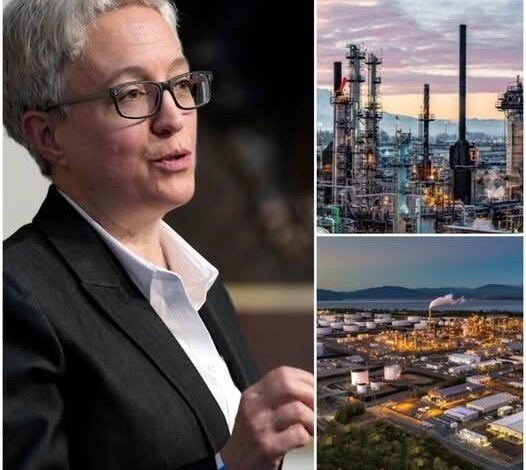
Oregon is confronting a growing sense of vulnerability in its energy system, as developments in the broader West Coast refining market raise questions about the reliability of the state’s fuel supply. At the center of the concern are recent regulatory filings from Phillips 66 indicating plans to divest roughly $3 billion in refinery assets. While asset sales are not unusual in the energy sector, one facility in particular—the Ferndale refinery in Washington—plays an outsized role in Oregon’s fuel stability.
Unlike many states, Oregon has no operating oil refineries within its borders. It depends almost entirely on out-of-state production, with the majority of its gasoline and diesel originating from refineries in Washington. Among those facilities, Ferndale is a key contributor to the fuel that ultimately reaches Portland and is distributed across the state. Any uncertainty surrounding its ownership or operational continuity therefore carries significant implications.
These concerns are heightened by recent history. In late 2024, Phillips 66 announced the permanent closure of its Los Angeles refinery, a facility capable of processing approximately 139,000 barrels of crude oil per day. That shutdown reduced West Coast refining capacity and tightened regional supply margins. Although markets adjusted, the event underscored how sensitive the West Coast fuel network can be to refinery closures. The prospect of another major asset transition in the Pacific Northwest has revived fears of additional strain.
Oregon’s geographic position compounds the issue. The state receives nearly all of its refined fuel via the Olympic Pipeline, a roughly 400-mile system that transports gasoline and diesel from five Washington refineries—BP Cherry Point, Phillips 66 Ferndale, Marathon Anacortes, Shell Puget Sound, and U.S. Oil Tacoma—to terminals in Portland. From there, fuel is distributed by truck throughout Oregon. On average, the state consumes about 100,000 barrels of gasoline and diesel per day.
This infrastructure creates a highly centralized supply chain. If refinery output declines or the pipeline flow is interrupted, alternatives are limited. Storage reserves in Oregon are relatively modest—estimated at roughly 10 to 15 days of supply, depending on demand levels. By comparison, many regions maintain larger buffers through diversified sourcing or greater storage capacity.
The system’s sensitivity became evident during a brief pipeline maintenance disruption in September 2025. Although the pause was planned and temporary, it led to price spikes and localized supply anxiety. Gas stations reported tighter inventories, and consumers responded with precautionary purchases. The event served as a reminder that even short interruptions can ripple quickly through a supply chain with limited redundancy.
For Oregon’s economy, fuel reliability is not an abstract issue. Diesel powers the trucking industry that supports agriculture, timber, manufacturing, and retail distribution. Rural communities, where distances between towns are significant, rely heavily on steady access to fuel for commerce and emergency services. Any prolonged disruption could affect freight movement, input costs, and consumer prices.
Energy analysts caution that a divestiture does not necessarily mean a refinery will shut down. In many cases, assets are sold to new operators who continue production. However, transitions can introduce temporary uncertainty. New ownership may involve operational adjustments, maintenance shutdowns, or strategic shifts in output. Additionally, the West Coast refining sector has faced regulatory and economic pressures in recent years, prompting some companies to reevaluate long-term investments in the region.
The absence of a robust backup supply route is a key point in current policy discussions. Some have suggested expanding marine fuel imports through the Port of Portland. While feasible in principle, existing port infrastructure may not be scaled to replace pipeline volumes without upgrades. Increasing onshore storage capacity is another option, though such projects require significant capital investment and can face environmental permitting challenges.
At the same time, Oregon is pursuing long-term decarbonization goals, including transportation electrification and alternative fuels. Policymakers must therefore balance short-term fossil fuel reliability with broader climate objectives. The transition period—when conventional fuel demand remains high but infrastructure investment becomes more cautious—presents a complex planning challenge.
As Phillips 66 moves forward with its divestiture timeline, state officials, industry groups, and consumer advocates are closely monitoring developments. Some lawmakers have floated proposals for minimum in-state fuel reserve requirements, modeled loosely on strategic stockpile concepts. Others warn that maintaining such reserves could raise costs for consumers.
For now, attention remains focused on the Ferndale refinery and the broader Washington refining network. The issue illustrates how interconnected regional energy systems can be—and how decisions made in corporate boardrooms or neighboring states can directly affect daily life in Oregon.
More broadly, the situation highlights the risks inherent in a highly concentrated supply chain. Oregon’s reliance on a single primary pipeline and a small cluster of refineries creates efficiency under normal conditions, but limited flexibility in times of stress. Whether through infrastructure expansion, diversified imports, or accelerated transition strategies, the state faces strategic decisions about how to strengthen energy resilience in the years ahead.