Medical reason Barron Trump can’t join US military as furious Americans wants to send him to Iran war

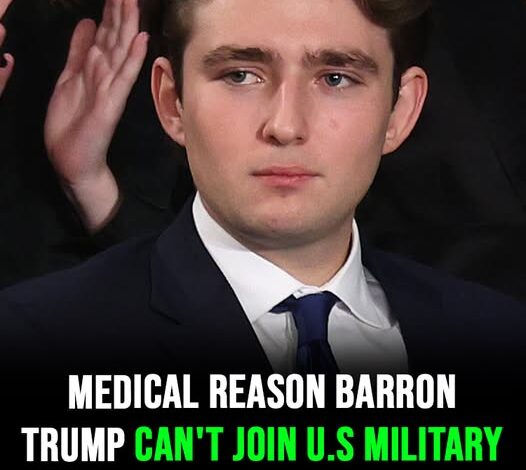
As the #SendBarron hashtag surged across social media feeds, it quickly became clear that the outrage extended far beyond one 19-year-old. The slogan became shorthand for something deeper — a simmering frustration over who bears the burden of war and who remains insulated from it.
For many critics, the anger was less about Barron Trump personally and more about what his name symbolized: the enduring perception that political power can create distance from consequences. In moments of military escalation, emotions intensify. Questions about fairness, sacrifice, and shared responsibility rise to the surface with unusual force.
Donald Trump’s own Vietnam-era draft deferments — including those attributed to bone spurs — resurfaced in public discourse, adding historical context to the current criticism. To some Americans, those past deferments sharpened the sense of irony surrounding today’s debates. They see a pattern of separation between decision-makers and those asked to serve.
At the same time, it’s important to acknowledge that military eligibility is governed by established standards. Height, medical conditions, physical requirements, and other criteria determine qualification. If Barron Trump does not meet those standards, that determination follows the same regulatory framework applied to all applicants. The military’s screening process is structured, not discretionary in the way public perception sometimes imagines.
Yet public reaction is rarely driven by policy manuals. It is driven by emotion — particularly in times of heightened international tension. Parents with children in uniform may experience a visceral response when they perceive inequality in who faces risk. For families with sons and daughters deployed abroad, debates about eligibility can feel abstract compared to the reality of potential loss.
The debate, then, is less about a single young man’s height or medical status and more about a broader American anxiety: whether the costs of national security are distributed evenly. Historically, wars have often amplified existing social divides. Questions about class, influence, and access to deferments are not new to American political life. They echo from previous conflicts and resurface whenever the prospect of military engagement intensifies.
It is also worth noting that Barron Trump, like any civilian of draft age, has not been accused of wrongdoing. Much of the public discourse projects broader political grievances onto an individual who does not shape policy decisions. The intensity of online campaigns often reflects anger at leadership rather than at private citizens themselves.
Ultimately, the surge of commentary reveals something enduring about democratic societies under strain. When the possibility of war looms, citizens scrutinize not only foreign adversaries but also their own institutions. They ask who serves, who decides, and who sacrifices. Those questions do not disappear easily — especially when history, perception, and politics intersect.
The #SendBarron moment, then, is less a literal call and more a symbol of that reckoning. It underscores how deeply Americans care about fairness in times of crisis — and how quickly that concern can transform into outrage when they believe the scales are uneven.