In the opening months of 2026, the relationship between personal leadership and global security has taken on a new and unsettling prominence in public debate. Political analysts, security experts, and ordinary citizens alike have found themselves discussing questions that once belonged mostly to theoretical planning: presidential safety, the mechanics of succession, and the stability of national leadership during periods of heightened geopolitical tension. As international conflicts intensify and rhetoric between major powers grows sharper, the health, security, and continuity of leadership in the United States have become subjects of unusual public attention.
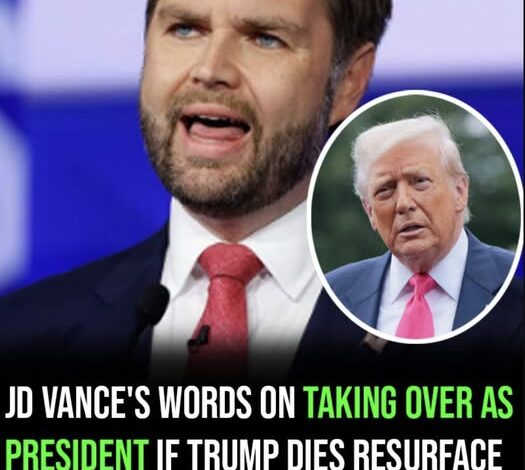
At the center of this discussion are renewed references to remarks made by Vice President JD Vance about the constitutional responsibility of presidential succession. While succession has always been a core element of the American system of government, the topic rarely enters daily conversation unless prompted by moments of crisis or uncertainty. Recent global developments, however, have brought those constitutional safeguards back into focus.
The structure itself is straightforward but critically important: if a president becomes unable to perform the duties of the office, the vice president assumes the role to ensure continuity of leadership. The system was designed to prevent instability during emergencies and to reassure both citizens and international partners that the government remains functional even under extraordinary circumstances.
Vice President Vance has previously addressed this responsibility in measured terms, emphasizing preparedness rather than personal ambition. In various interviews and policy discussions, he has acknowledged that the vice presidency carries the obligation to be ready for unforeseen events. His comments reflect a long-standing expectation in American governance that those in the line of succession must remain informed about national security matters and capable of assuming leadership at a moment’s notice.
These conversations have taken on greater resonance as global tensions rise. The United States currently faces a complex international environment shaped by regional conflicts, shifting alliances, and renewed strategic competition among major powers. In such an atmosphere, the stability of leadership structures becomes more than a domestic matter—it becomes a signal to the international community that institutional continuity remains intact.
Part of the heightened discussion stems from recent statements made by President Donald Trump regarding threats against his life in connection with geopolitical conflicts. In remarks addressing tensions involving Iran, Trump indicated that any successful attack against him would provoke an extremely forceful response from the United States. His comments were framed as a deterrent, intended to signal that threats against American leadership would carry severe consequences.
The rhetoric surrounding such statements reflects the evolving nature of modern deterrence. Leaders sometimes use stark language to discourage adversaries from contemplating acts of political violence or destabilization. At the same time, this approach can spark debate among analysts about the risks of linking personal security threats to large-scale military consequences.
For critics, such language blurs the line between individual protection and broader strategic policy. They argue that deterrence strategies traditionally rely on carefully calibrated messaging rather than statements that appear to tie global military responses directly to personal threats. Supporters, however, interpret the posture as a demonstration of resolve designed to discourage hostile actors from even considering such actions.
Within this context, the role of the vice president takes on additional visibility. Historically, vice presidents have been closely involved in national security briefings, contingency planning, and diplomatic coordination. Their participation ensures that they remain prepared to maintain continuity of government should circumstances ever require it.
JD Vance’s position within the administration reflects this tradition. As vice president, he participates in high-level security discussions and policy deliberations that span domestic and international issues. These responsibilities are part of the institutional design intended to safeguard stability regardless of unexpected events.
The broader political climate has also contributed to a heightened sense of vigilance among the public. In the age of constant news updates and social media discussion, even routine reports about leaders’ health or security arrangements can quickly become topics of widespread speculation. Information that might once have remained confined to official briefings now circulates instantly among millions of people.
This environment has led to increased public awareness of contingency planning within government. Systems designed decades ago to ensure continuity—such as the presidential line of succession, emergency command protocols, and national security coordination—have become subjects of public conversation rather than obscure administrative details.
At the same time, international observers closely monitor how American leadership responds to crises. Allies and adversaries alike evaluate signals of stability, cohesion, and decision-making within the United States government. Clear succession structures and prepared leadership are often viewed as important indicators that the country’s institutions remain resilient under pressure.
In this sense, the attention given to Vice President Vance’s readiness reflects not only domestic political debate but also the broader strategic importance of continuity. The United States has long emphasized the durability of its constitutional framework, which allows governance to proceed even during moments of uncertainty.
Political historians note that succession planning has been a defining feature of American stability across generations. From the assassination of President John F. Kennedy to medical emergencies involving other presidents, the constitutional system has repeatedly demonstrated its capacity to transfer authority without disruption to the broader structure of government.
Today’s discussions, however, unfold against a backdrop of unusually intense global tensions. Conflicts in several regions, including the Middle East, have heightened the sense that international events can shift rapidly and unpredictably. In such circumstances, questions about leadership preparedness naturally attract greater attention.
For many observers, the key takeaway from the current conversation is not alarm but reassurance. The existence of clear procedures and prepared successors reflects the deliberate design of a political system built to withstand shocks. Regardless of rhetoric or speculation, the framework of governance remains anchored in constitutional continuity.
Vice President Vance’s statements about readiness therefore function less as a warning than as a reminder of how the system is intended to operate. The vice presidency exists partly to ensure that leadership does not depend on a single individual but rather on a structure capable of adapting to unforeseen circumstances.
As 2026 continues to unfold amid geopolitical uncertainty, discussions about leadership, deterrence, and succession will likely remain part of the broader national conversation. In moments when global events feel unpredictable, the stability of institutions becomes one of the most important signals a nation can offer—to its citizens, to its allies, and to the world.
Ultimately, the emphasis on preparedness underscores a fundamental principle of democratic governance: the continuity of the state does not rest on any one person alone. Instead, it rests on institutions designed to endure beyond individual leaders, ensuring that even in times of crisis, the framework of government continues to function.