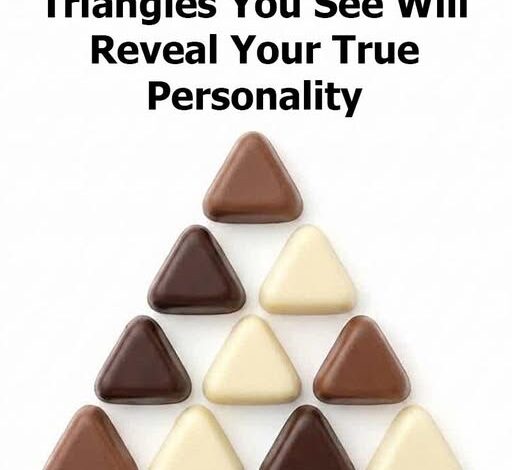
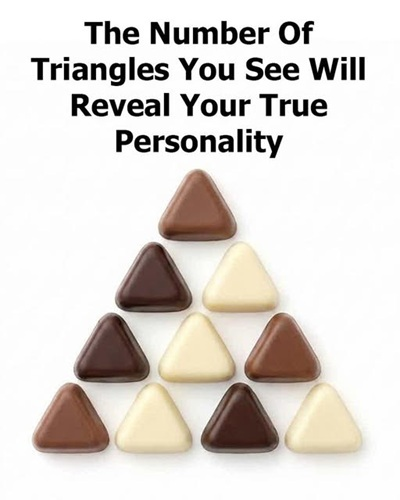
At first glance, the vibrant triangle puzzle might look like nothing more than a simple visual trick—an interesting geometric design meant to catch the eye for a moment before moving on.
Yet beneath its colorful and seemingly uncomplicated appearance lies a fascinating demonstration of how the human mind interprets patterns, shapes, and spatial relationships.
When people try to count the triangles in the image, their answers often vary widely. Some individuals quickly identify around nine triangles, others count thirteen or sixteen, and a few claim to see more than twenty hidden within the design.
These differences are not errors; rather, they highlight the unique ways each person’s brain processes visual information.
The colorful triangle puzzle is therefore more than just a fun challenge—it acts as a reflection of our cognitive processes. By observing how people approach and solve the puzzle, psychologists, neuroscientists, and educators can better understand how the mind organizes visual input, recognizes patterns, and prioritizes details within complex images.
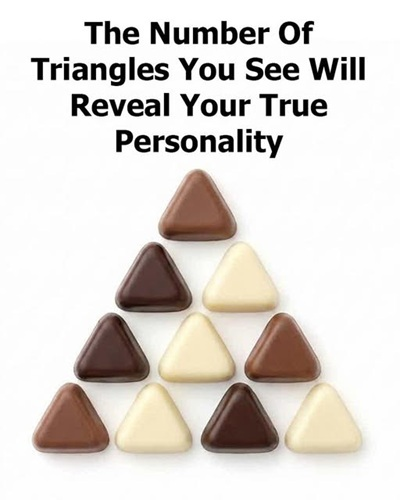
This phenomenon is closely related to concepts in cognitive psychology, especially the Gestalt principles of perception. These principles suggest that people naturally interpret visual elements as part of a unified whole rather than as isolated pieces.
Because of this tendency, our brains automatically search for patterns, balance, and completeness. As a result, we may perceive shapes, relationships, or groupings within an image that others might not immediately notice.
Viewed through this lens, the triangle puzzle becomes more than a visual game. It offers insight into how attention works, how patterns are recognized, and how differently individuals interpret the same visual information.
Why People Count Different Numbers of Triangles
The large range of answers—some people seeing 9 triangles, others 13 or 16, and some more than 20—can be explained by several psychological factors.
Global vs. Local Processing
Some individuals tend to process visual information globally, meaning they focus on the overall structure or dominant shapes within an image. These observers are more likely to identify the largest triangles first and may overlook smaller triangles hidden within the design.
Others process information locally, paying closer attention to fine details and subtle divisions. These individuals are more likely to detect smaller triangles nested inside larger shapes. Research in visual cognition shows that these different processing styles can also influence how people approach problem-solving in other areas.
Attention to Detail
People who notice the smaller triangles often display strong attentional precision—the ability to extract fine details from complex visual scenes. This skill is commonly associated with analytical thinking and careful observation in academic, professional, and creative settings.
On the other hand, individuals who count fewer triangles may be relying on selective attention, focusing primarily on the most obvious shapes while filtering out less noticeable elements.
Cognitive Flexibility
Successfully identifying many of the triangles often requires switching between different ways of organizing the image and recognizing shapes that overlap or are embedded within others.
Those who count a moderate number of triangles—often between 13 and 16—may demonstrate cognitive flexibility. They are able to alternate between seeing large structures, intermediate patterns, and smaller hidden shapes within the puzzle.
Pattern Recognition and Creativity
People who detect more than twenty triangles tend to be particularly strong in complex pattern recognition. They often notice subtle intersections, implied edges, and geometric relationships that others might overlook.
This ability is frequently associated with creative thinking, abstract reasoning, and a willingness to explore less obvious possibilities. In essence, their minds are especially tuned to identify hidden patterns and multiple interpretations within visual information.
The Puzzle as a Reflection of Personality and Thinking Styles
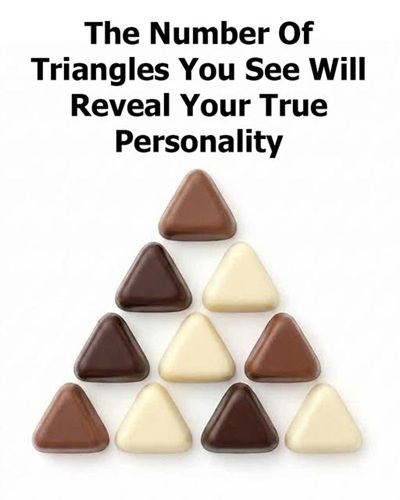
Interestingly, the way a person approaches the triangle puzzle can sometimes reflect certain cognitive habits or thinking styles.
Fewer triangles (9 or fewer):
People who see only a small number of triangles often focus on the most obvious structures within the image. They may prefer clarity, organization, and efficiency when processing information. These individuals tend to prioritize what appears most relevant and often approach problems with a straightforward, structured mindset.
Moderate triangles (13–16):
Those who count a moderate number of triangles often show a balance between analytical thinking and creativity. They are able to shift between noticing the overall structure and examining smaller details within the design. This flexibility allows them to adapt their perspective and often helps them solve problems that require both logical reasoning and imaginative thinking.
Many triangles (20 or more):
Individuals who identify a large number of triangles are typically very sensitive to subtle details and hidden relationships within visual patterns. They may naturally engage in divergent thinking—a cognitive style linked to creativity, innovation, and exploring multiple possibilities at once. Such observers are often comfortable dealing with complexity and ambiguity.
It’s important to remember that none of these approaches is inherently better than the others. Each reflects a different cognitive strength and a unique way of interpreting visual information. The triangle puzzle is not meant to produce one “correct” answer; instead, it encourages people to reflect on how their perceptual habits influence the way they see and understand the world.
Gestalt Principles at Work
The triangle puzzle also demonstrates several key ideas from Gestalt psychology, which explains how humans organize visual information.
Figure–Ground Perception
Our brains instinctively separate the main object of attention (the “figure”) from the surrounding background (the “ground”). In the triangle puzzle, some viewers focus primarily on the largest triangle, while others notice smaller triangles hidden within the background structure, leading to different totals.
Closure
Humans tend to mentally complete shapes that appear incomplete. In this puzzle, intersecting lines or partial edges may still be interpreted as forming a full triangle, even if the triangle is not fully outlined.
Proximity and Similarity
The spacing and coloring of the triangles influence how viewers group them together. Some people may treat clusters of similarly colored or closely positioned shapes as one unit, while others separate them and count each triangle individually.
Multistability
Similar to well-known illusions like the “duck–rabbit” image or the “Necker cube,” the triangle puzzle can be interpreted in multiple ways. Depending on where a person directs their attention, the same image may reveal different patterns and structures.
These principles highlight that perception is not simply a passive recording of what the eyes see. Instead, it is an active process in which the brain organizes, interprets, and sometimes even reconstructs visual information. As a result, what one person notices in an image can differ significantly from what another person sees.
Applications Beyond Simple Puzzles
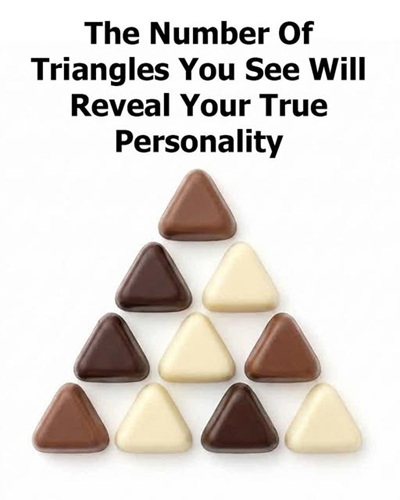
The ideas illustrated by the triangle puzzle extend far beyond recreational brain teasers. In fact, the way people interpret visual patterns has meaningful applications in several real-world areas.
Education
Teachers often use visual puzzles to strengthen students’ spatial reasoning and critical thinking skills. Activities like counting hidden shapes encourage learners to examine problems from different angles. Students who initially notice only the most obvious elements can gradually learn to explore deeper patterns, helping develop cognitive flexibility and stronger analytical abilities.
Problem-Solving and Innovation
In fields such as business, technology, and engineering, the ability to switch between big-picture thinking and close attention to detail is extremely valuable. Just as some people focus on the overall structure of the triangle puzzle while others detect smaller embedded shapes, effective teams benefit from combining multiple perspectives. This diversity of thinking often leads to solutions that are both creative and practical.
Art and Design
Designers, architects, and visual artists frequently rely on Gestalt principles to shape how audiences interpret images and spaces. By understanding how people naturally group shapes, perceive balance, and recognize patterns, creators can design compositions that guide the viewer’s attention and create stronger visual impact.
Cognitive Training and Mindfulness
Visual puzzles can also serve as mental exercises that strengthen focus and awareness. Working through pattern-recognition challenges helps train the brain to pay attention to subtle details while still maintaining an understanding of the overall structure. This balance between detail and context is closely related to mindfulness and attentive observation.
The Influence of Individual Differences
The triangle puzzle also highlights an important idea: perception varies greatly from person to person. Several factors can influence how someone interprets shapes and patterns.
Neurological Differences
Different areas of the brain—particularly regions in the parietal and occipital lobes—are responsible for processing spatial relationships, visual attention, and pattern recognition. Variations in how these regions function or communicate can influence how easily a person identifies complex visual arrangements.
Cultural and Educational Background
Experience plays a major role in perception. Individuals who have studied geometry, art, or design may be more accustomed to identifying structural relationships between shapes. As a result, their training may lead them to notice configurations that others might overlook.
Cognitive Style and Personality
People also differ in their natural thinking styles. Some prefer structured, detail-focused analysis, while others are more comfortable exploring abstract patterns and creative possibilities. These tendencies can shape how individuals approach a visual challenge like the triangle puzzle.
Together, these influences help explain why a single image can produce such a wide range of answers. Rather than indicating right or wrong thinking, the variety of responses reflects the unique ways each person’s mind organizes and interprets visual information.
Reflections on Perception and Interpretation
In the end, the triangle puzzle highlights an important truth about human perception: the way we interpret what we see is often subjective. Rather than having a single definitive answer, the puzzle demonstrates how individuals can perceive the same visual image in very different ways. Attempting to force one “correct” solution may overlook the fascinating diversity of human thought and perception.
When people examine the same puzzle, their responses can reveal different cognitive tendencies:
- Some individuals focus on clarity and efficiency, identifying the most obvious shapes first.
- Others combine logical analysis with imaginative thinking, exploring both large and hidden patterns.
- Some observers notice intricate details and subtle relationships, embracing the complexity of the design.
Each of these approaches reflects different strengths in how people process information, direct attention, and solve problems.
Conclusion
The colorful triangle puzzle is far more than a simple visual challenge. It represents a small but powerful example of how the human mind works—showing the interplay between perception, attention, reasoning, and creativity.
By encouraging people to count the triangles, the puzzle prompts us to think about how we interpret visual information, how we organize patterns, and how we approach complex problems.
Whether someone identifies nine triangles or more than twenty, the true value of the puzzle lies not in reaching a single correct answer but in appreciating the different ways people think and perceive. It invites curiosity, highlights the diversity of cognitive styles, and shows how multiple interpretations can emerge from the same visual experience.
In a world that increasingly depends on collaboration, innovation, and diverse perspectives, puzzles like this serve as both a learning tool and a metaphor. They remind us that perception is shaped not only by what we see, but also by how our minds interpret and organize the information around us.
Ultimately, the colorful triangle puzzle offers a simple yet profound insight: understanding different viewpoints can deepen our appreciation of both the human mind and the many ways people experience the world—one triangle at a time.