Two Countries Announce Travel Ban on US Citizens, Citing Reciprocity After New American Restrictions!

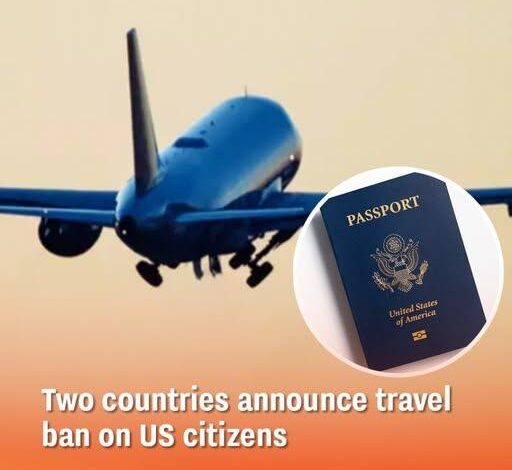
The global system of travel and mobility is undergoing a significant shift as the early months of 2026 bring a noticeable increase in diplomatic tension and stricter border policies. Since returning to the White House, President Donald Trump has once again placed immigration enforcement and border security at the center of his administration’s agenda. This approach reached a new stage earlier this month when the U.S. government announced a broad expansion of travel restrictions, adding additional countries to a list of nations facing either full or partial limitations on entry into the United States.
With 39 countries now affected, the United States is operating under one of the most extensive travel restriction frameworks in recent decades. Officials in Washington describe the policy as a necessary step to protect national security and ensure that travelers entering the country meet strengthened identification and documentation standards.
According to the administration, the expanded measures are intended to encourage foreign governments to improve passport security, share biometric data with U.S. authorities, and strengthen their own border monitoring systems. Supporters of the policy argue that these steps help close potential security gaps and provide leverage for negotiating stronger international cooperation on migration and counterterrorism.
However, critics both inside and outside the United States have expressed concern about the broader implications of the policy. International organizations, diplomats, and advocacy groups warn that sweeping travel restrictions could damage diplomatic relationships, disrupt economic ties, and create hardships for civilians who have no connection to security concerns.
Countries Facing Full Travel Restrictions
The list of countries currently subject to comprehensive travel bans includes nations such as Afghanistan, Myanmar (Burma), Chad, the Democratic Republic of Congo, Eritrea, Haiti, Iran, Libya, Somalia, Sudan, Yemen, and Syria. Citizens from these countries face severe limitations on obtaining visas to enter the United States, with only narrow exceptions for certain humanitarian or diplomatic circumstances.
For individuals in these countries, the restrictions significantly reduce opportunities to travel for education, employment, or family reunification. Students hoping to study in the United States, professionals seeking business partnerships, and families hoping to visit relatives often find the process effectively closed.
Partial Restrictions for Additional Countries
In addition to full bans, the administration has imposed partial travel restrictions on several other countries, including Angola, Nigeria, Tanzania, and Zambia. These measures do not completely prohibit travel but place tighter controls on specific visa categories, such as student visas, temporary work permits, and certain business travel applications.
The result is a substantial slowdown in travel between these nations and the United States, affecting academic exchanges, corporate partnerships, and cultural programs that once operated more freely.
Debate Over Security Standards
U.S. officials maintain that the restrictions are based on measurable concerns regarding document security, identity verification, and information sharing between governments. The Department of Homeland Security has argued that some countries do not currently meet updated standards for biometric identification systems and data transparency.
Yet foreign governments and international watchdog organizations have questioned how those determinations are made. Some critics argue that the evaluation process lacks transparency and that affected nations often receive limited guidance on what changes are required to have restrictions lifted.
This uncertainty has left many governments attempting to determine how to meet evolving American requirements while maintaining their own sovereignty and legal systems.
Reciprocal Measures from Other Nations
The global response has been swift in some regions. Several countries have invoked the diplomatic principle of reciprocity, imposing their own restrictions on U.S. travelers.
Countries such as Mali and Burkina Faso have introduced new entry limitations for American citizens, while Niger has taken a particularly firm stance by suspending the issuance of visas to U.S. travelers altogether. These decisions follow earlier actions from Chad, which had already halted visa privileges for Americans during earlier disputes over travel policy.
Such responses signal a broader shift in how international mobility is negotiated. Rather than accepting unilateral restrictions, some governments are choosing to respond in kind, potentially reshaping long-standing diplomatic relationships.
Impact on International Cooperation
The consequences of these policies extend beyond tourism or short-term travel. Aid organizations, journalists, researchers, and business leaders often depend on the ability to move between countries quickly. Restrictions and retaliatory bans complicate that movement, particularly in regions where humanitarian or development work is already challenging.
For international companies, uncertainty about travel permissions can disrupt negotiations, supply chains, and investments. Academic institutions have also expressed concern about reduced international student enrollment, which affects both cultural exchange and university funding.
Expansion of Biometric Screening
Alongside the expanded travel restrictions, the administration has introduced enhanced biometric screening procedures at U.S. airports and border crossings. Travelers who are not U.S. citizens may now encounter expanded facial recognition systems and additional identity verification measures.
Officials describe these tools as essential for identifying individuals who may pose security risks. By collecting biometric data, authorities say they can more effectively track visa overstays, detect identity fraud, and strengthen border enforcement.
Privacy advocates, however, have raised concerns about the long-term storage and use of this data. They warn that large-scale biometric databases create potential risks related to surveillance, data misuse, and civil liberties.
Reactions from Allied Countries
Even close allies have taken notice of the tightening travel environment. Governments in countries such as the United Kingdom and Germany have issued updated travel advisories reminding citizens that possessing a valid visa or ESTA authorization does not guarantee entry into the United States.
Border officers retain significant discretion during inspections, and travelers may be denied entry if officials determine that documentation or travel purposes raise concerns.
These warnings highlight a growing sense of uncertainty among international travelers, many of whom once viewed U.S. entry procedures as predictable and routine.
The Human Impact
Beyond diplomatic debates and policy discussions, the most significant effects are often felt by ordinary people. Families separated by borders face longer waits or outright denial when applying for visas. Students lose opportunities to study abroad, and workers hoping to build careers across borders find their plans abruptly disrupted.
Humanitarian organizations have also reported difficulties sending personnel into regions where travel restrictions and reciprocal bans limit movement.
For many individuals, international mobility—once considered a normal part of modern life—has become far less certain.
A Changing Era of Global Mobility
As 2026 unfolds, the growing network of travel bans and reciprocal restrictions suggests a broader transformation in how countries manage borders and migration. The era that followed the Cold War saw increasing globalization and relatively easier international travel for many people.
Today, however, national security concerns, geopolitical rivalry, and domestic political pressures are reshaping those assumptions.
Whether these policies ultimately lead to stronger security cooperation or deepen global fragmentation remains an open question. What is clear is that the rules governing international travel are evolving rapidly, and governments around the world are adjusting their policies in response.
For travelers, diplomats, and businesses alike, the landscape of global mobility is becoming more complex—and the once simple act of crossing a border now often involves far greater scrutiny than in years past.