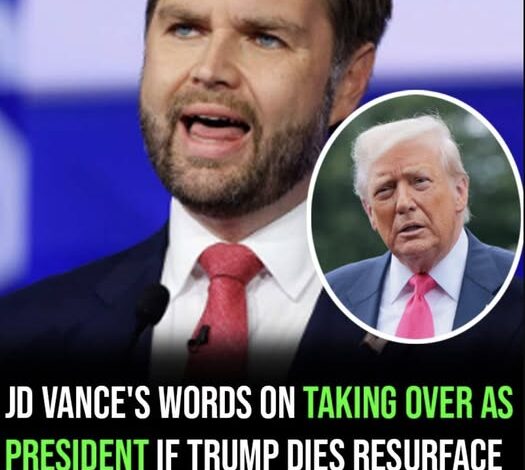
In the opening months of 2026, conversations about leadership, security, and succession have taken on a more serious tone in the United States. As global tensions rise and domestic politics remain deeply polarized, public attention has increasingly focused on how the country prepares for unexpected crises at the highest levels of government. Discussions that once belonged mostly to constitutional scholars—such as presidential succession and continuity of leadership—are now part of broader national debate.
Vice President JD Vance has become a central figure in these conversations. In previous remarks about his role in the constitutional order, Vance emphasized the importance of maintaining stability should a transition of power ever become necessary. His comments were framed less as political ambition and more as recognition of the responsibilities that come with being next in the line of succession. In a time of heightened international tensions, that acknowledgment has drawn renewed attention.
At the same time, recent statements from President Donald Trump about responding forcefully to threats against the United States have intensified discussion about deterrence and national security strategy. Supporters interpret such rhetoric as a strong signal meant to discourage hostile actions by adversaries. Critics argue that the language risks escalating already fragile geopolitical relationships. Either way, the remarks have contributed to a broader climate in which the connection between leadership, security policy, and global stability is being closely examined.
Within this environment, the role of the vice president takes on additional visibility. Historically, vice presidents have often operated largely outside the spotlight until moments of crisis arise. Today, however, the public appears more aware of how essential that role can be in ensuring continuity of government. Vance has repeatedly emphasized that the system is designed to function regardless of circumstances, with clear constitutional procedures to maintain stability.
Political analysts note that this renewed focus reflects a broader shift in how Americans view leadership risk. In earlier decades, contingency planning was largely confined to government agencies and military strategists. Now, with global events unfolding rapidly and information circulating instantly through social media, the public is far more engaged in conversations about preparedness and resilience.
The result is a political atmosphere where discussions about security, leadership health, and succession often appear side by side in news coverage. While such topics can create anxiety, constitutional scholars emphasize that the framework for continuity of power has been carefully built over generations. The line of succession, emergency protocols, and institutional safeguards exist precisely to prevent instability during uncertain moments.
For Vice President Vance, the increased attention underscores the quiet but significant responsibility of his office. His role is not only to support the administration’s agenda but also to represent the assurance that governance will continue under any circumstances. In that sense, the vice presidency serves as both a political partnership and a constitutional safeguard.
The current climate also highlights the delicate balance between strong deterrence abroad and measured communication at home. Leaders must project confidence while avoiding rhetoric that could unintentionally heighten global tensions. Navigating that balance has become one of the defining challenges for policymakers in an increasingly interconnected and unpredictable world.
Ultimately, the ongoing discussion about succession and preparedness reflects a broader awareness of how fragile and complex modern governance can be. The United States relies not only on individual leaders but also on the durability of its institutions. While personalities may dominate headlines, the underlying system is designed to endure far beyond any single administration.
As 2026 unfolds, the focus on continuity of leadership serves as a reminder that stability is built through planning, constitutional order, and the steady functioning of democratic institutions. In moments of uncertainty, those structures remain the foundation that allows the country to move forward—even when the world around it feels unsettled.